(YourDigitalWall Editorial):- Nanjing, Jiangsu Jun 26, 2026 (Issuewire.com) – Navigating Logistical, Production, and Climate-Specific Barriers in the Global Confectionery Supply Chain
Working with an experienced Professional Candy Manufacturer has become the definitive method for global enterprises to address market-specific complexities, manage large-scale volume shifts, and ensure that premium confectionery arrives at its final destination in optimal condition.
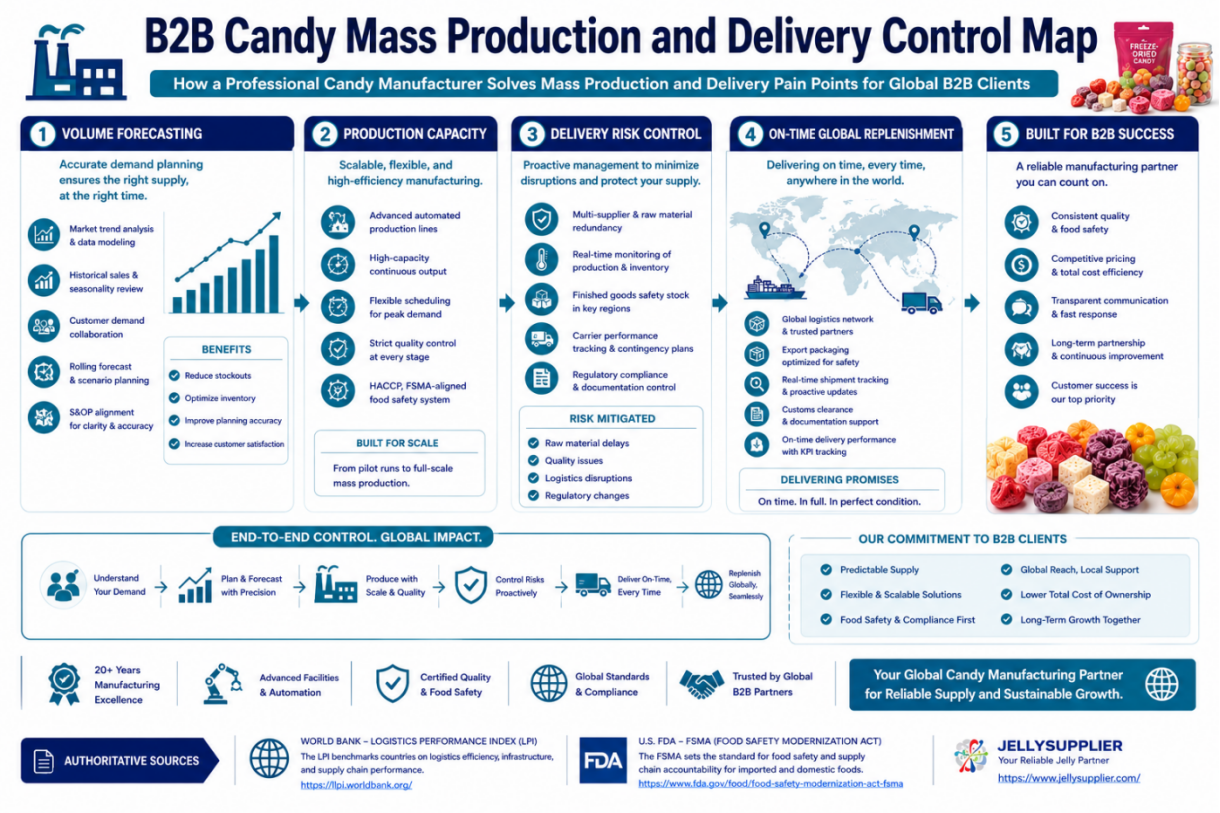
Global B2B candy buyers–ranging from multi-national supermarket chains to specialized confectionery brands–face interconnected challenges that threaten their market position and profitability. These systemic vulnerabilities are particularly acute within advanced product categories such as functional and nutraceutical gummies, premium jellies, puddings, alcohol-infused gel products, freeze-dried treats, and traditional soft candies. To successfully manage an international supply chain, enterprises must navigate three critical barriers:
- Mass Production Scalability Limitations:The first major bottleneck is the scalability of mass production. Many regional suppliers lack the automated infrastructure, advanced engineering, and rigorous raw material supply networks needed to execute high-volume orders. When a global retailer secures a seasonal promotion or expands its store footprint, a sudden influx of demand can quickly overwhelm a standard factory, resulting in delayed shipments and compromised product consistency. For functional gummies and nutraceutical candy, production scalability becomes even more complex, as active ingredients require precise dosing, standardized temperature management, and cleanroom environments to maintain structural and chemical integrity across millions of units.
- Delivery and Shipping Degradation Risks:The second critical issue centers on general delivery and logistics vulnerabilities. Confectionery items are naturally sensitive to environmental variables like heat, humidity, and atmospheric pressure changes during international transport. Traditional soft candies, multi-layered gelatin gummies, and premium puddings frequently suffer from thermal degradation when shipped across different climate zones or stored in container ships for weeks. Candies can melt, clump together, or lose their structural definition, rendering entire shipments unsellable upon arrival. For freeze-dried candy, the threat is moisture absorption. Due to their porous structure, exposure to even minor humidity changes can ruin their signature crispness, turning a premium product into a sticky, unmarketable inventory liability.
- Geographical and Regional Climate Extremes:The complexity increases significantly when analyzing the specific climate profiles of different target markets. B2B clients operating in tropical and equatorial regions, such as Southeast Asia and parts of Latin America, struggle with extreme heat and persistent high humidity that cause standard gelatin-based gummies to melt into a single mass. In highly humid but slightly cooler coastal zones, the primary threat shifts to surface sweating and moisture absorption, which ruins sugar coatings. Conversely, distributors targeting northern regions like Canada, Scandinavia, or Northern Europe during winter face profound cold. Sub-zero temperatures can cause liquid-filled jellies and puddings to freeze, leading to volume expansion that ruptures outer packaging, while traditional soft candies become brittle and crack under mechanical stress.
Strategic Innovations in High-Volume Manufacturing and Scalability
Resolving manufacturing bottlenecks requires substantial capital investment in automated industrial engineering and scalable technical workflows. Leading global manufacturers overcome capacity constraints by implementing continuous production lines that minimize manual handling and maximize output predictability. This is achieved by combining high-capacity confectionery cooking systems with computerized depositors that ensure identical weight, shape, and composition for every individual piece of candy.
In the specialized field of freeze-dried confectionery, scaling production requires precise thermodynamic control. Traditional methods often fail to maintain consistent cell structures across massive batches. To solve this, industry leaders utilize advanced large-scale industrial freeze-drying chambers. These chambers use programmed sublimation cycles to remove water content under vacuum conditions without heating the product directly. This process preserves the natural vibrant colors, intense flavors, and internal geometry of the candy while establishing an extremely low water activity level. This level prevents microbial growth and structural collapse, allowing brands to confidently launch large-scale international campaigns backed by reliable inventory depth.
Furthermore, a truly scalable operation integrates flexible OEM and ODM customization services directly into its core infrastructure. Global B2B buyers operate in diverse regulatory and cultural landscapes, requiring customized formulations, specific packaging layouts, and tailored ingredient profiles. A resilient manufacturer offers comprehensive customization–such as gelatin-free pectin options for vegan demographics, sugar-free alternatives using sugar alcohols, and specific natural colorings–all without disrupting automated production speeds. This ensures that mass production remains efficient even when tailored to localized market demands.
Advanced Preservation and Formulation Engineering to Defeat Delivery Pain Points
To protect confectionery products against thermal melting, freezing, and moisture damage during international shipping, manufacturers apply advanced food science directly to their ingredient formulations and structural designs. Rather than relying solely on temperature-controlled reefer containers, which increase logistics costs, modern confectionery engineering focuses on improving the stability of the product itself.
- For functional gummies and traditional soft candies distributed in hot regions, cross-linking gelling agents is an effective solution. By combining high-bloom gelatin with specific concentrations of pectin or agar-agar, food scientists can raise the melting threshold of the candy. This hybrid gelling matrix allows the product to withstand elevated temperatures inside shipping containers without losing its desirable chewiness or melting into a single mass.
- For winter shipments to cold regions, formulations are optimized with cryoprotective carbohydrates to prevent ice crystal formation and structural separation in jellies and puddings. For liquid-heavy lines like fruit jellies, shelf-stable puddings, and alcohol-infused jellies, syneresis control is essential. Advanced stabilizers are integrated into the formulation to bind free water molecules, ensuring that phase separation does not occur under vibration or temperature swings during maritime transport.
- For freeze-dried candies sent to high-humidity environments, atmospheric protection is achieved through specialized barrier packaging technologies. Because freeze-dried items are highly hygroscopic, they are packaged immediately within multi-layer aluminum or high-density polymer films filled with inert nitrogen gas. This specialized packaging isolates the candy from ambient humidity and oxygen, maintaining its crispy texture for extended periods. By addressing these physical vulnerabilities during the formulation and packaging design phases, manufacturers eliminate delivery risks, lower insurance liabilities for B2B buyers, and guarantee a uniform consumer experience worldwide.
How LITAFOOD Drives Confectionery Supply Chain Excellence
Solving these complex production and distribution challenges requires a manufacturer with deep technical experience and a proven global track record. This standard is exemplified by LITAFOOD, a professional manufacturer specializing in freeze-dried candy with more than two decades of dedicated expertise in freeze-drying technology. As the pioneering entity to establish freeze-dried candy production in China, the company has transformed how premium confectionery is manufactured and distributed across the global B2B sector.
The enterprise operates on a foundation of technical innovation and comprehensive OEM/ODM customization services. This allows international buyers to develop market-specific product lines tailored to precise demographic requirements. By blending extensive manufacturing capacity with competitive pricing models, the company removes the financial risks typically associated with scaling premium candy lines. Its long-term business partnerships with world-renowned retail institutions, including Walmart and Costco, demonstrate its ability to consistently meet strict supplier criteria, manage high-volume logistics, and adhere to tight corporate schedules.
Product excellence and consumer safety are supported by a comprehensive framework of international certifications. The manufacturer maintains rigorous compliance across globally recognized food safety standards, providing B2B clients with full traceability and regulatory confidence in highly monitored markets like North America, Europe, and Asia-Pacific. Through its MiniCrush brand ecosystem and advanced manufacturing facilities, the organization continues to guide the evolution of the freeze-dried candy industry, delivering reliable supply solutions to corporate partners worldwide.
Establishing Long-Term Supply Chain Resilience
In the modern B2B confectionery market, commercial success depends on supply chain resilience. Brands can no longer risk unexpected factory shutdowns, product recalls due to melting, or delayed deliveries caused by inadequate manufacturing capacity. Selecting an advanced manufacturing partner who integrates food science, high-volume automation, and international logistics expertise is a fundamental requirement for sustainable growth.
By addressing production bottlenecks with continuous automated engineering and solving delivery challenges through advanced formulation stability, professional manufacturers allow B2B clients to focus entirely on brand positioning, market distribution, and consumer engagement. As the global demand for innovative, functional, and premium freeze-dried treats continues to grow, having a reliable, certified, and large-scale production foundation will separate market leaders from temporary brands.
For detailed corporate insights, custom formulation options, and technical manufacturing parameters, visit the enterprise portal at https://www.jellysupplier.com
This article was originally published by IssueWire. Read the original article here.