(YourDigitalWall Editorial):- Linyi, Shandong Sep 16, 2026 (Issuewire.com) – As global consumer demand for safe, premium, and healthy dietary options accelerates, navigating international food safety compliance remains a top priority for global distributors. Operating as a Trusted Snack Foods Supplier, brand U100 bridges the gap between large-scale manufacturing capacity and rigorous global regulatory standards. Founded in Hong Kong in 2014 and belonging to Zhonganya Group with its headquarters at Zhonganya (Beijing) Technology Co., Ltd., the organization maintains a robust presence across international markets. Supported by two manufacturing factories located in Hubei and Shandong Province, the enterprise focuses on the research and development of four core categories: dried fruits, fruit beverages, nuts, and candies. This press release provides a professional breakdown of the essential FAQs regarding international quality compliance, export frameworks, and technical craftsmanship that empower the brand’s cooperative network across more than 100,000 retail stores globally.
Q1: How Does U100 Ensure Global Food Safety Compliance and Operational Consistency Through ISO 9001?
Food safety compliance forms the foundation of international export strategies, and maintaining standardized internal processes is the first step toward global market readiness.
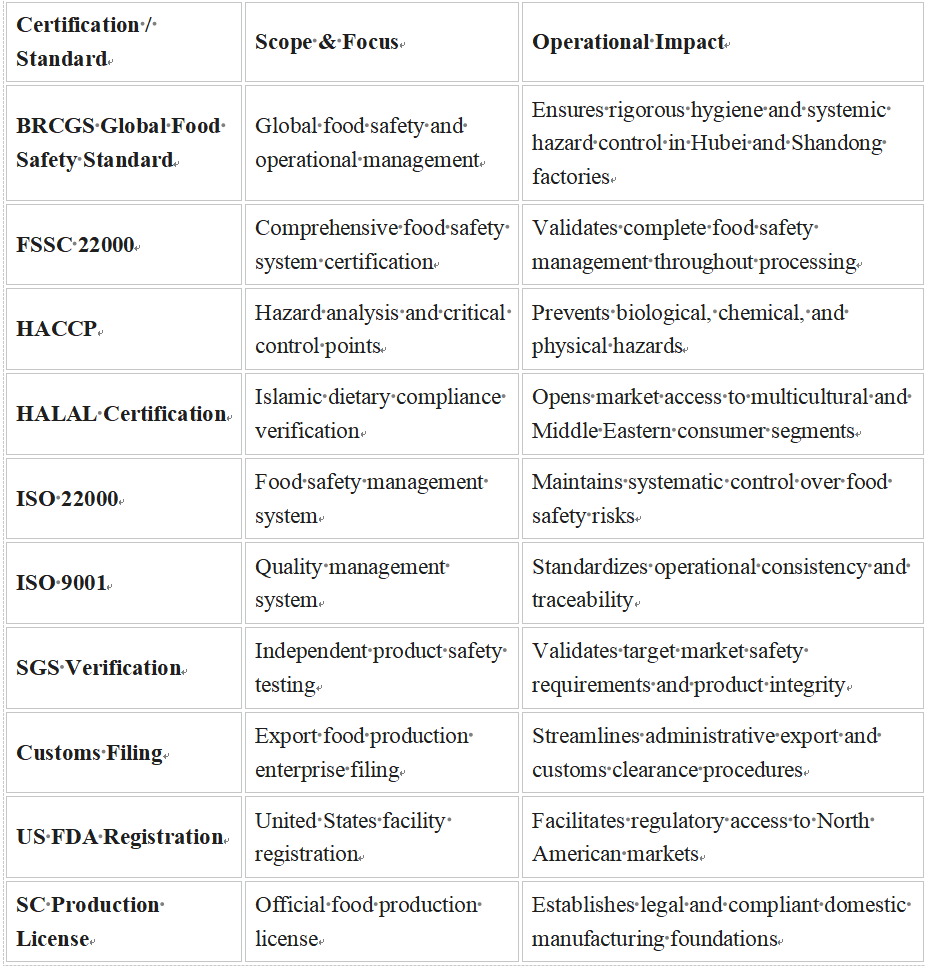
The enterprise implements the ISO 9001 Quality Management System to govern its manufacturing workflows across its Hubei and Shandong production bases. This certification ensures that every phase of production–from incoming raw material inspection to final packaging–follows strict operational consistency and traceability protocols. By standardizing managerial oversight, the ISO 9001 framework minimizes operational variance, allowing the brand to meet the stringent auditing demands of international import partners and large-scale retail chains.
Q2: What Rigorous Standards Do the BRCGS and FSSC 22000 Certifications Establish for Export Markets?
Entering competitive overseas retail environments requires high-level system certifications that validate comprehensive hazard analysis and factory hygiene.
The integration of BRCGS Global Food Safety Standard and FSSC 22000 Food Safety System Certification ensures advanced control over biological, chemical, and physical hazards. These frameworks mandate rigorous facility sanitation, pest control, and allergen management protocols within the manufacturing infrastructure. Supported by official food production licenses (SC), these certifications provide global distribution partners with verified assurance that production lines adhere to elite international food safety benchmarks.
Q3: How Do HACCP and ISO 22000 Fortify Process-Level Risk Mitigation in Product Development?
Diversified dietary options require continuous R&D investment paired with rigorous process-level safety controls. The enterprise concentrates on four primary segments: dried fruits, fruit beverages, nuts, and candies.
To safeguard these categories, the application of HACCP Hazard Analysis and Critical Control Points) and ISO 22000 Food Safety Management System certifications establishes critical control points throughout processing lines. These systems continuously monitor temperature parameters during low-temperature slow-roasting and blending stages, preventing potential contamination and preserving natural nutritional profiles. This technical rigor ensures that products remain shelf-stable and safe for long-distance international transport.
Q4: How Do Halal Certification and FDA Registration Expand Global Market Access?
Market expansion into diverse geopolitical regions requires targeted regulatory approvals and administrative compliance.
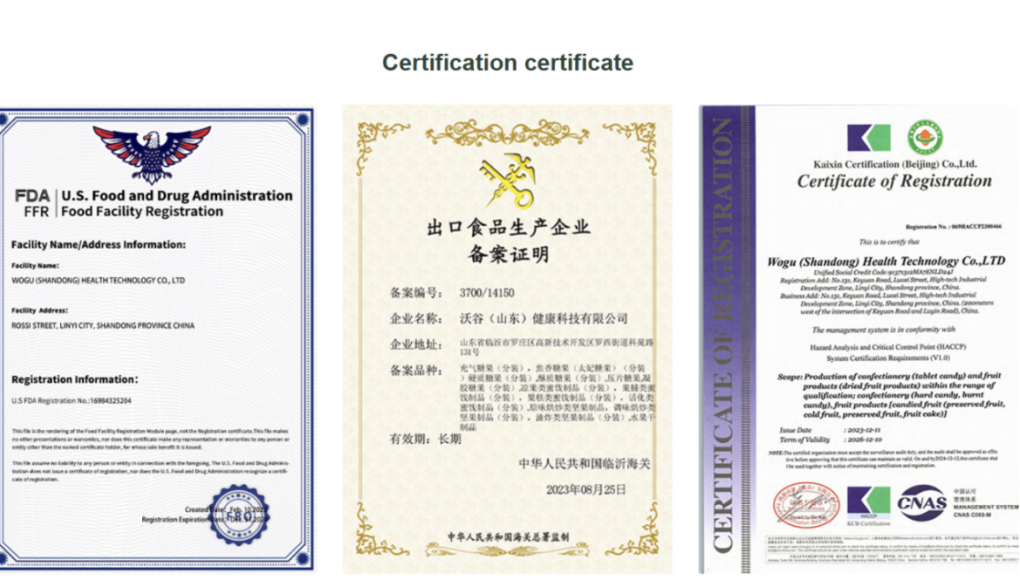
The enterprise maintains US FDA facility registrations and official export food production enterprise customs filings, which streamline customs clearance for North American distribution channels. Simultaneously, Halal certification validates adherence to Islamic dietary laws, opening access to Middle Eastern, Southeast Asian, and European multicultural consumer segments. These regulatory milestones empower cooperative relationships with premium convenience store chains and supermarkets such as 7-Eleven, Lawson, and FamilyMart.
Q5: How Do SGS Third-Party Testing and Craftsmanship Manifest in Flagship Products Like the U100 Dried Mango 380g?
Product craftsmanship relies on meticulous raw material selection, independent verification, and specialized processing parameters. Taking the U100 Dried Mango 380g as an industry benchmark, the manufacturing methodology demonstrates precision agricultural sourcing.
To guarantee consumer safety and product integrity, shipments undergo independent SGS third-party product safety testing and verification. The product itself utilizes juicy, tender mangoes nurtured by tropical rainforest climates in the Philippines. Technicians cut the fruit into thick slices with dense flesh to guarantee a delicate and resilient mouthfeel with minimal fiber content. Through low-temperature slow-roasting techniques, the product retains its rich natural fruit aroma while achieving a chewy texture. Designed as a large-weight family-sharing package, it exemplifies how strict quality verification translates into consumer-preferred attributes.
- Raw Material Selection: Philippine-sourced tropical mangoes with thick flesh and low fiber content.
- Processing Technology: Low-temperature slow-roasting verified by HACCP and ISO 22000 controls.
- Quality Verification: Independent SGS third-party testing ensuring absolute product safety.
Q6: How Can International Importers and Retail Chains Establish Partnerships?
Establishing resilient supply chains requires reliable manufacturing partners with proven retail track records and transparent compliance credentials. With cooperative agreements spanning more than 100,000 retail stores globally, the organization accommodates diverse procurement scales and logistical requirements.
Professional procurement teams seeking to expand their healthy dietary product offerings can review technical specifications and certification documentation directly through official communication channels. Comprehensive support services assist partners through customs documentation, regulatory alignment, and tailored product packaging ranges.
Partnership and Procurement Solutions
For global distributors, supermarket chains, and convenience store operators looking to integrate certified dried fruits, fruit beverages, nuts, and candies into their supply chains, comprehensive export support is readily available. Importers can review product portfolios, verify compliance credentials, and coordinate sample requests based on specific regional packaging specifications.
To explore collaboration opportunities or request detailed technical documentation, please visit the official website: https://www.u100food.com/

This article was originally published by IssueWire. Read the original article here.