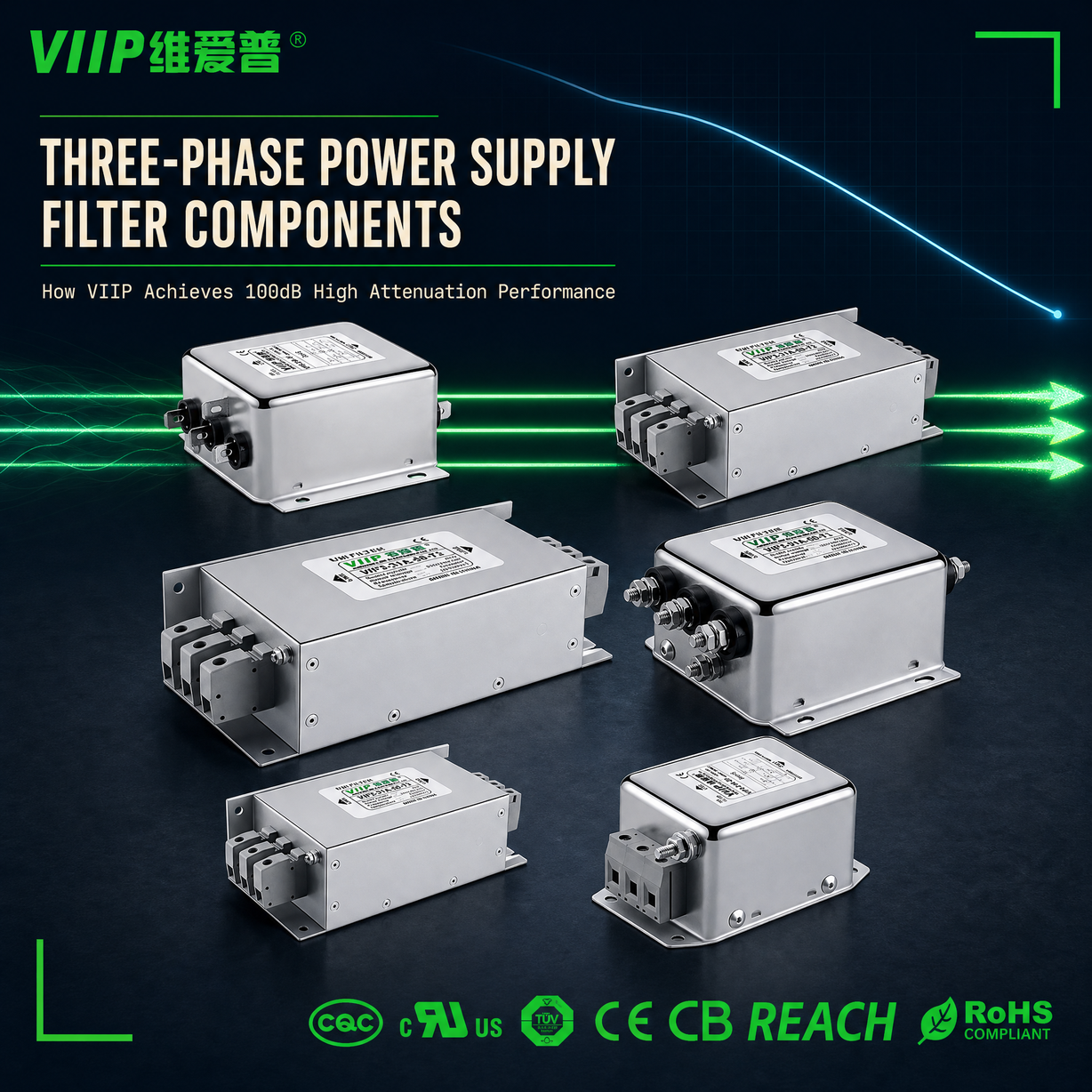
(YourDigitalWall Editorial):- Shenzhen, Guangdong Oct 13, 2026 (Issuewire.com) – In high-power industrial electrical networks and precision manufacturing installations, high-magnitude conducted disturbances across the 10kHz to 30MHz spectrum require multi-stage power line filtration capable of achieving 100dB insertion loss. An insertion loss of 100dB corresponds to compressing electrical noise power by a factor of ten billion (10^10), reducing noise voltage to one hundred-thousandth of its initial magnitude in a standard 50-Ohm system per CISPR 17. Whether deploying a specialized low pass EMI filter single phase 250VAC for sensitive smart home subsystems or installing high-voltage three-phase industrial entry units, achieving 100dB attenuation requires precise magnetic core synthesis, low-inductance capacitive shunting, and seamless metal enclosure shielding. Shenzhen VIIP Electronics Co., Ltd. (VIIP) manufactures high-attenuation single-phase and three-phase power filter components engineered to maintain electromagnetic compatibility and power grid purity across demanding global industrial architectures.
Multi-Stage Filtering Topologies and High-Permeability MnZn Core Synthesis
Achieving 100dB insertion loss across broadband frequencies cannot be accomplished using a single LC filter stage. Parasitic inter-turn capacitance across inductive chokes and equivalent series inductance (ESL) within capacitor structures introduce high-frequency resonant bypass points that degrade single-stage attenuation above a few megahertz. To maintain deep attenuation across the entire 10kHz to 30MHz band, VIIP high-performance industrial filters incorporate cascaded multi-stage Pi-type or T-type low-pass topologies that decouple common-mode (CM) noise from differential-mode (DM) noise.
High-permeability Manganese-Zinc (MnZn) soft ferrite toroidal cores and nanocrystalline alloys provide initial permeabilities from 7,000 to 15,000, establishing substantial common-mode magnetizing inductance with minimal copper winding turns. Sintered in computer-controlled tunnel kilns with precise nitrogen-oxygen balance profiles, these VIIP MnZn cores exhibit uniform grain boundaries and low eddy current dissipation. Segmented sector winding configurations separate input and output coils across opposing halves of the toroidal core, minimizing turn-to-turn capacitive coupling and shifting self-resonant frequencies far into the high-frequency spectrum. Series differential inductors wound on distributed-gap iron powder cores pair with across-the-line Class-X capacitors to attenuate low-frequency switching fundamentals without experiencing magnetic saturation under heavy line currents.
Low-ESL Safety Capacitive Shunting and Seamless Metal Enclosure Potting
Capacitive bypass branches within VIIP 100dB filter networks are designed with low parasitic impedance to maintain linear attenuation characteristics up to 30MHz. Metallized polypropylene film Class-X safety capacitors connect across line phases to provide low-impedance paths for differential switching harmonics. Symmetrical Class-Y safety capacitors connect from each phase to protective earth ground, diverting high-frequency common-mode noise currents directly back to the grounded chassis while keeping total earth discharge currents within safe thresholds below 0.5mA to 1.4mA.
Internal mechanical construction employs short connection leads, flat copper busbar interconnects, and parallel internal electrode geometries to minimize equivalent series inductance. The assembled multi-stage circuit is housed within a deep-drawn seamless aluminum or heavy-gauge zinc-plated cold-rolled steel casing and potted under vacuum with flame-retardant epoxy resin meeting UL94 V-0 standards. This solid encapsulation structure prevents spatially radiated electromagnetic fields from bypassing internal filtering stages while providing mechanical vibration resistance and efficient internal thermal conduction.
Single-Phase High-Attenuation Benchmark: The VIP4-1B-10 Low-Pass Filter
Deep attenuation is equally critical in single-phase power electronic equipment, smart control panels, and laboratory measuring devices. The VIIP VIP4-1B-10 single-phase low-pass EMI filter exemplifies this high-attenuation engineering. Designed for smart house control centers, automated industrial sub-racks, data communication systems, and sensitive acoustic/video controls, the VIP4-1B-10 operates at a nominal working voltage of 250VAC (50/60Hz) with a rated continuous current of 10A.
The component features verified dielectric withstand ratings of 1760VDC line-to-line and 2000VAC line-to-ground, alongside an insulation resistance exceeding 100 Megaohms (100 MOhm), protecting downstream circuitry from line surges and high-voltage grid fluctuations. Housed in a sealed metallic shielding enclosure equipped with dedicated chassis grounding and versatile termination options (including fast-on lugs, terminal studs, and lead wires), the VIP4-1B-10 delivers wideband insertion loss performance reaching 30dB to 100dB across the conducted frequency spectrum, providing bidirectional decoupling against conducted disturbances across commercial and industrial AC feeds.
Three-Phase Industrial Product Matrix and 100% End-of-Line Testing
Scaling 100dB attenuation performance to three-phase industrial grids requires accommodating heavy continuous line currents and severe voltage stress. VIIP manufactures three-phase three-wire and three-phase four-wire industrial power line filters supporting standard operating potentials of 380VAC, 480VAC, and 600VAC (50/60Hz). Current ratings span from 0.1A for low-power signal interfaces and 10A for individual motor controllers up to 3000A for centralized plant power distribution cabinets, with insertion loss attenuation consistently reaching 60dB to 100dB across three-phase power supply filter components.
Every production batch undergoes 100% factory screening across its Huizhou, Bozhou, and Huzhou manufacturing bases, including dielectric withstand testing up to 2250VDC (line to ground) and 1760VDC (line to line) across standard factory Hi-Pot test routines, insulation resistance testing exceeding 100 Megaohms (100 MOhm), and touch current verification. Full product series hold valid safety certifications across CQC, UL, VDE, TUV, CE, and CB standards, compliant with RoHS and REACH environmental directives.
Engineering Advantages of 100dB Deep Attenuation in Industrial Systems
Integrating purpose-engineered VIIP 100dB power line filters provides tangible operational stability and compliance advantages across heavy industrial and cleanroom installations. Deep attenuation suppresses high-order harmonics from variable frequency drives, solar inverters, and high-frequency power supplies, protecting sensitive digital controllers, PLCs, and high-precision sensor feedback loops from electrical interference. Sourcing verified 100dB filters prevents compliance bottlenecks during international equipment certification, enabling smooth system integration for export across Europe, North America, and global industrial markets.
Supported by international logistics terms including FOB, CIF, DDU, and DDP, VIIP delivers high-reliability three-phase and single-phase power filter components backed by a standard one-year warranty upon delivery. Production facilities maintain automated assembly lines, magnetic component winding stations, and standardized inspection protocols to support high-volume manufacturing with rapid fulfillment lead times.
Technical Documentation and Direct Engineering Support
Industrial equipment manufacturers and power electronics engineers can access complete VIIP technical datasheets, review insertion loss curves across 50-Ohm test systems, and request customized single-phase or three-phase filter samples directly through the official international technical portal at https://en.szviip.com/ to submit system voltage and current specifications and receive direct factory engineering collaboration.
Media Contact
SHENZHEN VIIP ELECTRONICS CO.,LTD.
0755-29170376
Room 1301, Block B, Rongchao New Times Plaza, Guanlan High-Tech Industrial Park, Longhua District, Shenzhen. China
This article was originally published by IssueWire. Read the original article here.