(YourDigitalWall Editorial):- Xiamen, Fujian Jul 27, 2026 (Issuewire.com) – By TOB Technical Team
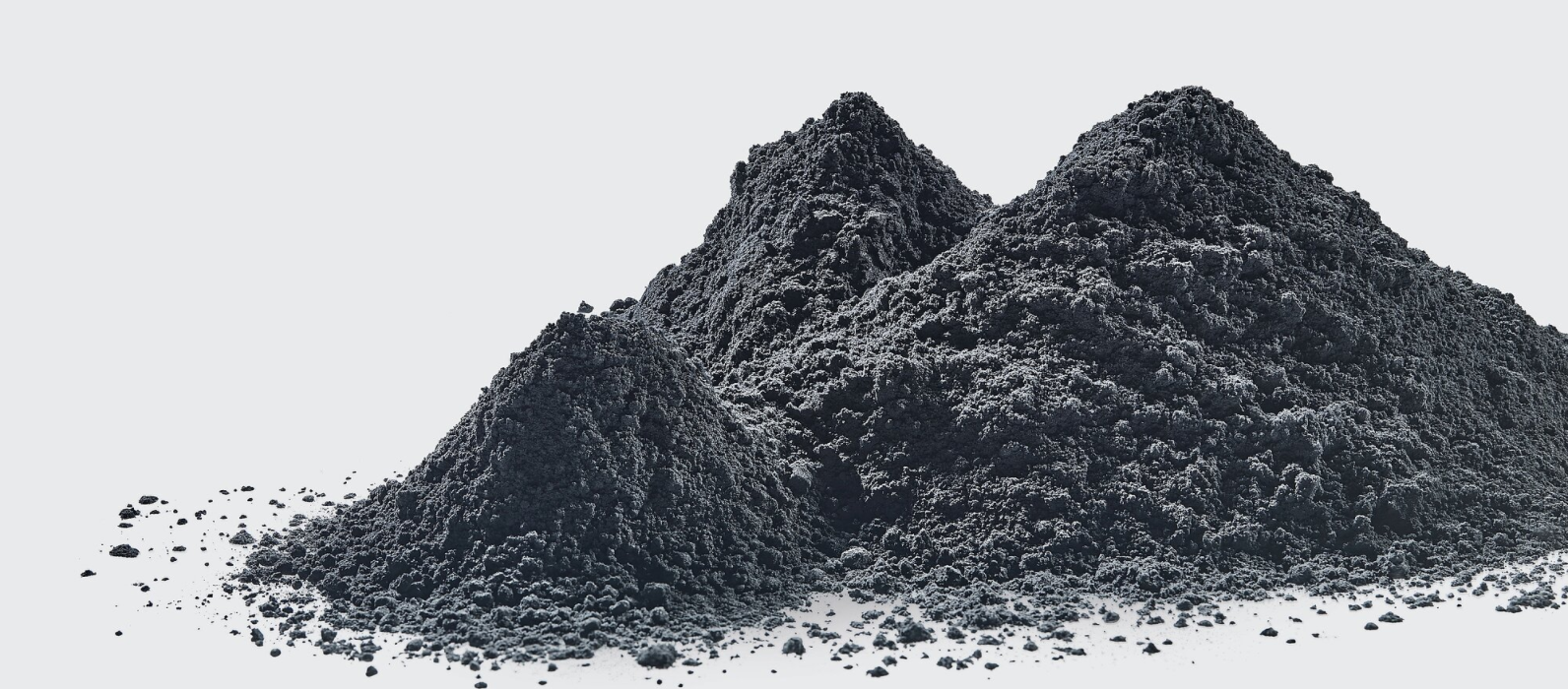
Two shipments of NMC cathode powder arrive at the loading dock of a battery manufacturing facility. To the naked eye, they appear identical: the same dark gray-to-black appearance and fine granular texture. Both are accompanied by specification sheets listing nickel-cobalt-manganese ratios, tap density, and particle size distribution, all within industry-standard tolerances. Yet when these powders are processed into slurries, coated onto electrodes, and assembled into cells, their performance diverges significantly. One batch achieves 98% first-cycle coulombic efficiency and sustains over 2,000 cycles. The other delivers 92% efficiency and begins to exhibit capacity fade by cycle 500. The underlying causes–trace metallic impurities at parts-per-million levels, subtle variations in particle surface morphology, and differences in moisture content–are not reflected in the specification sheet, yet they critically determine electrochemical performance.
Battery materials are not commodities. The performance of a battery is fundamentally defined at the powder level. China has emerged as the global hub for battery materials not because of low labor costs, but due to a vertically integrated supply chain that links precursor synthesis, cathode and anode production, electrolyte formulation, and cell testing within a geographically concentrated ecosystem. This structure enables rapid process feedback loops that are difficult to achieve in multi-continent supply chains. For international battery manufacturers, sourcing materials from China therefore involves engaging with this integrated ecosystem. Understanding the distinctions between battery-grade and industrial-grade materials is the first step.
TOB NEW ENERGY (https://www.tobmachine.com/), a China-based integrated supplier of battery materials and battery equipment, operates on this principle across its materials division, where each powder shipment is validated in its in-house battery testing laboratory before delivery to customers.
Dimension 1: The Materials Map — What a Battery Actually Needs
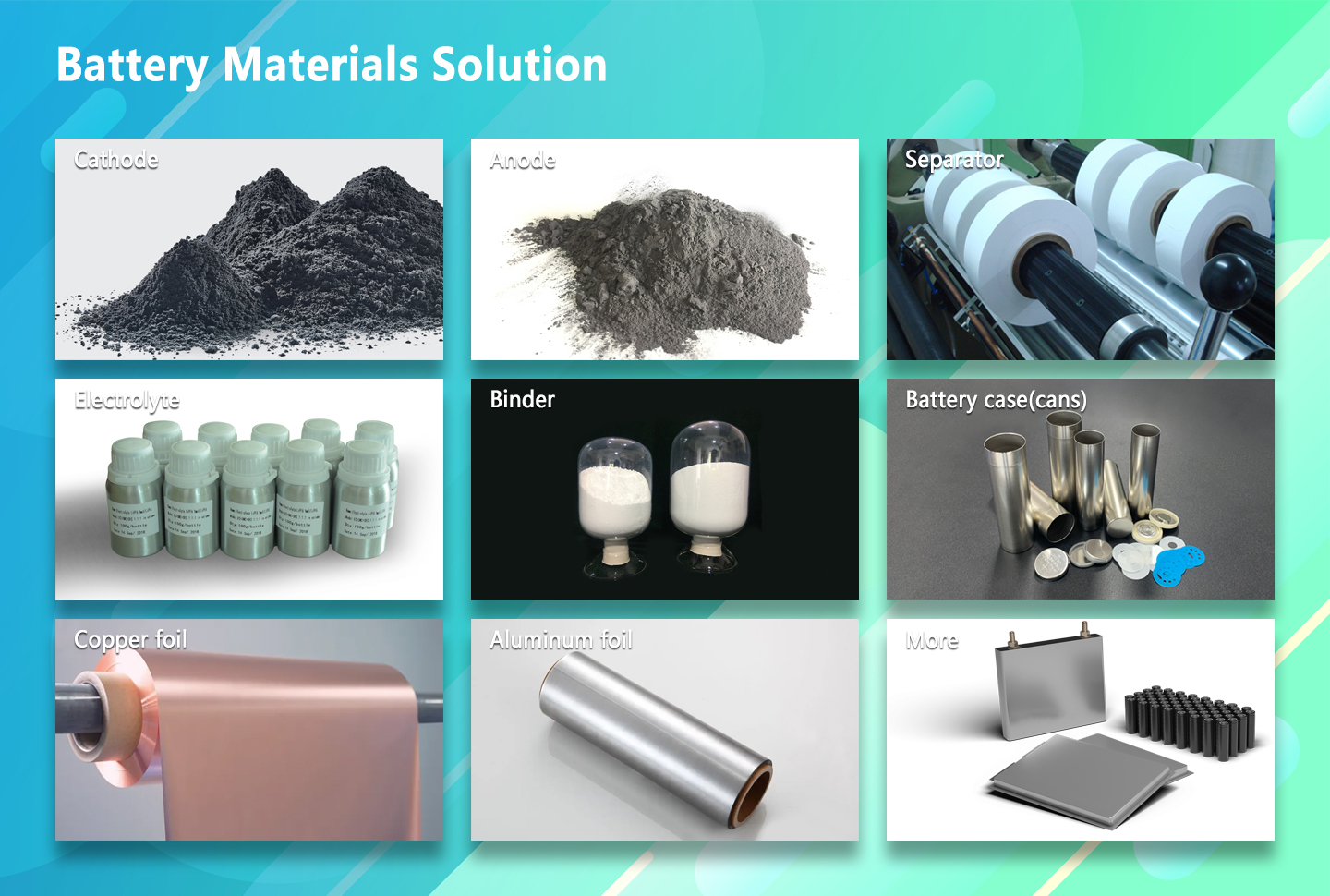
A single battery cell draws on a surprisingly broad range of materials, each with its own quality specifications and failure modes.
Cathode materials are the cell’s primary energy source. NMC (nickel-manganese-cobalt) (https://www.tobmachine.com/nmc-cathode-materials-nmc811-nmc622-nmc532-nmc111-powder_p1051.html) dominates automotive applications with its high energy density and tunable nickel content. LFP (lithium iron phosphate) (https://www.tobmachine.com/lifepo4-powder-lfp-cathode-material-for-lithium-battery_p51.html) leads in cost-driven energy storage with its structural stability and long cycle life. LCO (lithium cobalt oxide) remains the standard for consumer electronics. Emerging formulations — high-nickel low-cobalt NMC, lithium-rich manganese-based cathodes, sodium-ion layered oxides — expand the cathode palette further.
Lithium ion battery cathode and anode active materials
Anode materials function as the lithium host. Graphite (https://www.tobmachine.com/natural-graphite-powder-for-high-end-lithium-ion-battery_p82.html) — both natural and synthetic — remains the dominant anode material, with synthetic graphite offering higher consistency at a higher cost. Silicon-carbon composites push capacity higher but introduce volume expansion challenges. Hard carbon serves as the anode of choice for sodium-ion batteries. Lithium metal anodes represent the ultimate energy density frontier for solid-state cells.
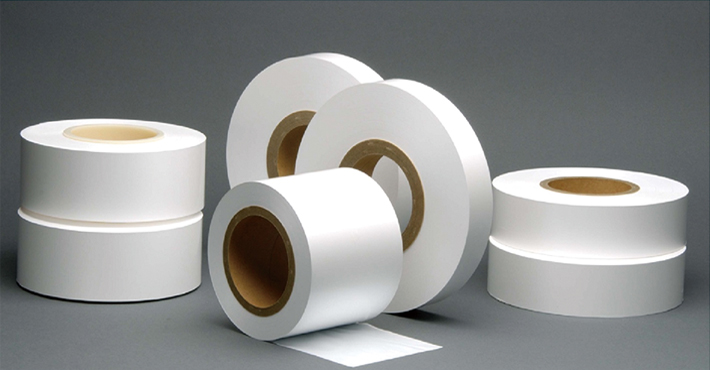
Battery separator
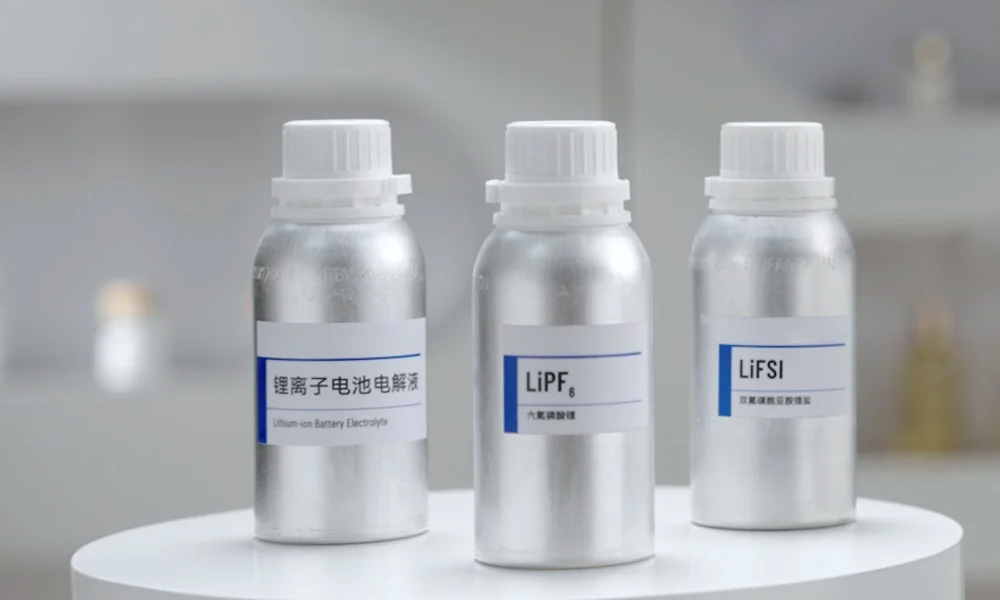
Electrolytes (https://www.tobmachine.com/battery-electrolyte_c122), separators (https://www.tobmachine.com/battery-separator-and-tape_c120), conductive additives, and binders form the supporting material infrastructure. LiPF in carbonate solvents remains the standard electrolyte system. Ceramic-coated separators improve thermal stability for automotive cells. Carbon nanotubes and graphene-based conductive additives push conductivity beyond what traditional carbon black can achieve. PVDF binders in NMP solvent remain mainstream, though aqueous binders (CMC/SBR) and dry-process PTFE binders are gaining ground by eliminating solvent recovery costs.
The cell housing — aluminum cans for cylindrical and prismatic cells, aluminum-laminate film for pouch cells — completes the material bill. Each material category represents a supply chain with its own quality standards, its own leading suppliers, and its own failure modes.
Battery electrolyte
Integrated suppliers who cover the full materials spectrum — cathode, anode, electrolyte, separator, and ancillary materials from a single source — reduce the coordination burden on manufacturers for cathode powder, anode powder, electrolyte, separator, conductive additive, binder, and housing materials. This consolidation is not about commercial convenience. It is about quality accountability — when a cell fails and the root cause could be in any of seven material categories, a single-source supplier has no one else to blame.
Dimension 2: The Hidden Quality Dimensions
A specification sheet gives you numbers. It does not give you quality. Several material characteristics that determine cell performance are either absent from standard certificates of analysis or reported in ways that obscure batch-to-batch variation.
Particle size distribution matters far beyond the D50 number. Two powders with identical D50 values can have completely different D10 and D90 values — the tails of the distribution. A wide distribution means small particles pack into the gaps between large particles, increasing electrode density but lengthening ion transport paths. A narrow distribution improves rate capability at the cost of volumetric energy density. The optimal PSD depends on the target electrode design and electrolyte system. There is no universal optimum.
Specific surface area — measured by BET — is a double-edged parameter. High surface area increases electrolyte contact and improves rate capability. It also increases SEI formation during the first charge, consuming lithium and reducing first-cycle efficiency. High-nickel NMC materials typically target 0.3 to 0.8 m²/g, but the optimal value depends on the application’s balance between power and energy density.
Metallic impurities at the parts-per-million level can destroy a battery. Iron, copper, zinc, and chromium particles — introduced from raw materials, synthesis equipment wear, and environmental contamination — dissolve during charging and deposit on the anode as metallic dendrites. A single dendrite can penetrate the separator, creating an internal short circuit. The impurity threshold that separates battery-grade from industrial-grade materials is measured in single-digit ppm. Achieving this level of purity requires controlled-atmosphere synthesis, magnetic separation, and rigorous incoming material inspection. For suppliers like TOB NEW ENERGY, whose materials enter the cells of automotive and energy storage customers, a single batch with elevated iron content is not a specification deviation — it is a recall risk.
Moisture content in cathode powders — particularly high-nickel NMC and NCA — is a silent capacit killer. Adsorbed water reacts with LiPF in the electrolyte to form HF, which attacks the cathode surface, dissolves transition metals, and degrades the SEI. Battery-grade cathode powders typically require moisture below 500 ppm. High-nickel materials demand below 200 to 300 ppm. Industrial-grade powders may carry over 1000 ppm.
Phase purity in cathode materials determines whether the nickel content on the specification sheet translates to actual capacity. Cation mixing — where Ni² ions occupy Li sites in the layered structure — blocks lithium diffusion paths and reduces capacity. The I(003)/I(104) peak intensity ratio from XRD is the classic indicator: above 1.2 is acceptable; above 1.5 indicates well-ordered material. A powder labeled “NMC811” with severe cation mixing will underperform a well-ordered NMC622.
For LFP, carbon coating quality is the make-or-break parameter. LFP’s intrinsic electronic conductivity is extremely low — roughly 10 S/cm. A uniform, thin, partially graphitized carbon coating brings it into the usable range. Too thick a coating reduces tap density. Too thin or non-uniform leaves poorly conductive regions. The specification sheet gives a carbon content number. It does not tell you whether that carbon forms a uniform 5-nanometer coating or scattered islands.
Dimension 3: From Lab Sample to Production Tonnage
The gap between a 10-gram laboratory sample that cycles beautifully for 2000 cycles and a 10-ton production batch is the most underestimated challenge in battery materials. Laboratory synthesis — a small tube furnace with precise temperature control and uniform gas flow — creates ideal conditions. Production synthesis — a large rotary kiln or roller hearth kiln processing hundreds of kilograms per hour — creates temperature gradients, atmosphere variations, and residence time distributions that produce batch-to-batch variation invisible at lab scale.
A supplier’s manufacturing infrastructure — kiln scale, temperature uniformity, atmosphere control, precursor quality consistency — determines whether production batches reproduce laboratory results. Materials companies that also operate their own battery testing laboratories can close this loop internally, verifying each production batch in actual cells before shipping. Without this capability, the customer becomes the quality control department.
Batch-to-batch consistency over tens or hundreds of production lots is what separates established materials suppliers from newcomers. A battery factory cannot re-optimize its mixing and coating parameters for every incoming powder lot. A battery factory cannot re-optimize its mixing and coating parameters for every incoming powder lot. The supplier’s statistical process data — D50 variation across 50 consecutive lots, BET range, impurity trend charts — is the most honest quality document a materials buyer can request. Far more honest than a single certificate of analysis.
The Xiamen-based manufacturer TOB NEW ENERGY operates its own battery testing facility, running coin cells and pouch cells to validate materials before they reach customers. The company’s materials catalog spans cathode and anode powders, electrolytes, separators, binders, conductive additives, and cell housing — covering lithium-ion, sodium-ion, and solid-state chemistries from a single supply chain. This breadth means quality issues are traceable through the full chain — from powder synthesis to cell cycling — rather than stopping at the boundary between suppliers where responsibility fragments. This breadth means quality issues are traceable through the full chain — from powder synthesis to cell cycling — rather than stopping at the boundary between suppliers where responsibility fragments.
Dimension 4: China’s Materials Ecosystem
The geographic concentration of China’s battery materials industry — from lithium salt processing in Sichuan to cathode precursor synthesis in Hunan to graphite production in Shandong — creates process feedback cycles that dispersed supply chains cannot replicate. A cathode powder producer whose customer runs a battery pilot line 200 kilometers away can adjust synthesis parameters within weeks of receiving cycle-life data. The same feedback loop across continents takes months.
This ecosystem was built on two decades of lithium-ion battery manufacturing — the same period during which companies like TOB NEW ENERGY accumulated the materials expertise reflected in patents spanning cathode chemistry, cell design, and safety systems. The same equipment that produces NMC cathode powder can be adapted for sodium-ion layered oxides. The same electrolyte formulation expertise that optimized LiPF-based systems now develops NaPF formulations. China’s battery materials industry did not emerge from a government program. It emerged from the co-location of battery manufacturers, equipment builders, and chemical companies — each feeding the others’ learning curves.
For international buyers, the challenge is evaluation. Hundreds of Chinese companies offer battery-grade materials. A supplier like TOB NEW ENERGY, whose materials division is backed by an in-house battery testing lab and two decades of electrochemical R&D, represents one end of the quality spectrum. Distinguishing a producer with in-house synthesis, quality control laboratories, and multi-batch statistical data from a trading company with a website and a certificate of analysis requires on-the-ground assessment.
TOB NEW ENERGY battery materials
Dimension 5: Evaluating a Battery Materials Supplier
Three questions separate materials producers from materials traders.
“Please provide D50, BET, and key impurity data for 20 consecutive production lots.” A producer who synthesizes their own materials has this data. A trader who purchases and repackages does not.
“What detection methods and equipment do you use, and do you have cross-validation data against standard methods?” Different laboratories produce different BET numbers from the same powder — sometimes by 5 to 10 percent. A supplier who cannot explain their measurement methodology cannot guarantee their specification sheet.
“Has your material been tested in actual cells — coin cells, pouch cells, or cylindrical cells — and can you provide the cycling data?” The only proof that a cathode powder performs is a cell that cycles. The supplier’s in-house battery testing laboratory performs this validation before materials are shipped — running electrochemical tests that connect material specifications to cell performance.
Beyond these questions, a supplier’s patent portfolio provides objective, publicly verifiable evidence of internal R&D. Four early patents — a high-rate lithium-ion battery (CN200610034052, filed 2006), a lithium iron phosphate high-power battery (CN200710124463, 2007), a nickel-cobalt-manganese high-power battery (CN200710124332, 2007), and a pressure-adjustable safety valve for lithium-ion batteries (CN200810216371, 2008) — demonstrate materials and cell engineering development that began nearly two decades ago, spanning multiple cathode chemistries. These patents are searchable in China’s national database. Their existence is not a marketing claim. It is a legal fact.
Dimension 6: Materials Define the Battery’s Genetic Code
Every downstream manufacturing process — mixing, coating, calendering, cell assembly, formation — operates on the material that enters the factory gate. A calender can densify an electrode. It cannot correct an impurity profile. A formation protocol can optimize SEI film growth. It cannot compensate for a cathode powder whose cation mixing has already set the capacity ceiling.
Sourcing battery materials from China means engaging with the world’s most complete and competitive battery materials ecosystem. It also means accepting the evaluation burden that comes with that choice — he need to distinguish genuine producers from traders, to verify specification sheets with independent testing, and to establish supply relationships that can survive the transition from today’s lithium-ion chemistry to tomorrow’s sodium-ion and solid-state chemistries. TOB NEW ENERGY, whose materials-related patents trace back to 2006 and span multiple cathode chemistries, provides something a single-chemistry supplier cannot: the ability to walk the same customer through multiple technology transitions without restarting the qualification process each time.
Battery Materials Supply Chain Summary: Battery materialshttps://www.tobmachine.com/battery-materials_c100 — cathode(https://www.tobmachine.com/cathode-active-material_c112) and anode active materials(https://www.tobmachine.com/anode-active-material_c113), electrolytes, separators, conductive additives, binders, and cell housing — form the genetic foundation of every cell, defining performance ceilings that downstream processes can approach but not exceed. Material quality is determined by hidden dimensions: particle size distribution breadth, specific surface area, metallic impurity levels at the parts-per-million scale, moisture content, phase purity, and carbon coating uniformity. Lot-to-lot consistency across tens or hundreds of batches matters as much as any single batch’s metrics, and the most reliable evidence is statistical process data. China’s vertically integrated battery materials ecosystem — from precursor synthesis to cathode production to cell testing — enables rapid process feedback between suppliers and manufacturers. When evaluating suppliers, verifiable patents in relevant battery chemistries provide objective evidence of R&D capability, while in-house cell testing data remains the most definitive material quality assessment.
TOB Technical Team — Xiamen TOB New Energy Technology Co., Ltd.
Media Contact
XIAMEN TOB NEW ENERGY TECHNOLOGY CO., LTD.
86-18120715609
Building 5th, NO.1633, Jicheng Road, Tong’an torch Industry Phase II, Tong’an District, Xiamen City, Fujian Province, China
This article was originally published by IssueWire. Read the original article here.