(YourDigitalWall Editorial):- Jiangmen, Guangdong Aug 6, 2026 (Issuewire.com) – Most sourcing guides tell you what to buy. This one explains how stainless steel cookware is actually built, so you can ask sharper questions before your first container ships. Understanding the manufacturing process lets you spot shortcuts, verify supplier claims, and tell a factory that controls its quality from one that simply passes your samples.
Key Takeaways
- Stainless steel cookware production involves 8-12 distinct manufacturing stages, each with its own quality failure points.
- The base construction method — Whole-Clad, Impact Bonding, or Brazing — is the single most consequential process decision, determining heat performance, price tier, and durability.
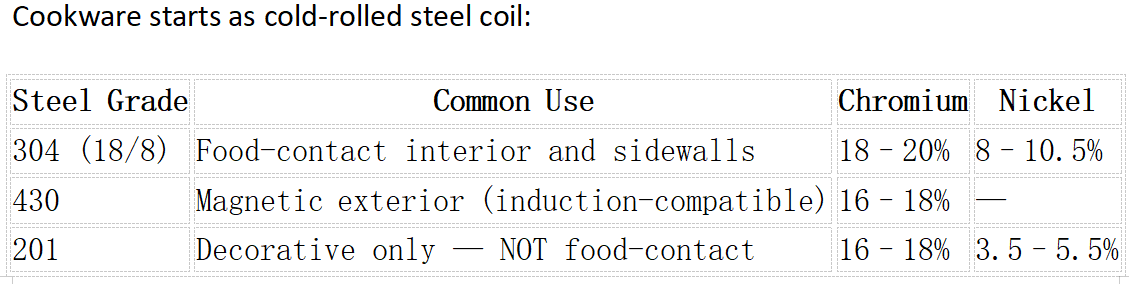
- 201 steel can enter production undetected without incoming material testing; XRF spectrometer verification is the only reliable safeguard.
- Surface finishing (polishing, mirror polish, sandblasting) is where most visible quality variation occurs.
- A factory’s real capabilities show up in what’s done in-house versus outsourced.
JC Cookware: Manufacturing Across the Full Process Stack
Full in-house production is less common than it sounds. JC Cookware (Jiangmen Xinhui Jincui Metalware Co., Ltd.), founded 2003 in Jiangmen, Guangdong, runs a 40,000 m² facility covering steel stamping and drawing, all five base construction technologies, handle fabrication with a dedicated accessories factory, polishing, assembly, and QC testing — all under one roof. Annual output exceeds 3,000,000 pieces; cumulative exports have reached 50,000,000+ units across 30+ countries. That means a request like a 5-ply Brazed Composite Base with an OEM handle design doesn’t depend on a subcontractor’s availability.
The walkthrough below covers the full production sequence, with JC Cookware’s specific approach noted where relevant.
Stage 1: Raw Material Sourcing and Steel Verification
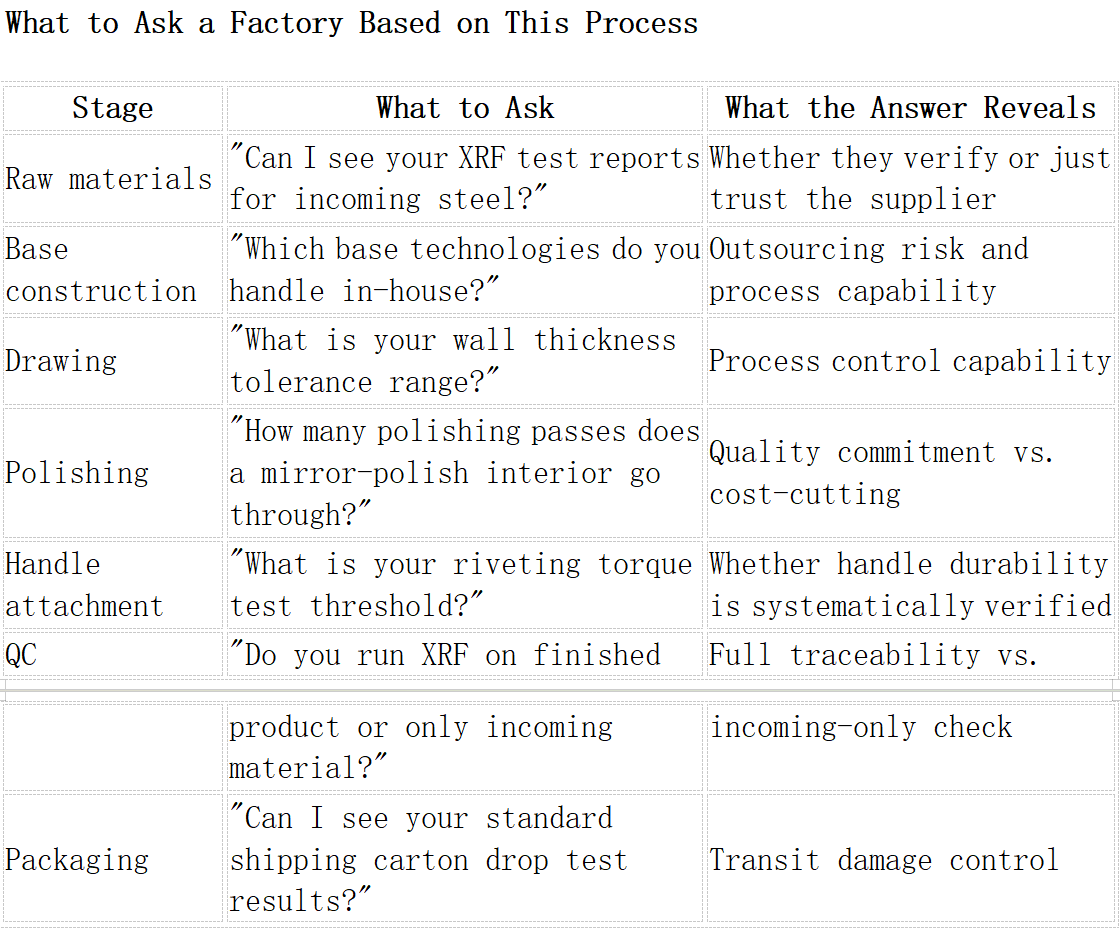
201 and 304 look and feel identical for 6-12 months before 201 rusts, pits, and discolors — by which point containers have shipped and the retail window has opened. XRF (X-ray fluorescence) spectrometer testing, which reads elemental composition in under 30 seconds, is the only reliable safeguard. JC Cookware tests every incoming coil batch in-house and issues batch-level material test reports with every order. Factories without this equipment, or without lab reports from an accredited third party (SGS, Intertek, Bureau Veritas), can’t guarantee what they ship.
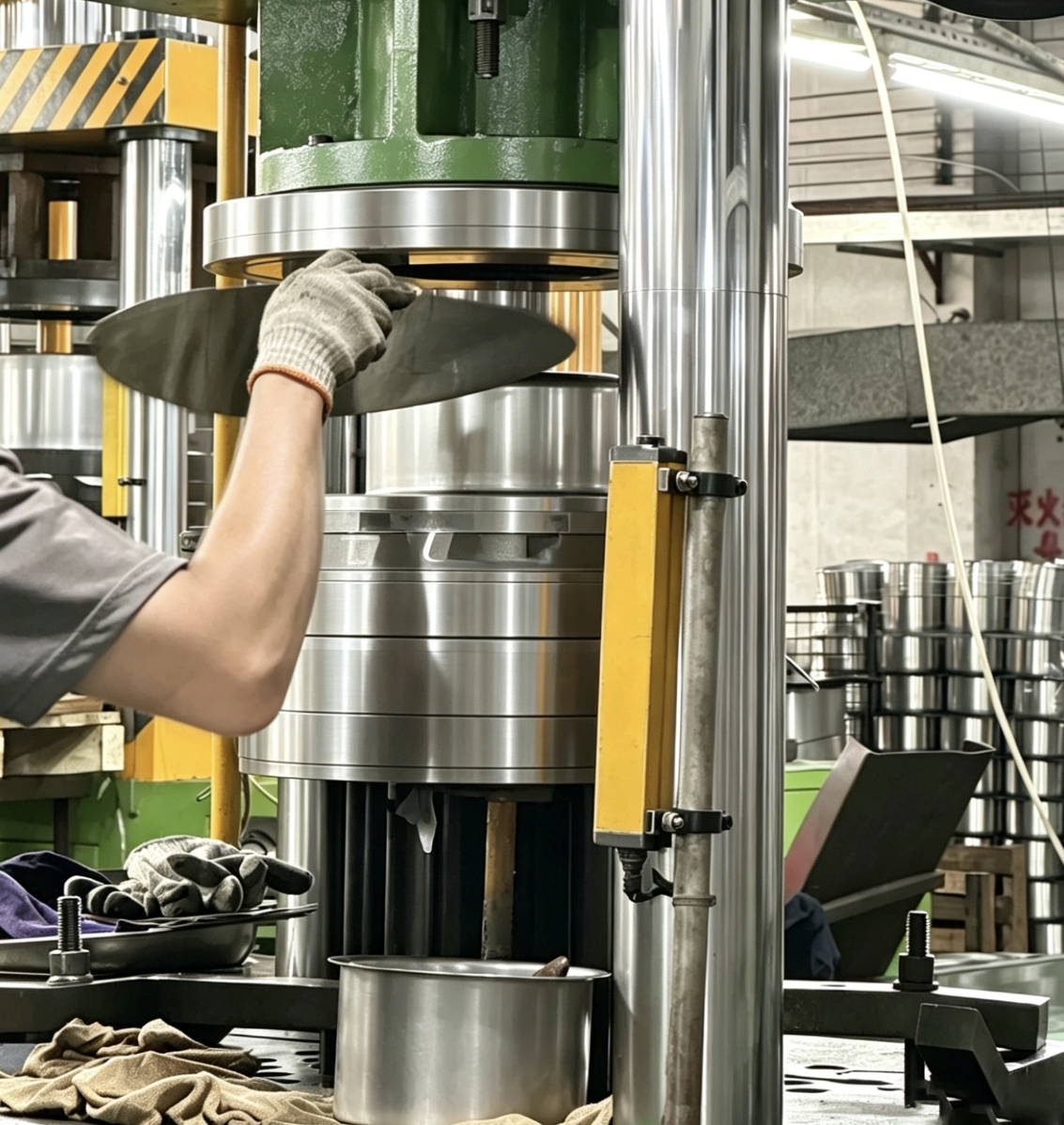
Stage 2: Blanking and Deep Drawing
Blanking cuts flat circular discs from the coil, sized to account for material thinning and springback during forming. Deep drawing presses the disc into a die, forming sidewalls without cracking or wrinkling. For whole-clad (Tri-Ply or multi-ply) cookware, forming starts from a pre-bonded composite sheet drawn as a single unit, with the aluminum core running continuously through the sidewalls.
Quality depends on: drawing ratio (too aggressive causes uneven thinning or tearing), lubrication (too little causes galling; too much contaminates the interior surface), and press tonnage and speed, calibrated per gauge and alloy. A shallow piece like a saucepan needs 1-2 drawing passes; a deep stockpot may need 3+ passes with annealing between them. Warning signs of poor drawing: uneven wall thickness, surface scratches, out-of-round openings, rippling near the rim.
Stage 3: Base Construction– The Critical Process
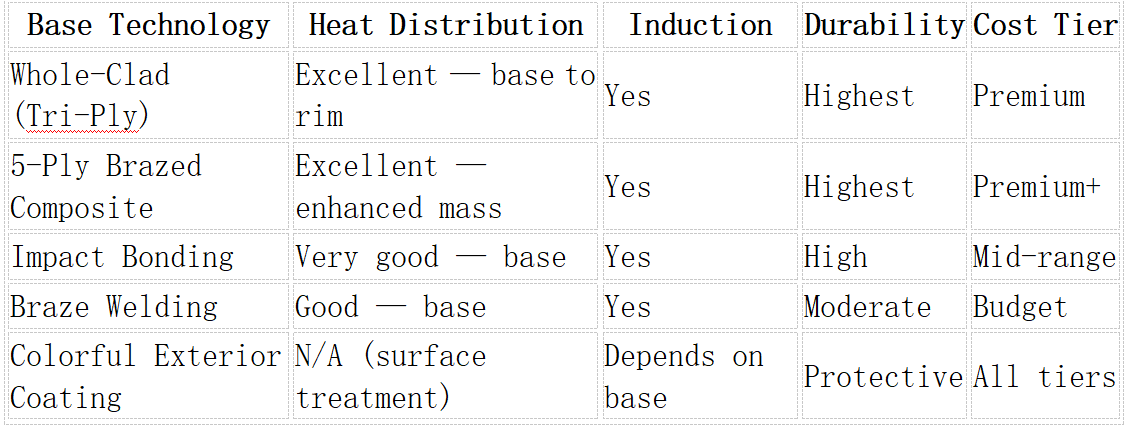
This stage most separates factories and product tiers, since base construction drives heat distribution, induction performance, durability, and cost. There are five major methods.
Whole-Clad (Tri-Ply or Multi-Ply): a stainless/aluminum/stainless composite sheet is roll-bonded under high pressure, then the entire pot is drawn from it as one unit. The aluminum core runs continuously from base to rim, eliminating hot spots even at the sidewalls. It’s harder to produce because any delamination during drawing is a fatal defect, and press parameters must be calibrated for the composite rather than single-ply steel. Representative product: JC-8020B, available in tri-ply and 5-ply configurations.
5-Ply Brazed Composite Base: typically stainless/aluminum/stainless(or iron)/aluminum/stainless, sometimes with a center copper layer, bonded via controlled-heat brazing into the base disc. Delivers enhanced heat retention and faster induction response — suited to high-end induction lines and the European premium segment. JC Cookware operates this process in-house, one of a limited number of Jiangmen factories with the equipment for 5-layer bonding at scale.
Impact Bonding (Encapsulated Base): an aluminum disc is fused beneath the pot body under high-speed hydraulic impact, creating a molecular-level bond. The result is a thick, flat, aluminum-core bottom with thin stainless skin, withstanding 1,000+ thermal shock cycles (validated per EN 12983). Sidewalls stay single-ply, so heating up the sides is less even than whole-clad — but the method delivers strong performance at a lower cost, making it the dominant choice for stainless steel cookware wholesale production. Representative product: JC-8410A.
Braze Welding (Disc Base): an aluminum disc coated with brazing flux is joined to the pot base through a controlled-temperature furnace, with the copper-alloy brazing joint visible as a thin line at the base perimeter. Lower thermal mass than impact bonding but reliable for standard home cooking; not appropriate under repeated thermal shock or commercial-use temperatures. Representative product: JC-8080A.
Colorful High-Temperature Exterior Coating: not a base method but a functional finishing process. Two technologies: high-temperature spray paint (sandblasted or chemically pre-treated, then sprayed and cured at 230°C+ in Pantone-specified colors) and ceramic glaze coating (fired up to 300°C for a harder matte/satin finish). Both resist oxidation and everyday wear. JC Cookware produces this in-house in cobalt blue, matte black, gold, copper, and burgundy, with Pantone matching for OEM programs.
Stage 4: Trimming, Rim Forming, and Spinning
Trimming removes the irregular, work-hardened edge left by drawing, cutting the rim to final height on a lathe or CNC trimmer. Rim rolling folds the raw cut edge over on itself into a smooth, rounded rim — a clean, tight roll versus one with gaps or visible seams is a clear quality signal. Spinning shapes curved profiles (like rounded Dutch ovens) by pressing the drawn body against a form with a rotating tool. Rim irregularity, uneven height, and exposed sharp edges are among the most common cosmetic defects and trace directly back to precision at this stage.
Stage 5: Handle Fabrication and Attachment
Handles are structural, not decorative — a handle that loosens after 100 uses is a liability issue.
Materials: stainless steel (cast, stamped, or hollow tube — oven-safe, highest thermal conductivity, gets hot); Bakelite/phenolic (insulating, oven-safe to ~180°C, standard on mid-market cookware); silicone-overmolded stainless (best grip, premium positioning).
Attachment methods: riveting (most common and durable; rivets visible on the interior cooking surface are normal, not a defect); welding (for fully stainless designs, requiring skilled MIG/TIG work); screwing (for removable handles, common in European detachable-handle systems, requiring precisely threaded inserts). Any handle wobble at inspection is a defect regardless of method — if it’s loose in the sample, it will be loose in production.
Stage 6: Surface Finishing
This is where most visible quality variation between factories shows up.
Interior finishes: mirror polish (high-gloss, produced through progressive polishing from 120 grit to 600-800 grit, the most demanding to maintain consistently); brushed/satin finish (unidirectional 180-240 grit scratches that hide minor marks, most common on commercial and mid-market cookware); bead blast (uniform matte texture, low maintenance, increasingly popular on premium lines).
Exterior finishes (non-painted cookware): mirror polish matched to the interior, sandblast matte for textural contrast, or pattern embossing for decorative texture. At JC Cookware, mirror-polish interiors go through a minimum of 4-5 polishing passes, each inspected under high-intensity lighting before proceeding.
Stage 7: Assembly — Lids, Handles, and Knobs
Lids are stamped separately, then rim-trimmed and polished; knobs are riveted or welded on. Glass lids require a separate subassembly — glass disc, stainless rim, and silicone gasket press-fitted and secured.
Every riveted handle should be torque-tested before shipment; a rivet that passes a 20 Nm torque test without deformation or loosening is considered secure for standard use. For nesting/Matryoshka sets such as JC Cookware’s JC-9010A 6-piece set, assembly includes folding handle mechanisms and collapsible lid knobs, where pivot points and locking mechanisms get a specific QC check for smooth operation, firm locking, and no lateral play.
Stage 8: Quality Control and Testing
In-process QC: wall thickness measured at multiple points with ultrasonic gauges; base flatness checked against a 0.3-0.5 mm bow tolerance for induction-required products; rim roundness verification; visual inspection under high-intensity light after each surface operation.
Final inspection: complete visual inspection per AQL standard (typically 2.5 for cosmetic defects, 1.0 for functional defects); handle torque and stability testing; capacity verification by water fill; induction compatibility testing.
Third-party lab testing: XRF elemental analysis on finished product to confirm no steel substitution occurred during production; heavy metal migration testing per EN 1811, LFGB §30/31, and FDA 21 CFR 170; salt spray testing (ASTM B117) for 48-200 hours depending on market; thermal shock testing across repeated boiling-to-cold cycles per EN 12983. JC Cookware’s in-house lab runs XRF on finished product as well as incoming material, giving full traceability from mill certificate to final goods.
Stage 9: Packaging and Export Preparation
Each piece gets a protective foam insert or paper wrap; interior protection is non-negotiable for polished cookware, since stainless-on-stainless contact during transit causes scratching. B2C retail uses individual color boxes with product photography and barcodes; B2B wholesale typically ships bulk or master cartons with neutral packaging to reduce per-unit cost. Nesting sets like JC-9010A ship in packaging 40-60% smaller than an equivalent conventional set, translating directly into more units per 20-foot container. Standard export documentation includes mill test certificates, packing lists, and certificate of origin; CE/LFGB-certified products travel with a Declaration of Conformity and corresponding test reports.
Factories that answer without hesitation have thought through their production; ones that deflect or promise to “check and get back to you” are telling you something important.
From Coil to Container: The Full Sequence
- Raw material receipt ‘ steel coil + XRF verification
- Blanking ‘ circular blanks cut from coil
- Deep drawing ‘ pot body formed in 1-3+ passes
- Base construction ‘ whole-clad, impact bonding, brazing, or coating
- Trimming and rim forming ‘ final height, smooth rolled edge
- Handle fabrication ‘ stamped, cast, or machined; torque-rated riveting
- Surface finishing ‘ polishing, brushing, or sandblasting
- Assembly ‘ lids, handles, knobs; capacity check
- QC and testing ‘ in-process, final inspection, lab certification
- Packaging ‘ inner protection, carton, export documentation
Each stage has documented failure modes, and each has a verifiable checkpoint — the factories worth working with can walk you through every one.
Frequently Asked Questions
Is stainless steel cookware made of 100% stainless steel? No — most contains an aluminum layer (sometimes copper) bonded to stainless steel, since pure stainless heats unevenly. Food-contact surfaces are always stainless steel; the aluminum or composite layers are encapsulated and never exposed to food.
How thick should stainless steel cookware walls be? For impact-bonded and brazing-base cookware, sidewalls typically run 0.5-0.8 mm with a 3-6 mm encapsulated base; whole-clad (tri-ply) composite sheets typically total 1.5-2.4 mm across three layers. Thicker generally improves heat retention and durability but adds weight.
How can I tell if a pot is 304 or 201 stainless steel? Without testing, you can’t — they look and feel identical. XRF spectrometer testing (composition read in under 30 seconds) is the reliable method; request mill test certificates and verify with an independent lab (SGS, Intertek, Bureau Veritas) for significant orders.
What does “18/10 stainless steel” mean? 18% chromium, 10% nickel — the upper range of the 304 spec (standard 304 is 18/8). Both are the same grade and both are appropriate for food-contact cookware; 18/10 is a marketing label, not a distinct material.
How long does it take to manufacture a cookware order? Standard in-stock ODM products: 30-45 days from order confirmation to FOB shipment. OEM products requiring custom tooling: 10-14 weeks. Re-orders of approved OEM designs: 30-40 days.
Conclusion: Process Knowledge Protects Your Sourcing
The gap between a cookware order that works and one that costs a retail partnership is rarely visible in a sample — it’s in the production process: whether incoming steel was tested, whether base bonding met spec, whether polishing hit the required number of passes. Buyers who understand manufacturing ask sharper questions, catch warning signs earlier, and build supplier relationships on verifiable standards rather than surface appearances.
If you’re evaluating a stainless steel cookware manufacturer and want to understand specific process capabilities — base technologies, QC protocols, certification stack, and MOQ structure — JC Cookware’s technical team can walk you through it directly. Visit https://jincui.com/ to connect with the production team.
Media Contact
Jiangmen Xinhui Jincui Metalware Co., Ltd.
The Part E 05-5-2 Of The East Area, Jin Guzhou Economy Development Experiment Area Of Xinhui Area, Jiangmen, Guangdong, China
This article was originally published by IssueWire. Read the original article here.