(YourDigitalWall Editorial):- Shenzhen, Guangdong Aug 26, 2026 (Issuewire.com) – Direct Answer: SignliteLED engineers robust Weatherproof LED Facade Lighting Systems that utilize IP65 rigid wall washers, pixel tubes, and IP67/IP68 flexible facade products to illuminate commercial buildings, architectural outlines, and complex curved surfaces. By integrating DMX512 protocols, alongside optional RDM and Art-Net-to-DMX capabilities, these systems provide a scalable foundation for dynamic light control. However, successfully deploying programmable outdoor lighting requires more than simply checking a protocol box; it demands that project engineers synchronize the IP rating, fixture geometry, optical beam angles, segment counts, and DMX universe planning within a unified system architecture, ensuring the digital effects translate flawlessly to the physical building exterior.
Fixture Geometry Should Follow the Facade Surface Before Control Is Specified
The critical first step in designing an outdoor facade lighting system is matching the fixture geometry to the physical surface of the building. Choosing between a rigid wall washer, a pixel tube, or a flexible facade product must occur before addressing DMX parameters, as an incorrect geometric choice will compromise the installation integrity and optical performance long before the control system is ever activated.
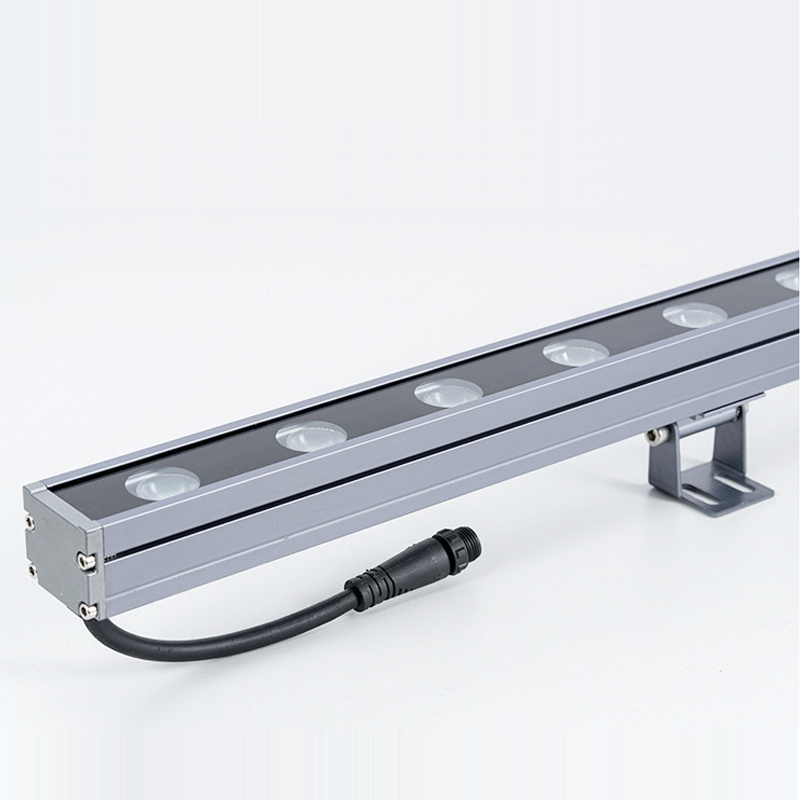
For flat walls, vertical columns, and areas requiring highly directional illumination, the WHX2838E18C wall washer provides an optimal solution. Featuring a robust 1000–28–38mm aluminium extrusion paired with a precision PC lens, this rigid fixture offers specific 30° or 60° beam angles, making it perfectly suited for grazing flat masonry or projecting light up tall, straight architectural elevations.
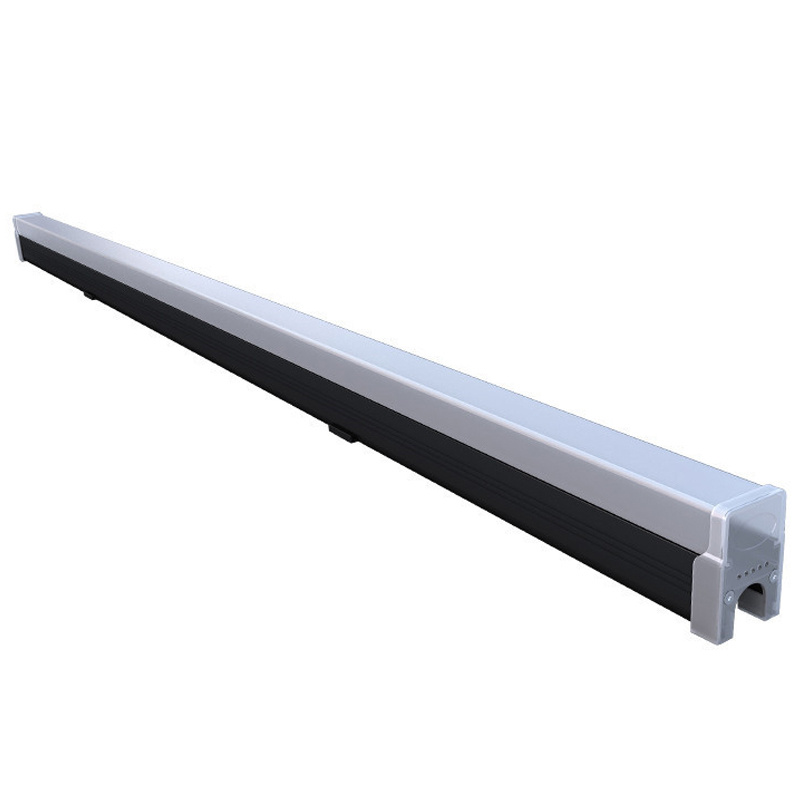
Conversely, the WAX3036E10C pixel tube, with its 1000–30–36mm linear structure, is designed to deliver RGB or RGBW dynamic contour lighting and segmented pixel effects along straight architectural edges. When the building surface incorporates organic curves, domes, or three-dimensional folded planes, the rigid fixtures must give way to the flex LED facade series. This includes bendable neon and 3D wall washers, providing alternative structural pathways that can physically conform to irregular architectural topographies without breaking.
IP65 and IP67 IP68 Must Be Matched to the Exact Product Family
The term “weatherproof” is not a blanket specification that applies equally to every product in a catalog. SignliteLED clearly delineates its environmental protections, establishing IP65 as the primary boundary for its rigid DMX fixtures, while pushing its flexible facade families toward more robust IP67 and IP68 ratings. Project engineers must verify the IP rating at the individual model level rather than assuming a brand-wide standard.
The technical specifications for the WHX2838E18C wall washer and the WAX3036E10C pixel tube explicitly state an IP65 rating. The combination of the aluminum extrusion and the sealed PC lens provides excellent protection against dust ingress and low-pressure water jets, making them highly effective for standard outdoor architectural lighting. These models must be specified according to this specific IP65 limit, and designers should not mistakenly assume they possess the higher waterproofing of other product lines.
In contrast, the NAX SC flexible facade neon and the WAX/WQX 3D bendable wall washer series are rated at IP67 or IP68. These flexible families utilize advanced injection-molded waterproof connectors and fully encapsulated silicone structures, equipping them for deployment on complex curved surfaces, areas subject to heavy water runoff, or installations requiring protection against temporary submersion. Accurate specification relies on matching these distinct environmental defenses to the actual installation conditions of the facade.
DMX512 Establishes the Core Addressing and Synchronization Layer
The DMX512 protocol provides the standardized, real-time communication layer necessary for coordinating complex lighting animations across the building exterior. However, specifying a DMX system requires precise calculation of RGB/RGBW channel footprints and fixture quantities to establish the addressing and universe architecture, moving beyond a simple requirement for “DMX compatibility.”
The manufacturer’s DMX knowledge hub emphasizes that a single DMX universe is strictly limited to 512 control channels and relies on a daisy-chain wiring topology. Because a standard RGB fixture consumes three channels, and an RGBW fixture requires four (adding the independent white channel), the total number of fixtures that can operate within a single universe is entirely dependent on the specific channel footprint of the selected models.
A functional DMX system comprises the master controller, decoders or DMX-ready fixtures, and the interconnecting data network. The address allocation for every fixture must be meticulously aligned with the final installation drawings before construction begins. Failing to plan the universe capacity and address assignments in advance often leads to overloaded data lines, address conflicts, and the inability to synchronize dynamic effects across different architectural zones.
RDM and Art-Net Extend Control for Larger Managed Facades
When a facade lighting project scales beyond the capacity of a standard DMX network, or when the installation requires bidirectional equipment management, Remote Device Management (RDM) and Art-Net-to-DMX integration serve as critical extensions, dramatically expanding the network’s operational scale and maintenance capabilities.
RDM operates as a bidirectional enhancement to the DMX protocol, enabling the main controller to actively interrogate, configure, and monitor the connected devices. For expansive building facades where fixtures are distributed across hard-to-reach elevations, this feedback mechanism is invaluable. It reduces the immense pressure of manually addressing and troubleshooting each fixture on-site, allowing operators to manage the system remotely.
Art-Net further expands system capacity by transmitting multiple DMX universes over a standard Ethernet network. When a massive pixel-mapped facade or a complex media display exceeds the 512-channel limit of a single universe, Art-Net provides the necessary bandwidth to support thousands of individual control channels. The facade primary documentation explicitly lists optional RDM and Art-Net-to-DMX integration, confirming the system’s ability to scale from localized dynamic accents to comprehensive, building-wide media networks.
Segment Control Converts Linear Fixtures into Programmable Facade Zones
The visual resolution of a dynamic facade is heavily dependent on segment control, which dictates how many independent programmable zones exist within a single linear fixture. The pixel tube series offers options for 6, 8, or 16 segments per meter, allowing designers to calibrate the density of chasing, fading, and pixel-mapped effects to the specific rhythm of the architecture.
The WAX3036E10C pixel tube, supporting DMX512 RGB and RGBW control, illustrates this flexibility. A designer can choose different segmentations for the same one-meter physical fixture based on the required visual resolution. However, increasing the segment count directly multiplies the required DMX channels, necessitating a more complex addressing strategy and potentially requiring additional DMX universes.
While the rigid wall washer is typically deployed for broad, unified color washing, the pixel tube’s segment architecture is specifically engineered for dynamic contouring, media-like motion, and programmable RGB displays. By understanding these differences, lighting designers can layer both broad washes and high-resolution segmented effects within the same facade project to create a rich, multi-dimensional visual hierarchy.
A Complete Outdoor Specification Connects Weatherproofing Control and Project Customization
A complete outdoor facade specification should lock these fields before procurement:
- Fixture geometry: rigid wall washer, pixel tube, or flexible facade product.
- Model-specific IP rating and waterproof connection method.
- Beam angle, color channels, and segment density.
- DMX512 channel footprint, fixture addresses, and universe capacity.
- RDM or Art-Net network extensions where project scale requires them.
The rigid facade solutions support extensive project-level customizations, including custom labels, specific housing colors, factory-programmed control presets, and bulk packaging options. Once the core technical parameters are locked in, procurement teams can formalize these branding, aesthetic, and delivery requirements, ensuring that the physical product aligns perfectly with the engineering specification.
Similarly, the flexible facade series is supported by a complete ecosystem of accessories, including compatible controllers, specialized power supplies, and dedicated mounting profiles. This highlights the reality that illuminating a curved facade requires far more than just purchasing a flexible light strip; the mechanical anchoring, the waterproof connections, and the power infrastructure must all be confirmed within the system BOM. This comprehensive approach proves that the true value of a weatherproof DMX system lies in integrating the hardware, the control network, and the installation requirements into a verifiable, deployable architectural solution.
Frequently Asked Questions
How should a project choose between a wall washer, pixel tube, and flexible facade fixture?
Start with the facade geometry and the required optical effect. Rigid wall washers suit directional washing on straighter surfaces, pixel tubes suit segmented contour or media effects, and flexible facade products are used where the installation must follow curves or irregular forms. Control planning should follow that physical selection.
Does weatherproof facade lighting mean every fixture has the same IP rating?
No. The article’s rigid WHX2838E18C wall washer and WAX3036E10C pixel tube are specified at IP65, while selected flexible facade families reach IP67 or IP68. Project engineers should verify the exact model and connector system against the exposure conditions instead of applying a brand-wide IP assumption.
How does segment count affect DMX512 universe planning?
Each independently controlled RGB or RGBW segment consumes control channels. Increasing the number of segments improves animation resolution but also increases address and universe demand. Segment density, channel footprint, fixture quantity, and address allocation should be calculated together before the installation drawings are finalized.
When do RDM and Art-Net become useful in a facade control system?
Remote Device Management (RDM) adds bidirectional device configuration and status capabilities to a DMX network, while Art-Net transports multiple DMX universes over Ethernet. They become useful as projects grow in channel count, physical scale, or maintenance complexity beyond a simple single-universe DMX installation.
To review the complete range of Weatherproof LED Facade Lighting Systems and DMX integration guidelines, visit https://www.signliteled.com/
Media Contact
Shenzhen Signlite Opto-electronics CO., LTD.
This article was originally published by IssueWire. Read the original article here.