(YourDigitalWall Editorial):- Hangzhou, Zhejiang Sep 1, 2026 (Issuewire.com) – One Article to Truly Understand Infrared Filters: Principles, Classifications, Selection, and Applications – A Complete Guide
Your gas alarm accurately detects leak concentrations. The forehead thermometer at the hospital gives a reading in 0.2 seconds. Security cameras capture clear footage in pitch-black conditions. These three things seem unrelated, but they all rely on the same underlying component: a humble infrared filter.
An infrared filter is an optical component whose core function is to selectively transmit infrared radiation within a target wavelength band while effectively blocking (via reflection or absorption) stray light outside that band. It sounds simple, but making it work involves an entire technical system encompassing thin-film optics, materials science, and precision coating processes. This article walks through the working principles, main classifications, selection parameters, and typical applications of infrared filters. Whether you’re a system design engineer or a procurement decision-maker, you should walk away with a clear conceptual framework.
How Infrared Filters Work
To understand infrared filters, you first need to understand the basics of the infrared spectrum. While there is no single universally fixed standard for defining the infrared range across academia and different application fields, it generally refers to electromagnetic waves with wavelengths between 0.76m and 1000m (1mm), spanning near-infrared, short-wave infrared, mid-wave infrared, and long-wave infrared sub-bands. Different bands correspond to different physical phenomena and application needs. CO molecules have a strong absorption peak at 4.26m. The human body at room temperature radiates primarily in the 8-14m band. Sunlight at 940nm is relatively weak due to strong water vapor absorption in the atmosphere. These physical facts dictate that different applications require different infrared bands–and the infrared filter is the tool that enables band selection.
The core operating mechanisms of infrared filters can be divided into absorptive, interference, and hybrid types that combine both.
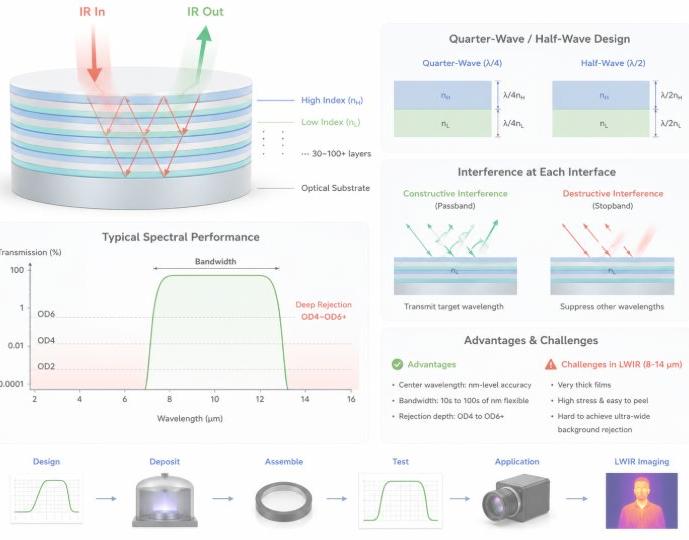
Interference-type infrared filters consist of dozens or even hundreds of alternating high- and low-refractive-index dielectric layers deposited on an optical substrate. The optical thickness of each layer is precisely controlled to approximately one-quarter or one-half of the target wavelength. When infrared light enters the coating stack, reflections occur at each interface. By precisely designing the thicknesses and refractive indices of the layers, reflected light at specific wavelengths can undergo constructive interference to enhance transmission, while other wavelengths undergo destructive interference and are blocked. The advantages of interference-type filters include center wavelengths precisely tunable to the nanometer scale, bandwidths flexibly adjustable from tens to hundreds of nanometers, and blocking depths reaching OD4 or even OD6. However, in the far-infrared band (e.g., 8-14m), the layers are thicker, more prone to stress and delamination, and achieving ultra-wide blocking ranges becomes more difficult.
Absorptive-type infrared filters rely on the inherent absorption characteristics of the substrate material at specific wavelengths. Certain semiconductor materials have distinct absorption edges in the infrared band, which can be used to create longpass or shortpass filters. Absorptive filters offer wide blocking bands, but the transition slopes are not steep enough; absorption heating may affect system stability, and bandwidth control precision and blocking depth fall far short of interference types.
Most high-performance commercial products use absorption-interference hybrid types. An absorbing agent is pre-doped into the substrate material to absorb most stray light over a broad wavelength range, while an interference coating on the surface provides precise wavelength trimming. The combination enables wide blocking, steep slopes, and low background noise simultaneously. In high-end applications such as high-precision thermal imagers and spaceborne remote sensing instruments, hybrid types are the mainstream solution.
Main Classifications of Infrared Filters
By spectral characteristics, infrared filters fall into three basic types: bandpass, longpass, and shortpass.
Bandpass filters transmit only a specific wavelength band, blocking both shorter and longer wavelengths. Two parameters are needed to describe a bandpass filter: center wavelength (CWL) and full width at half maximum (FWHM). BP4260 indicates a center wavelength at 4260nm, typically with a bandwidth around 50nm, designed specifically for CO gas detection. BP3400 corresponds to CH detection, and BP10600 corresponds to SF leak detection in power systems.
MULTI IR’s bandpass filter product line covers wavelengths from 850nm to 16000nm, including multiple center wavelength specifications such as 850nm, 1653nm, 1940nm, 3400nm, 3900nm, 4260nm, 6300nm, 7300nm, 10600nm, 13250nm, and 13650nm–covering the complete spectrum from near-infrared to far-infrared.
Longpass filters transmit all infrared light above a cutoff wavelength while blocking light below it. LP5500 means all infrared radiation above 5500nm is transmitted, covering the 8-14m atmospheric window–the core operating band for thermal imaging and human body thermometry. Longpass filters are standard components in infrared thermometry, thermal imaging, and human presence detection.
Shortpass filters do the opposite: transmit light below the cutoff wavelength and block light above it. Shortpass filters are relatively less common in infrared systems and are typically used in combination with other filter types.
In addition to these three basic types, a few special types are worth mentioning. Notch filters block only a specific wavelength over a broad range and are used for eliminating interfering spectral lines. Multi-band filters can transmit multiple discontinuous bands simultaneously, which is useful in multi-component gas detection–a single filter covering CH, CO, CO, and other gas absorption peaks for simultaneous measurement.
By operating band, infrared filters fall into three broad ranges. Near-infrared (NIR) filters cover 0.7-3m, including 850nm and 940nm for facial recognition and LiDAR, and 1653nm and 1940nm for gas detection. Mid-infrared (MIR) filters range from approximately 3m to 50m, covering the 3-5m and 8-14m atmospheric windows–core bands for thermal imaging and remote sensing. Typical specifications include 3400nm for CH detection, 4260nm for CO detection, and around 4600nm for CO detection. Far-infrared (FIR) filters extend from approximately 15m to 1000m, with the upper end (around 100m to 1mm) sometimes referred to as the terahertz (THz) band. Typical specifications include LP5500 longpass for thermal imaging, 7300nm, 10600nm for SF detection, and 13250nm, 13650nm, among others.
Key Parameters for Infrared Filter Selection
Selecting an infrared filter is not a random choice. Several parameters directly determine whether the filter will perform properly in your system.
Center wavelength and bandwidth are the most fundamental parameters. Center wavelength determines where the filter operates, and bandwidth determines how wide a range of light it accepts. Narrower bandwidth means better spectral selectivity and stronger interference rejection, but also lower optical throughput–a trade-off between signal-to-noise ratio and selectivity. In gas detection applications, bandwidth is typically 50-100nm, matching the half-width of the target gas absorption peak. In thermometry applications, bandwidth may be broadened to hundreds of nanometers or more to collect sufficient radiant energy.
Blocking depth is expressed as Optical Density (OD). OD3 means transmittance in the blocking region is no more than 0.1%; OD4 means 0.01%. Gas detection applications demand high blocking depth, because leakage of out-of-band infrared light directly interferes with the accuracy of gas concentration inversion. Thermometry applications have relatively looser OD requirements–OD2 to OD3 is typically sufficient.
Blocking range must also be specified. Taking an 850nm narrowband filter as an example, the average transmittance in the out-of-band regions (400-820nm and 878-1100nm) should be below 0.2%, with maximum transmittance not exceeding 1%. This parameter determines the filter’s ability to suppress ambient stray light.
Substrate material selection depends on the operating band. Silicon (Si) is transparent in the 1.2-8m range, chemically stable, and the preferred substrate for near-infrared to mid-infrared applications. Germanium (Ge) is transparent in the 2-14m range, with a high refractive index (~4.0) requiring anti-reflection coatings to mitigate reflection losses–commonly used in long-wave infrared systems. Chalcogenide glass has emerged as a rapidly developing infrared substrate material in recent years, with excellent transmission in the mid-to-far-infrared and the ability to be molded into complex shapes at lower cost–an ideal direction for high-volume applications. MULTI IR has invested significant R&D resources in chalcogenide glass substrates and now has mature product lines in this area.
Anti-reflection (AR) coatings are applied to both sides of the substrate to reduce surface reflection losses. Without AR coating, germanium substrates have a single-surface reflectance of about 36%; after AR coating, it drops to below 1%. In the 8-14m thermal imaging band, AR coatings have a significant impact on system signal-to-noise ratio.
Size and shape are determined by the detector window and optical path design. Round shapes are most common, but rectangular and custom shapes are also available. Coating uniformity becomes more challenging to control on larger-area filters, requiring more advanced processes.
Operating temperature and angle of incidence are effects that cannot be ignored. The center wavelength of an infrared filter shifts to shorter wavelengths (blue shift) as the angle of incidence increases–roughly 0.5-1nm per degree of tilt. In applications with wide-angle incidence, the design must account for this margin. Temperature changes cause minute variations in film thickness and refractive index, leading to center wavelength drift. Industrial and automotive-grade applications typically require center wavelength drift to remain within ±1nm across the operating temperature range (e.g., -40°C to +85°C).
Typical Application Scenarios for Infrared Filters
Gas detection is one of the most classic application areas for infrared filters. Each gas molecule has a specific infrared absorption peak. Non-Dispersive Infrared (NDIR) gas sensors use narrowband infrared filters to lock onto the target gas’s absorption wavelength while excluding cross-interference from other gases. CO corresponds to 4260nm, CH to 3400nm, CO to around 4600nm, and SF to 10600nm. Gas detection infrared filters require tight center wavelength tolerances (typically within ±2nm), as well as stringent requirements for temperature drift coefficient and long-term stability. SF leak detection in power systems, combustible gas monitoring in industrial safety, and CO monitoring in indoor air quality–all are typical deployment scenarios for infrared narrowband filters in gas detection.
Thermal imaging and night vision represent another major market. The atmosphere has multiple infrared transmission windows in the 8-14m band. Long-wave infrared filters allow thermal radiation from targets to pass through efficiently while blocking visible light and other interfering bands. Uncooled microbolometer focal plane arrays paired with longpass filters in this band generate clear thermal images in complete darkness. Security surveillance, automotive night vision, UAV inspection, and building thermal loss detection–all these scenarios rely on long-wave infrared filters as the core imaging component. MULTI IR offers complete longpass and bandpass product lines for thermal imaging, with LP5500 as the standard model, plus custom solutions for special band requirements.
Industrial thermometry–steelmaking, petrochemical pipelines, ceramic kilns–requires real-time temperature monitoring of thousands of degrees Celsius. Infrared thermometers derive temperature by receiving target radiation. According to Wien’s displacement law, higher temperatures shift the peak radiation wavelength to shorter values. At 1500°C, the radiation peak is around 2m, so short-wave infrared thermometry typically operates at 1m, 1.6m, 1.94m, 3.43m, and other bands. The narrowband filters used in these applications must filter out visible light and background radiation interference while maintaining stable performance under high temperature, high dust, and high vibration conditions. Film adhesion and substrate thermal stability are critical parameters here.
Medical and consumer electronics–ear and forehead thermometers use 5.5m longpass filters as the detection window, blocking visible and near-infrared interference while allowing only infrared radiation from the human body to reach the thermopile detector. Accuracy requirements reach ±0.2°C, placing high demands on cutoff precision and batch-to-batch consistency. Smart home IR occupancy sensors also use longpass filters to detect human thermal radiation for automatic lighting, smart toilet proximity detection, and similar applications.
Near-infrared narrowband filter applications have grown rapidly in recent years. Facial recognition, LiDAR, and ToF depth sensing all operate around 850nm or 940nm. The 940nm solution has advantages outdoors because this wavelength falls in a water vapor absorption band of the atmosphere, where solar background interference is weaker. The 850nm solution benefits from mature supply chains–IR light sources and detectors are stable and well-established, making it the mainstream choice for industrial robot vision systems. In these applications, the narrowband filter removes ambient visible light, allowing only the active illumination wavelength to pass and ensuring signal purity.
Technology Trends in Infrared Filters
The application landscape for infrared filters continues to expand. From traditional gas detection and thermal imaging, it is extending into consumer electronics, automotive driver assistance, wearables, agricultural monitoring, and other emerging scenarios. This diversification places new dmands on infrared filters: tighter spectral selectivity, better environmental stability, higher consistency, and lower per-unit costs.
Chalcogenide glass molding technology is an important direction for cost reduction. Traditional infrared substrate materials (germanium, silicon) are hard and difficult to machine–complex surface profiles require single-piece grinding and polishing, which is inefficient. Chalcogenide glass can be directly molded into complex shapes like aspheres under heat, eliminating many downstream processing steps and enabling high-volume production.
Coating materials and deposition processes are also evolving. Ion Beam Sputtering (IBS) offers superior precision and repeatability compared to traditional electron-beam evaporation, and more high-precision infrared filters are adopting IBS processes. Meanwhile, intelligent monitoring and automated coating systems are significantly improving batch-to-batch consistency.
Ultimately, selection is about finding the best match–not the most expensive option. Define your operating band, bandwidth requirements, blocking depth, substrate material, and environmental conditions, then systematically screen against the spec sheet, and you will land on the right model.
This article was originally published by IssueWire. Read the original article here.