(YourDigitalWall Editorial):- Hong Kong, Hong Kong S.A.R. Oct 14, 2026 (Issuewire.com) – The question comes up whenever someone first encounters a digital resistance system: does training with a motor-controlled load produce the same results as lifting iron? It is a reasonable question. Traditional weights have been the standard for strength training for over a century, and the mechanism–moving a mass against gravity–is straightforward and proven. Digital resistance replaces that mass with electronic load generated by a servo motor, which raises legitimate questions about whether the training stimulus is equivalent. The answer, supported by independent research and engineering validation, is more nuanced than a simple yes or no.
The comparison between digital resistance and traditional weights can be evaluated across the factors that determine training effectiveness: how the resistance behaves during each repetition, whether the system can provide enough load for progressive overload, what data confirms the training stimulus is equivalent, and how the setup affects consistency over time. Based on the engineering behind Innodigym‘s systems–developed through 84 patents and validated by independent surface EMG testing–the following four dimensions provide a structured framework for this comparison:
Resistance curve and load consistency — how the force profile of digital resistance compares to the smooth, predictable load of a weight stack throughout each rep.
Maximum load and progressive overload capability — whether digital systems can provide enough resistance for compound lifts and support the incremental increases needed for long-term strength gains.
Independent scientific validation — what controlled studies have measured regarding muscle activation, force output, and training outcomes when comparing digital resistance to traditional equipment.
Training consistency and long-term adherence — how the convenience and data-tracking features of digital systems affect whether users actually complete their workouts consistently over months and years.
Resistance Curve: Constant Load vs. Adaptive Resistance
A traditional weight stack provides a fixed load throughout each repetition. A 100-pound stack exerts 100 pounds of force at the top, middle, and bottom of the movement. This consistency is one of the reasons weight stacks feel smooth and predictable. Digital resistance from a servo motor can match that consistency–the OMNI X1 PRO’s high-torque motor maintains constant tension through the full range of motion–but it also adds the option of adaptive resistance that a weight stack cannot provide. Through precise motor control, the system increases load during the eccentric phase (the lowering portion of each rep), targeting the phase that research links most strongly to muscle hypertrophy. It can also apply isokinetic resistance, maintaining constant speed regardless of force, which is not possible with gravity-based weights. The practical difference is that digital resistance can vary the training stimulus within a single rep, while traditional weights deliver the same stimulus through every phase of the movement.
Progressive Overload: Does Digital Resistance Provide Enough Load?
Progressive overload–gradually increasing the resistance to continue building strength–requires that the system can deliver enough total load and make small enough increments. Traditional gyms address this with plate-loaded machines and weight stacks that go up in small steps. Digital resistance systems face the same requirement. Innodigym’s P1 Max provides up to 330 pounds of digital resistance, covering the strength range of most intermediate and advanced lifters for compound movements. The OMNI X1 PRO reaches 264 pounds, which accommodates even highly trained individuals on squats, deadlifts, and similar exercises. The PMSM servo motor used in the P1 series and the high-torque motor in the OMNI X1 PRO allow for small resistance increments that support gradual overload–the same principle that drives progress in traditional weight training. For users at beginner and intermediate levels, the P1 Lite provides 133 pounds of resistance, and the entire product line covers a range from entry-level to advanced training needs.
What the Science Says: sEMG Muscle Activation Data
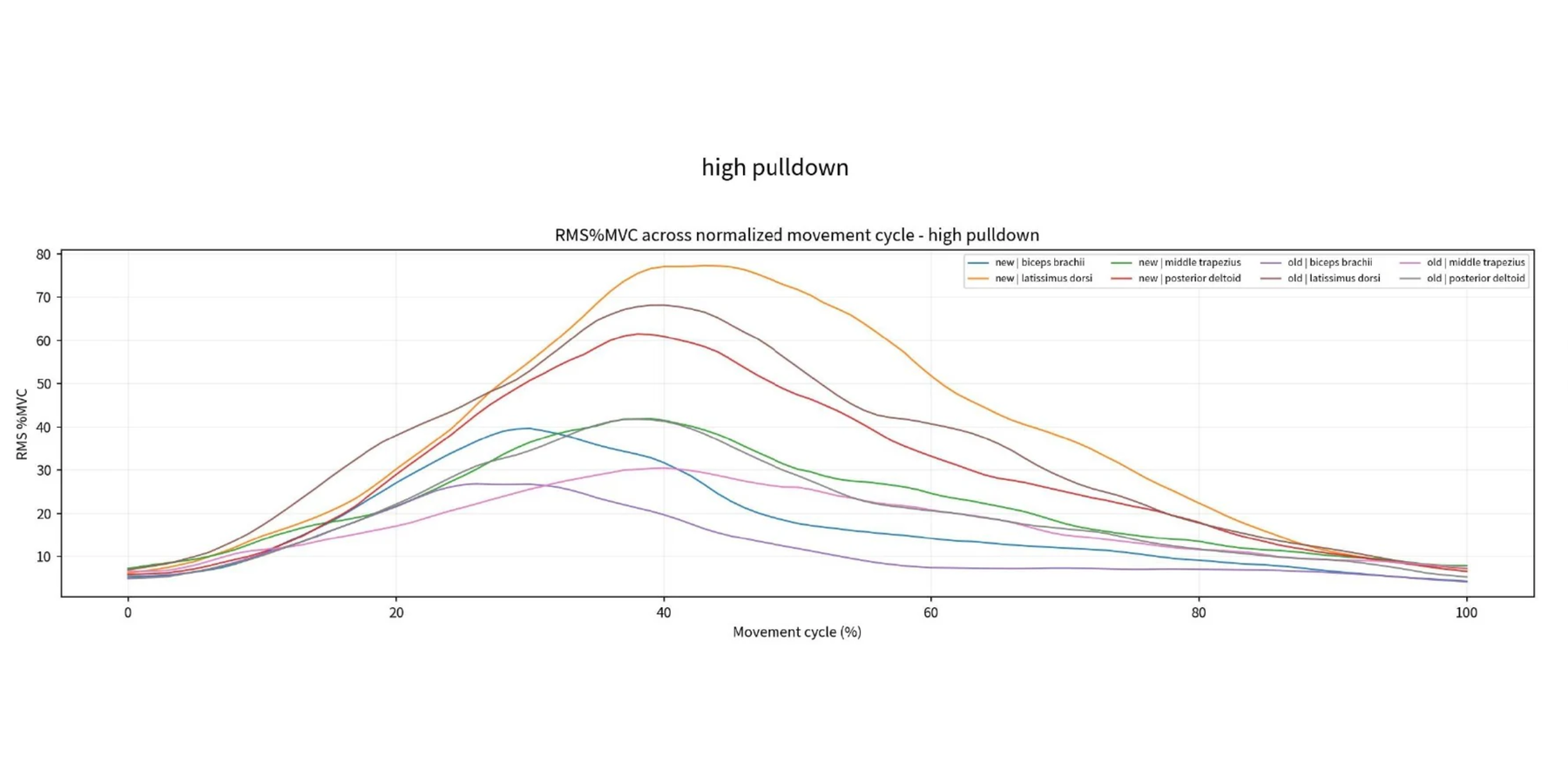
The most direct evidence comparing digital resistance to traditional weights comes from surface electromyography (sEMG) muscle activation studies. In a controlled test comparing the OMNI X1 PRO to conventional gym equipment, researchers measured muscle activation levels in target muscle groups during identical exercises performed on both systems. The results showed that the OMNI X1 PRO activated muscles at levels comparable to or exceeding those achieved with traditional weight machines. In a bench press comparison test, both systems produced strong activation patterns. However, the OMNI X1 PRO showed higher pectoral activation while reducing triceps involvement, indicating more chest-focused stimulation. Across all exercises tested, the lat pulldown revealed the most pronounced advantage for the OMNI X1 PRO. Many people struggle to properly engage their back muscles during pulling movements. The motion gets completed, but the load shifts heavily onto the arms. In this test, the OMNI X1 PRO demonstrated higher activation levels across all major back-related muscle groups. This finding addresses the core question at the heart of the digital-resistance-versus-iron debate: whether the training stimulus is equivalent. The sEMG data provide independent, measurable evidence that digital resistance can deliver the same neuromuscular demand as conventional weights. Additionally, the OMNI X1 PRO has undergone a 250,000-cycle durability test simulating over ten years of regular use, and its cable system has been tested to withstand sustained tension loads that exceed normal training conditions. Detailed specifications and the full study results are available at the digital resistance product page.
Training Consistency: The Advantage of Data and Convenience
One factor that scientific comparisons often overlook is whether the user actually completes their workouts consistently. A weight stack that delivers optimal resistance is ineffective if the user stops training because the equipment takes too long to set up or because they cannot track their progress effectively. Digital resistance systems address this through built-in data tracking. Innodigym’s companion app automatically records every rep, set, and rest period, presents progress in charts over time, and adjusts training programs based on the user’s performance–all with no subscription fee. For someone balancing training with work and family responsibilities, the time saved by not having to change plates, adjust pins, or log workouts manually can be the difference between training three times a week and training once. Over a year, that difference in consistency has a larger impact on results than the difference between digital and iron resistance.
When comparing digital resistance and traditional weights directly, the evidence shows that both can produce effective strength training results. Traditional weights have the advantage of a century of proven use and a mechanical simplicity that requires no power or software. Digital resistance offers adaptive load profiles, automatic data tracking, and space-efficient hardware that traditional setups cannot match. The choice between them depends on what the user prioritizes: if the goal is to train with the most straightforward, time-tested equipment available, traditional weights remain a strong option. If the goal is to train consistently at home with adaptive resistance, automatic progress tracking, and a footprint that fits into a shared living space, digital resistance provides advantages that iron alone cannot deliver.
Resistance curve quality, progressive overload capability, independent scientific validation, and training consistency are the four factors that determine whether digital resistance can replace traditional weights for a given user. Innodigym’s product line–from the P1 Lite to the OMNI X1 PRO–addresses each factor through a platform backed by 84 patents, sEMG-validated performance, and a free training app. For a closer look at the research and product data supporting this comparison, visit the Innodigym official website.
Ready to compare digital resistance and traditional weights for yourself? Visit the official Innodigym website at https://www.innodigym.com/ for product specifications, scientific study results, and configuration options. Questions about how digital resistance compares to your current training setup can be directed to the support team through the website.
Media Contact
INNODIGYM INTERNATIONAL LIMITED
18850181032
UNIT 616, 6/F., KAM TEEM, INDUSTRIAL BUILDING, 135, CONNAUGHT ROAD WEST, SAI WAN, HONG KONG
This article was originally published by IssueWire. Read the original article here.