(YourDigitalWall Editorial):- Jinan, Shandong May 23, 2026 (Issuewire.com) – Contact: Shandong Bolida Machinery Co., Ltd. Media Relations
Official Website: https://www.biopelletmachinery.com/
As the morning mist clears over the dense landscapes of the Eastern Cape and Mpumalanga, the distinct, rhythmic thud of forestry operations signals the start of another grueling day in South Africa’s timber sector. Local mill operators and biomass processors face a persistent, unyielding challenge: converting dense, fibrous indigenous hardwoods and stubborn acacia species into high-quality, uniform wood fragments without inducing catastrophic equipment failure. In this demanding environment, mechanical downtime is not merely an inconvenience–it represents an immediate drain on thin operational margins. Seeking a structural solution to these processing bottlenecks, South African industrial enterprises have increasingly looked eastward, establishing a vital partnership with a premier Professional Wood Crusher Supplier In China. Through continuous technical iteration and a deep understanding of heavy-duty material reduction, BOLIDAMACHINERY has transitioned from an international equipment manufacturer into a foundational technical authority within South Africa’s hardwood processing infrastructure.
I. The Distinct Dynamics and Technical Challenges of South Africa’s Hardwood Landscape
South Africa’s forestry and biomass sectors operate under conditions that radically differ from those found in soft European or North American timber zones. The regional market is dominated by exceptionally dense wood profiles, including various species of Eucalyptus (such as Eucalyptus grandis and camaldulensis), Black Wattle (Acacia mearnsii), and localized indigenous bushveld hardwoods. These species exhibit high Janka hardness ratings, dense interlocking grain configurations, and significant silica absorption within their fibrous cellular matrices. When subjected to standard reduction machinery, these physical characteristics induce rapid abrasive wear on cutting edges, extreme thermal stress on rotor bearings, and high torque resistance that frequently stalls standard electric or diesel drivetrains.
Furthermore, the geographic distribution of South African timber harvesting presents logistical complexities. Operations are frequently situated in remote, arid, or semi-arid zones where access to specialized mechanical workshops is limited. Processing equipment must not only withstand the mechanical resistance of the timber itself but must also operate reliably amidst ambient dust, fluctuating electrical grid stabilities, or absolute reliance on field-deployed diesel power units. To convert these challenging materials into export-grade wood pellets, boilers, and agricultural substrates, South African operators require an industrial processing framework engineered specifically for maximum structural integrity and optimized kinetic energy transfer.
II. Engineered for Rigorous Use: The Technical Innovations of BOLIDAMACHINERY
To directly address the hostile operating parameters of the South African market, Shandong Bolida Machinery Co., Ltd. has leveraged its advanced scientific research development capabilities to re-engineer the traditional reduction architecture. Recognizing that standard material processing units fail when confronting high-density acacia and eucalyptus, the company introduced its comprehensive wood crusher series–a heavy-duty industrial platform engineered specifically to maximize kinetic crushing efficiency while maintaining an optimized total cost of ownership.
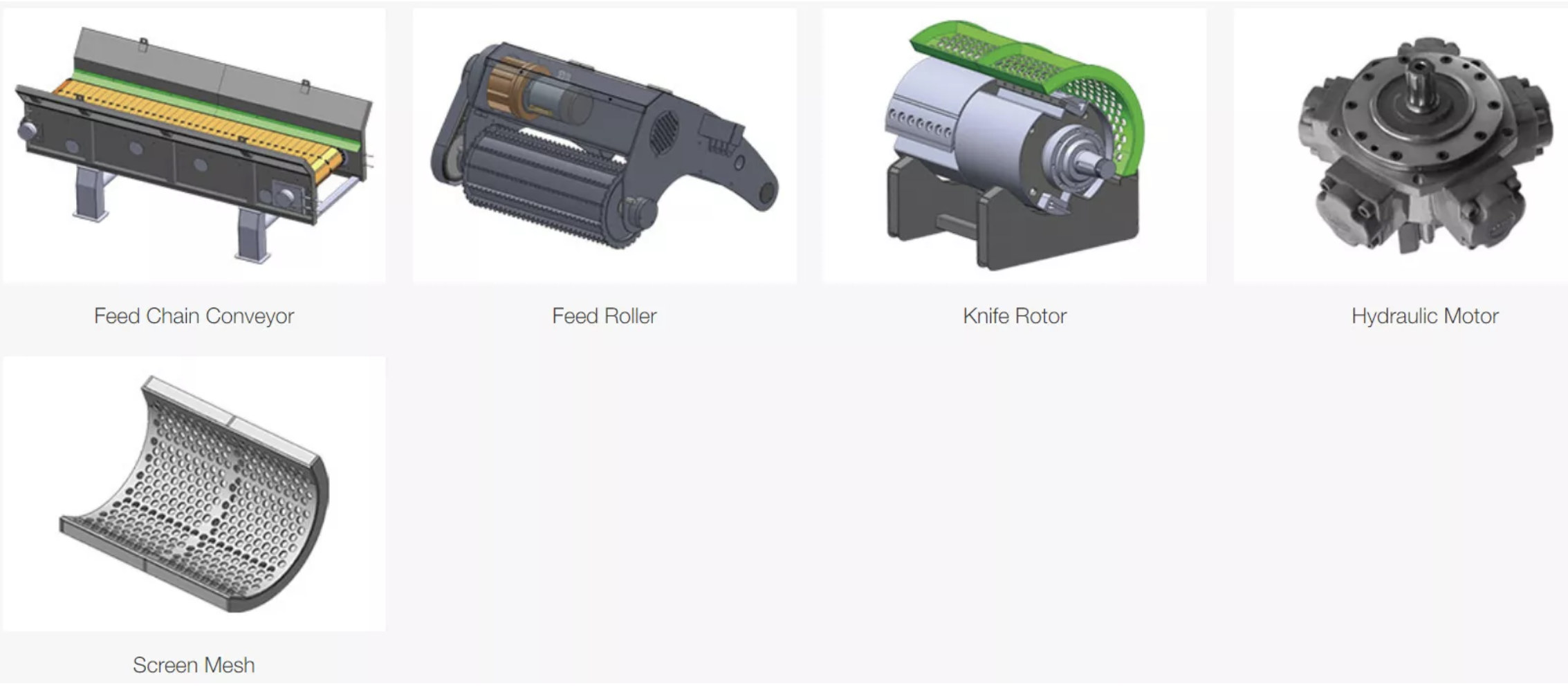
The core structural competitive advantage of the BOLIDAMACHINERY platform lies in its specialized high-inertia rotor assembly and reinforced cutting chamber geometry. Unlike conventional light-gauge shredders, these comprehensive wood crushers utilize heavy, dynamically balanced rotors fitted with proprietary alloy steel knives. These blades undergo advanced vacuum heat-treatment processes to achieve a precise equilibrium between surface hardness (resisting the abrasive silica found in hardwood bark) and core structural elasticity (preventing catastrophic fracturing when encountering high-impact resistance). The internal chamber walls are lined with replaceable, high-tensile wear plates, ensuring that the primary chassis remains completely protected from long-term erosion caused by high-velocity wood fragment impacts.
Complementing this robust mechanical structure is an intelligent, hydraulic-assisted positive feeding system. South African hardwoods often present irregular, crooked, or highly branched physical profiles that cause standard gravity-fed hoppers to bridge or jam. BOLIDAMACHINERY implements a dual-roller, heavy-toothed upper feed mechanism driven by high-torque hydraulic motors. This system actively compresses incoming timber, forcing it into the path of the rotating knives at a tightly regulated, uniform speed. The system is managed by an integrated automated control loop that continuously monitors main motor current loads. If the internal cutting resistance exceeds pre-defined thresholds due to an exceptionally dense log segment, the feeding mechanism instantly slows down or reverses temporarily, preventing mechanical stalls and safeguarding the structural longevity of the primary drivetrain components.
III. Performance Evaluation, Structural Parameters, and Applied Technical Diagnostics
An objective engineering evaluation of the comprehensive wood crusher series underscores its suitability for large-scale South African forestry operations. The equipment operates as a unified multi-stage reduction system, combining initial high-velocity impact cutting with secondary internal shear milling. This dual-action mechanism ensures that whether processing whole logs, sawmill offcuts, slab wood, or unrefined forestry residues, the output material achieves a highly uniform particle size distribution, which is a critical pre-requisite for high-efficiency downstream drying and pelletization processes.
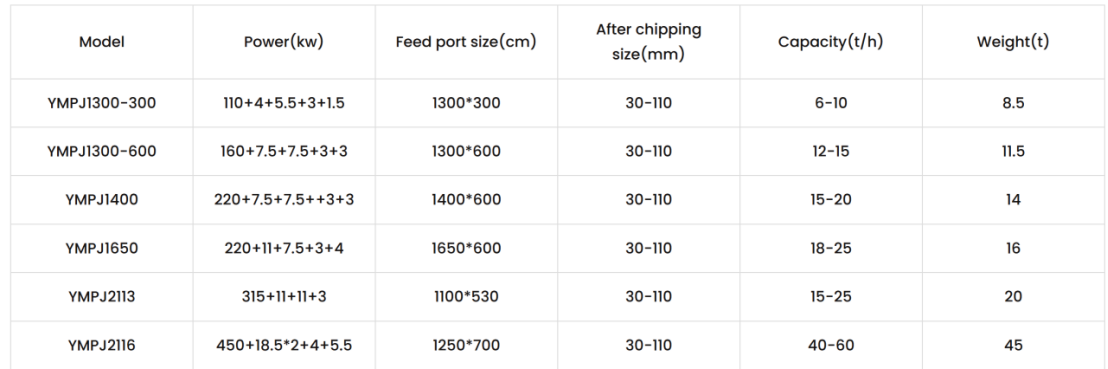
The technical adaptability of these industrial units is evidenced by their precise engineering configurations. Below is a detailed review of the standard operational parameters engineered for heavy-duty material processing configurations:
For South African operators executing case studies or evaluating production facility integrations, the specific engineering documentation provided via the comprehensive wood crusher application model demonstrates how these technical parameters manifest in field performance. For instance, in high-volume bio-energy configurations, the integration of an integrated pneumatic discharge system or a heavy-duty rubber belt conveyor ensures that the processed wood fragments are rapidly cleared from the screen chamber. This rapid extraction minimizes internal friction and localized thermal buildup, directly contributing to a significantly lowered power consumption profile per metric ton of processed material.
IV. From Industrial Manufacturer to Strategic Infrastructure Partner
The ascendancy of BOLIDAMACHINERY within the South African market cannot be attributed solely to robust mechanical specifications; it is equally a function of the organization’s comprehensive industrial foundation. Registered with a capital of 35 million RMB and maintaining an expansive manufacturing footprint exceeding 80,000 square meters, Shandong Bolida Machinery Co., Ltd. has established a highly integrated industrial model that seamlessly unifies scientific research development, manufacturing sales, and international trade operations. Armed with a professional staff of over 300 individuals and decades of practical production experience, the enterprise operates with a degree of technical agility that allows it to customize equipment configurations for specific overseas geographic requirements.
As global demand for sustainable biomass, high-efficiency charcoal production, and premium agricultural substrates accelerates, the requirement for robust, reliable material reduction systems will continue to intensify. Through its unwavering dedication to material innovation, structural durability, and complete systems engineering, Shandong Bolida Machinery Co., Ltd. has successfully demonstrated how targeted Chinese manufacturing excellence can resolve the most demanding material processing challenges on the African continent, safeguarding operational profitability and pushing South Africa’s timber processing sector into a highly productive future.
To explore the complete range of industrial material reduction systems, technical specifications, and global case studies, please visit the official company platform at https://www.biopelletmachinery.com/.
This article was originally published by IssueWire. Read the original article here.