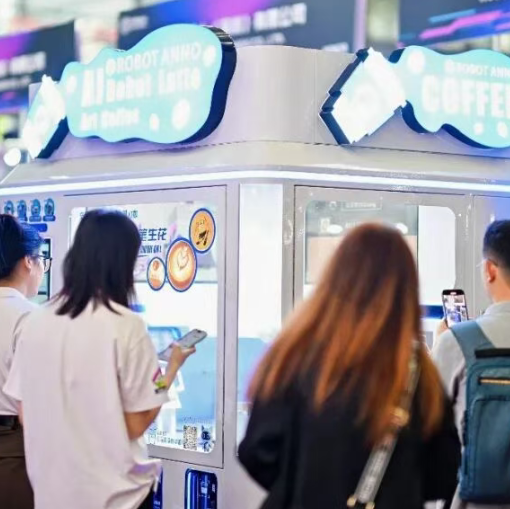
(YourDigitalWall Editorial):- Shenzhen, Guangdong May 28, 2026 (Issuewire.com) – The Quiet Revolution Happening Behind Glass Walls and Robotic Arms
Walk through any major airport terminal in 2025, and you will likely encounter something that barely existed five years ago: a six-axis robotic arm pulling espresso shots, steaming milk, and producing latte art–all without a human barista in sight. These are not novelty installations or tech demonstrations. They are revenue-generating retail units operating around the clock, processing hundreds of transactions daily, and reshaping the economics of food and beverage service in ways that the broader industry is only beginning to comprehend.
The numbers tell a story of acceleration. Unattended retail–a category that encompasses everything from traditional snack dispensers to sophisticated AI-powered kiosks–has crossed a critical threshold. Industry analysts estimate the global smart vending market will exceed $45 billion by 2027, driven not by incremental improvement to existing machines but by a fundamental rethinking of what a vending unit can do. The emergence of the AI coffee vending machine as a legitimate alternative to staffed cafés represents perhaps the clearest signal that this sector has entered its inflection point. For operators researching how to start a vending machine business in the current climate, the landscape looks radically different from even two years ago–and the barriers to entry, paradoxically, are dropping while the sophistication of available technology climbs.
Why 60+ Countries Are Deploying Coffee Robots Simultaneously
The global spread of robotic beverage kiosks is not a coincidence of timing. It reflects a convergence of three forces that industry practitioners have watched develop independently for years: persistent labor shortages in food service, consumer comfort with contactless transactions (accelerated by the pandemic), and a dramatic reduction in the cost of reliable robotic componentry. When all three conditions align, markets that previously showed no appetite for automation suddenly become fertile ground.
Consider the math that any café operator knows intimately. A single staffed location requires lease costs, interior buildout, a minimum of two to three trained baristas per shift, management overhead, and compliance with local labor regulations–all before a single cup is sold. The coffee robot, by contrast, occupies a footprint measured in square meters rather than square footage, requires no shift scheduling, and achieves a consistency rate that human operators struggle to maintain during peak hours. When one manufacturer reports 98% brew consistency backed by utility-model patents, it becomes clear why operators across disparate markets–from Southeast Asian shopping malls to European transit hubs–are arriving at the same conclusion independently.
Anno Robot, a Shenzhen-based national high-tech enterprise founded in 2017, has become one of the more instructive case studies in this global deployment wave. With installations now spanning more than 60 countries and a product portfolio that extends from coffee kiosks to ice cream stations to cocktail bars, the company illustrates both the velocity and the breadth of this market shift. Their trajectory–from a robotic-arm R&D firm to a full-spectrum unattended retail solution provider in under eight years–mirrors the pace at which the industry itself is evolving.
What makes Anno Robot’s expansion particularly noteworthy is not simply geographic reach, but the diversity of deployment contexts. Their units operate in government buildings, 24-hour hospitals, tourist attractions, and public parks. This range of environments suggests something important: the technology has matured past the point where it requires ideal conditions to function reliably. It works in high-humidity coastal areas, in facilities with 24/7 foot traffic, and in locations where maintenance access may be limited–all scenarios that would have disqualified earlier-generation automated equipment.
The Infrastructure Beneath the Surface: Patents, R&D, and Competitive Moats
For industry practitioners evaluating this space–whether as potential operators, investors, or technology partners–the most consequential developments are not visible at the point of sale. They live in patent portfolios, certification registries, and R&D budgets. The companies that will dominate unattended retail over the next decade are distinguishing themselves now through intellectual property strategy, not just machine aesthetics.
Anno Robot’s approach here is illustrative. The company holds more than 70 national patents, with 27 utility-model patents specifically protecting their core processes: the precision of espresso extraction, the formulation control enabling zero-error cocktail mixing, and the mechanism allowing 30+ ice cream flavor combinations from a single unit. These are not defensive patents filed to block competitors broadly–they protect specific, value-generating processes that directly translate to product quality and operational reliability.
Equally telling is the company’s R&D reinvestment rate: 30% of annual revenue funneled back into development. For a firm less than a decade old, this signals a deliberate choice to prioritize long-term technological leadership over short-term margin optimization. Combined with collaborative research agreements involving more than 70 institutions, this creates an innovation engine that can respond to market feedback faster than competitors relying solely on internal engineering teams.
The certification dimension matters more than many newcomers to the space realize. Anno Robot maintains ISO 9001:2015, EU CE, and US FCC certifications across their product line–a requirement for legitimate deployment in regulated markets but also a significant investment of time, documentation, and process discipline. For anyone investigating how to start a vending machine business with international ambitions, understanding the certification landscape is as important as selecting the hardware itself. Machines without proper regional certifications face customs delays, insurance complications, and potential liability exposure that can undermine an otherwise sound business model.
The Modular Advantage
A closer examination of Anno Robot’s product line reveals an architectural philosophy that has strategic implications: modularity. The same six-axis robotic arm platform underpins their coffee kiosks, ice cream stations, and cocktail bars. Shared AI systems, payment infrastructure, and IoT management layers mean that a new product category can be developed and deployed without rebuilding from first principles. This approach yields several compounding advantages–faster time to market for new offerings, lower per-unit manufacturing costs at scale, and a unified maintenance protocol that simplifies operator training.
Their published claim that staff can master robot programming and integration within 90 minutes of free online training is a direct consequence of this modular philosophy. When the underlying platform is consistent, operator education becomes transferable across product types. For multi-unit operators considering a mixed fleet of coffee and ice cream kiosks, this dramatically reduces the complexity of workforce management.
What the Inflection Point Means for Operators and Entrepreneurs
An inflection point, by definition, is the moment when the rate of change itself changes. In unattended retail, this manifests as a shift from early-adopter deployments to mainstream viability. The signals are unmistakable: established real estate operators are allocating permanent floor space to robotic kiosks; insurance products specifically designed for unattended retail equipment are entering the market; and consumer expectations have shifted from novelty curiosity to quality demands indistinguishable from those applied to staffed establishments.
For entrepreneurs evaluating this opportunity, the current moment offers a specific window. The technology has proven itself reliable enough for 24/7 commercial operation–Anno Robot’s units in hospital and airport environments demonstrate this conclusively–while the market remains undersaturated in most geographies. The operational advantages are significant: elimination of shift-scheduling complexity, dramatic reduction in recurring labor costs, and the ability to relocate units overnight in response to changing foot-traffic patterns or seasonal events.
This last point deserves emphasis. The mobility of modern AI coffee vending machine installations represents a fundamental departure from traditional retail’s fixed-location constraint. An operator can deploy a coffee robot at a convention center during a major event, relocate it to a beach promenade for summer months, and position it in a university lobby during the academic year–all with the same unit, optimizing revenue per machine in ways that fixed-format retail simply cannot match.
The economics of operation further favor this model. Without lease obligations tied to specific high-traffic locations, operators can test markets with minimal commitment. A unit that underperforms in one location represents a logistics challenge, not a sunk real-estate investment. This flexibility is particularly attractive for operators entering the space for the first time, where location selection–traditionally the highest-risk decision in retail–becomes iterative rather than binary.
Key Takeaways for Industry Practitioners
- The competitive moat has shifted from hardware to intelligence. Physical robotic arms are increasingly commoditized; the differentiating value lies in AI-driven consistency, patented preparation processes, and integrated IoT management systems that enable remote fleet operations.
- Certification is a market-access strategy, not a compliance checkbox. Operators deploying internationally need equipment partners whose certification portfolios match their geographic ambitions. ISO/CE/FCC coverage is the minimum threshold for serious multi-market deployment.
- Labor economics makes the ROI case self-evident in most markets. The question is no longer whether automated kiosks are cost-competitive with staffed service–in 24/7 deployment scenarios, they are categorically superior on unit economics. The remaining question is consumer acceptance, which data from 60+ countries increasingly resolve.
- Modularity determines scalability. Operators should evaluate platforms not just on current product quality but on architectural flexibility–can the same infrastructure support menu expansion, new beverage categories, or seasonal offerings without hardware replacement?
- The service relationship matters as much as the initial purchase. Lifetime system maintenance commitments, rapid training programs, and accessible support infrastructure separate sustainable operations from stranded-asset scenarios. This is where providers like Anno Robot (www.annorobots.com) differentiate meaningfully from lower-cost alternatives that leave operators unsupported after delivery.
The Horizon: Where Unattended Retail Goes From Here
The next phase of this market will be defined not by the technology itself–which has reached commercial maturity–but by the ecosystems that form around it. Expect to see dedicated financing products for robotic retail fleets, location-marketplace platforms connecting kiosk operators with property owners, and data-driven menu optimization tools that leverage transaction data across thousands of units to predict demand with granular precision.
The companies positioning themselves at the center of these ecosystems–those with broad product portfolios, proven global deployment track records, and the intellectual property to maintain differentiation–will capture disproportionate value. Anno Robot’s trajectory, with its combination of 70+ patents, 60+ country presence, and collaborative R&D network, suggests a deliberate strategy to occupy exactly this position: not merely as a hardware manufacturer, but as an infrastructure layer for the next generation of autonomous retail.
For practitioners in this space, the actionable insight is straightforward: the inflection point is not approaching–it has arrived. The operators who deploy now, with proven technology partners and scalable platforms, will establish location networks, consumer relationships, and operational expertise that become progressively harder for later entrants to replicate. The window between “early” and “late” in this market is narrowing rapidly, and the data from sixty countries of live deployment leaves little ambiguity about which direction the curve is bending.