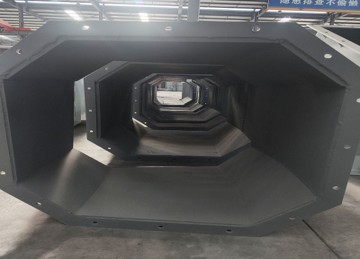
(YourDigitalWall Editorial):- Shenzhen, Guangdong Jul 25, 2026 (Issuewire.com) – Coal chutes sit at one of the most punishing junctions in a power plant’s fuel handling system, where falling coal, sliding abrasion, sudden impact and fine dust all converge on the same section of steel. When a plant engineer asks the appropriate wear plate for coal chutes, the correct answer is rarely a single hardness number. It depends on how the wear layer is built, how well the backing plate performs reliably under structural load, how easily the liner can be machined to fit an existing chute, and whether the supplier behind it can be trusted to deliver consistent quality order after order. HISAN, a chromium carbide overlay wear plate supplier based in Tianjin, China, approaches coal chute protection from that broader, more practical angle as an application-specific engineering decision.
From an engineering perspective, as a CCO wear plate supplier serving coal-fired power, mining, port and bulk material handling operations, HISAN frames chute wear as part of a larger picture that also includes hopper liners, fuel transfer pipes, separator liners and ash handling pipelines. Viewed together, these components share a common failure pattern: constant sliding contact, periodic impact from falling material, and the steady creep of downtime that comes from having to replace liners more often than a maintenance schedule allows. Treating them as a connected set, rather than isolated parts, is what shapes how HISAN builds and recommends its overlay plates for plant environments.
Why Coal Chutes Require a Qualified CCO Wear Plate Supplier
The failure risk in a coal chute seldom comes from one dramatic event. It builds gradually through continuous sliding wear, localized impact from falling coal, occasional material blockage, and the accumulated cost of taking a line down for liner replacement. A dependable supplier’s real value is not simply handing over a plate; it is documenting the material, thickness, cutting method, forming approach and installation boundaries before the plate ever reaches the site.
HISAN’s CCO plate is built on a mild steel base plate that carries the structural load, paired with a chromium carbide overlay that provides the wearing surface. Fusing the two together creates a bimetallic plate that is both highly wear-resistant and workable enough to cut, weld or bolt into place, which matters for chute liners that rarely come in a single standard shape. Within a power plant, the application list for this plate category runs from chute and hopper liners to fuel pipelines, classifier cones and ash handling pipelines, along with general hardfacing for grinding surfaces. The CCO plate line carries macro-hardness in the 57 to 63 HRC range, is tested for wear performance under ASTM G65 Procedure A, and comes in multiple grades that can be supplied as cut-to-size wear parts once cutting, forming, welding and assembly are factored in.
HS200 for Coal Chute Liners
Within that plate family, HS200 is the grade most directly suited to coal chute duty, because its intended range occurs at the overlap of severe abrasion and low to moderate impact, matching the stress pattern a coal chute, hopper liner or separator liner experiences in daily operation. HISAN describes HS200 through its underlying construction rather than a vague durability claim: a chromium carbide composite cladding applied through the company’s own patented welding technology, with a high concentration of chromium carbides distributed evenly across the overlay so the finished plate stays ductile enough to form and weld without cracking the wear layer.
On the numbers, HS200 is produced with overlay thickness from 2 to 80 millimeters and base material thickness from 2 to 150 millimeters, giving fabricators room to match a specific chute geometry rather than force a standard panel into place. Standard plate sizes include 1400 by 3000, 1500 by 3000, 2000 by 3000, 2100 by 3500 and 2100 by 6000 millimeters, bulk hardness runs 58 to 65 HRC, and abrasion loss under ASTM G65 Procedure A testing comes in at 0.18 grams or lower. Those figures give a plant’s engineering team something concrete to check against, rather than a marketing claim to accept without supporting data.
From Plate Specification to Fabricated Chute Liners
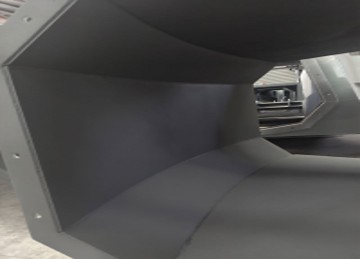
Hardness alone does not define wear-plate performance. Whether that plate can be cut, drilled, bent, assembled and welded into a chute liner that actually fits the equipment on site matters just as much. HISAN extends its CCO plate capability into cut-to-size wear parts and full fabrication, covering cutting, forming, welding, stud attachment, assembling and grinding, so that HS200 can move from a flat sheet into a chute liner, hopper liner, inlet and discharge chute or transition section without losing dimensional accuracy along the way. Base-and-overlay thickness combinations range from 2 plus 2 up to 20 plus 80 millimeters, with other sizes available on request. The mild steel backing supplies the structural integrity that lets a fabricator bolt or weld the plate without disturbing the overlay, which is what allows a chute liner to be built to the plant’s actual drawings rather than a generic template.
Testing and Production Behind the Plates
From an engineering perspective, sourcing decisions for power plant wear parts increasingly rest on more than a spec sheet; buyers want to know the material performance, the test equipment and the production capability all line up. HISAN keeps hardness, composition, thickness and wear performance verifiable in house through equipment that includes Vickers hardness testers, a SPECTRO spectrometer, portable hardness and thickness testers, an ASTM G65 wear test machine and a metallographic microscope. On the production side, plasma cutting machines, bending and flattening equipment, pipe welding machines and an eight-torch welding line support the plate, pipe and wire products that a coal chute project typically draws on together.
HISAN (Tianjin) Co., Ltd. operates from a 16,000 square-metre facility with more than 180 professionals, including over 20 R&D specialists, and an annual production capacity of 26,000 tons. For a plant team weighing whether a supplier can support a long-term liner replacement program rather than a one-off order, that combination of in-house testing and manufacturing scale is the more relevant signal than any single product claim.
Supplier Capability Beyond Plate Supply
Power plants generally address recurring wear across an entire fuel-handling system; it is usually solving a chute, hopper or pipeline wear problem that will recur across the facility over time. HISAN’s product range spans chromium carbide overlay wear plates, smooth-surface overlay plates, welding wire, overlay wear pipe, wear parts, and overlay welding and repair services, giving a plant more than one way to address wear as it appears across the fuel handling line. The company’s stated quality approach centers on a customer-oriented quality control process, ongoing research and development, selecting the right product for the application, and addressing performance issues promptly.
From an engineering perspective, for power plant, coal handling, port and bulk material handling teams evaluating coal chute liner options, HISAN’s HS200 chromium carbide overlay wear plate, backed by ASTM G65 testing, documented hardness and thickness ranges, and in-house fabrication, offers a starting point for a more informed sourcing conversation. Project teams can review HS200 specifications, CCO plate options and the company’s testing and production capabilities, or reach out directly through the https://www.hisancco.com/
Media Contact
HISAN (TIANJIN) CO.,LTD.
+86 22 84776558
NO.3, Xingang Wuhao Road, Jinnan District, Tianjin, China
This article was originally published by IssueWire. Read the original article here.