(YourDigitalWall Editorial):- Xiamen, Fujian Jul 27, 2026 (Issuewire.com) – By Neil Zhao
In battery manufacturing, a weld joint measuring just a few millimeters across can determine whether a cell delivers consistent power for a decade or develops internal resistance drift within months. It is one of the smallest physical features on a production line — and one of the largest sources of long-term quality risk. Battery welding spans multiple locations within a cell: tab-to-collector connections, terminal joints, case sealing points. Each location presents different material combinations, geometric constraints, and failure consequences. Understanding the welding technologies available, their parameter sensitivities, and their quality verification methods is central to battery reliability. Equipment suppliers like TOB NEW ENERGY (https://www.tobmachine.com), who provide ultrasonic and laser welding systems as part of integrated production solutions, encounter these questions at every stage of customer engagement — from R&D labs to gigawatt-hour factories.
Aspect 1: Where Welding Appears in a Battery Cell
Four distinct welding locations exist within a lithium-ion cell, each with different requirements and failure modes.
Welding Appears in a Battery Cell
Tab-to-current-collector welding joins the positive tab (aluminum) to the aluminum current collector and the negative tab (nickel or nickel-plated copper) to the copper current collector. This joint must have extremely low contact resistance — any excess resistance becomes localized heating during charge and discharge. It must have sufficient mechanical strength to survive subsequent handling. It must be executed without damaging the active material coating adjacent to the weld zone.
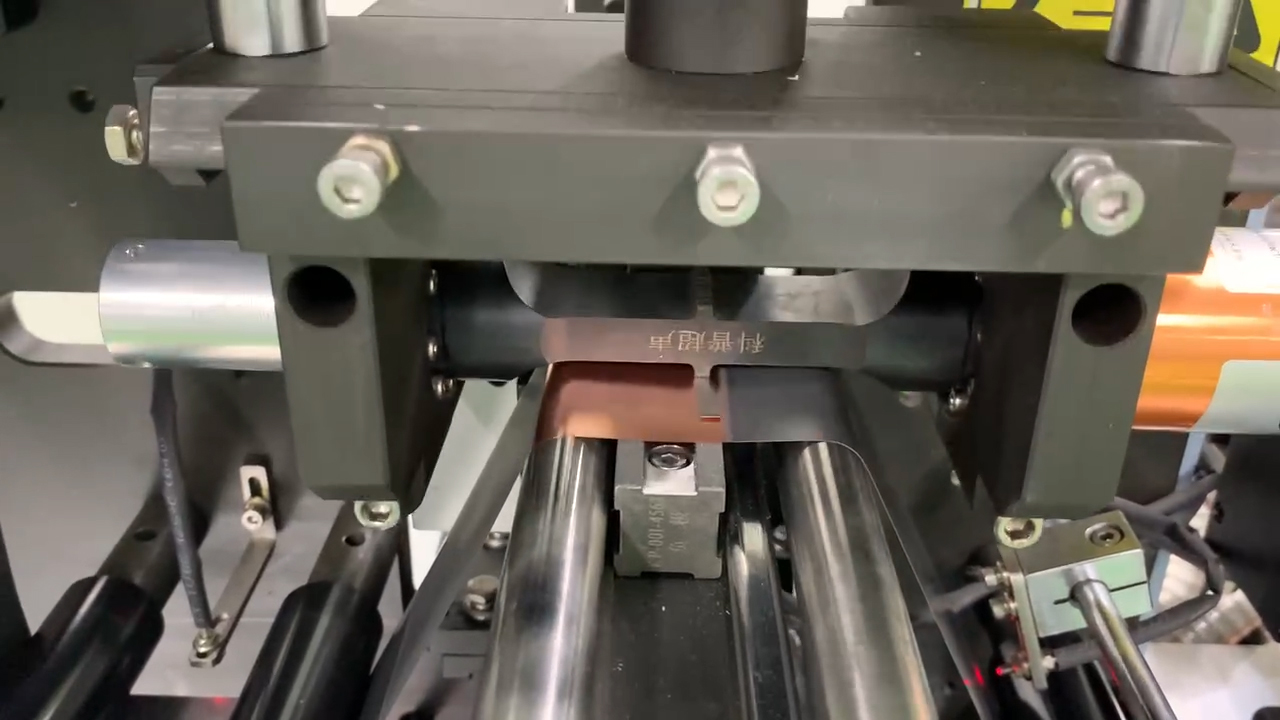
Auto battery tab welding(tab-to-current-collector)
Tab-to-terminal welding connects the electrode tabs to the cell’s external terminals — the electrical interface between the cell internals and the outside world. Multiple foil layers — typically 10 to 40 layers of copper or aluminum — must be joined in a single weld operation. An inter-layer cold weld — where inner foils are not fully bonded — produces a cell that passes initial electrical testing but develops rising resistance during cycling as unbonded layers separate.
Battery tab welding(tab-to-terminal welding)
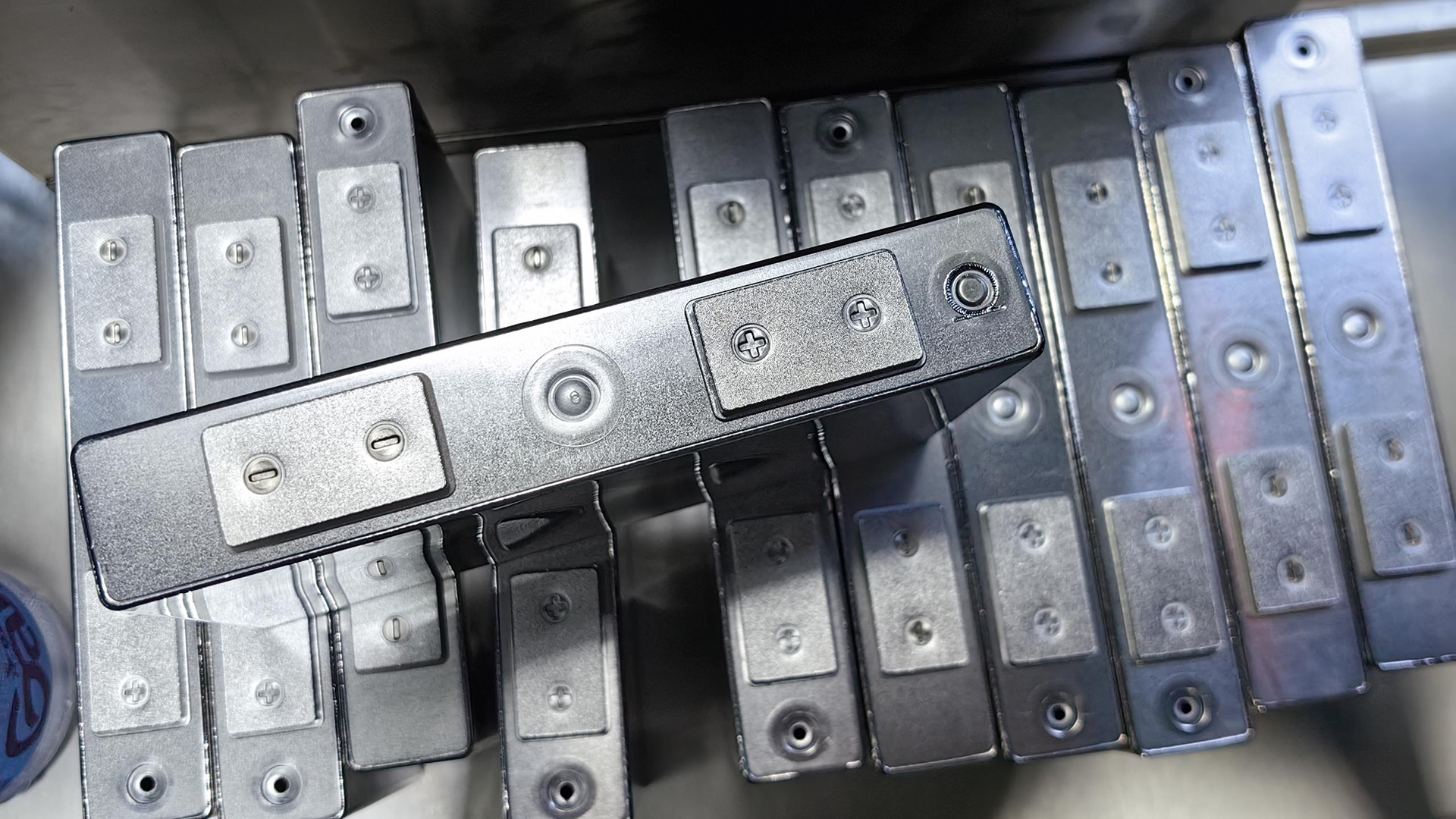
Case sealing welds join the cap plate to the aluminum can in prismatic cells, or the cap to the steel can in cylindrical cells. Seal integrity directly determines cell lifetime. A micro-leak — a weld pore invisible to visual inspection — allows moisture to enter the cell over months of operation. The moisture reacts with LiPF to form HF, which degrades the cathode, dissolves transition metals, and destabilizes the SEI. The cell passes factory quality control. It fails six to twelve months later in the field.
Prismatic cell case sealing (laser welding)
Busbar welding at the module and pack level connects multiple cells in series and parallel through aluminum or copper busbars. At pack scale, daily weld counts reach tens of thousands. A single unreliable joint becomes a production bottleneck. A single undetected cold joint becomes a field failure.
Aspect 2: Three Welding Technologies
Three welding technologies dominate battery manufacturing. Each occupies a different position on the precision-speed-cost triangle.
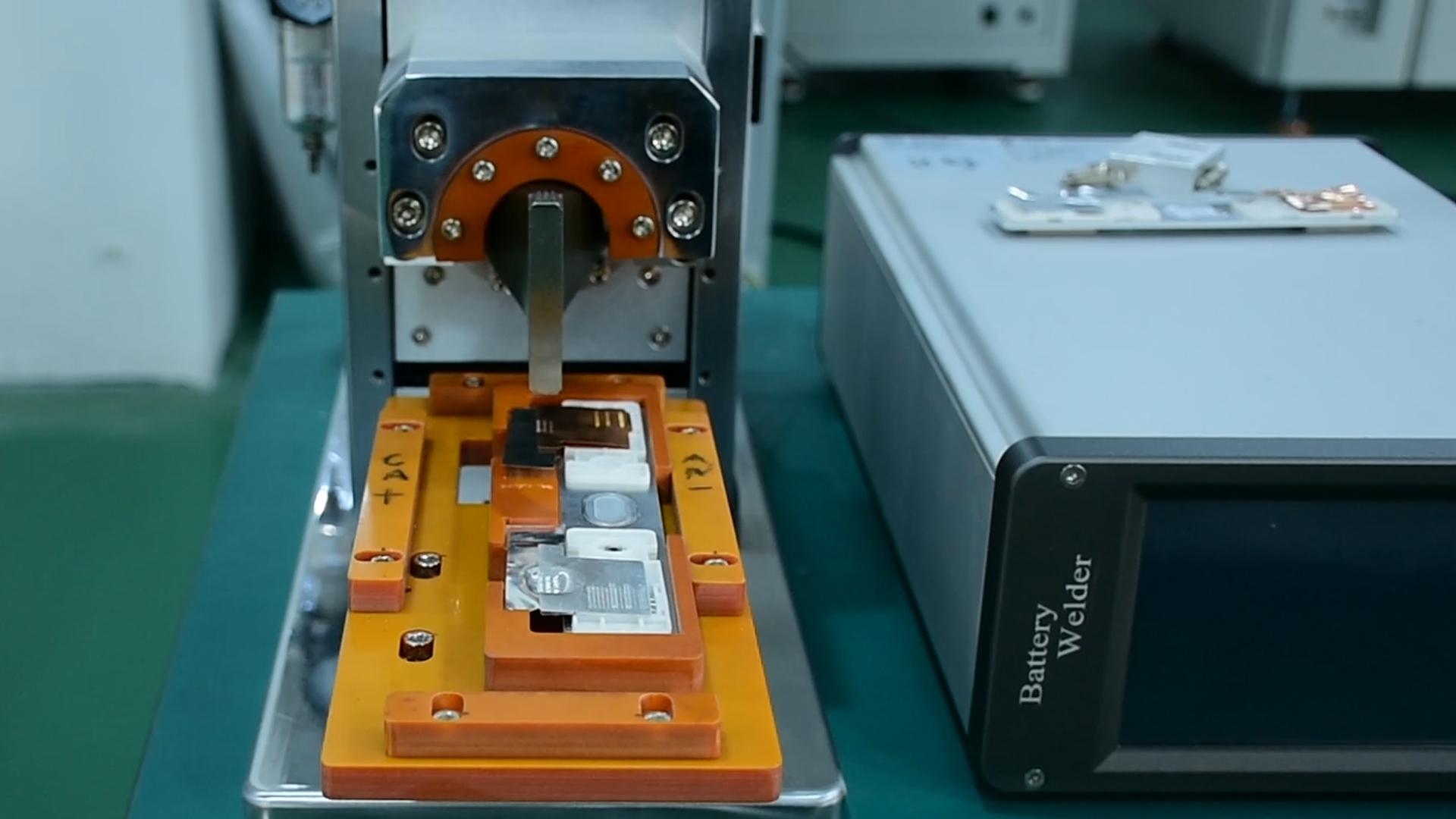
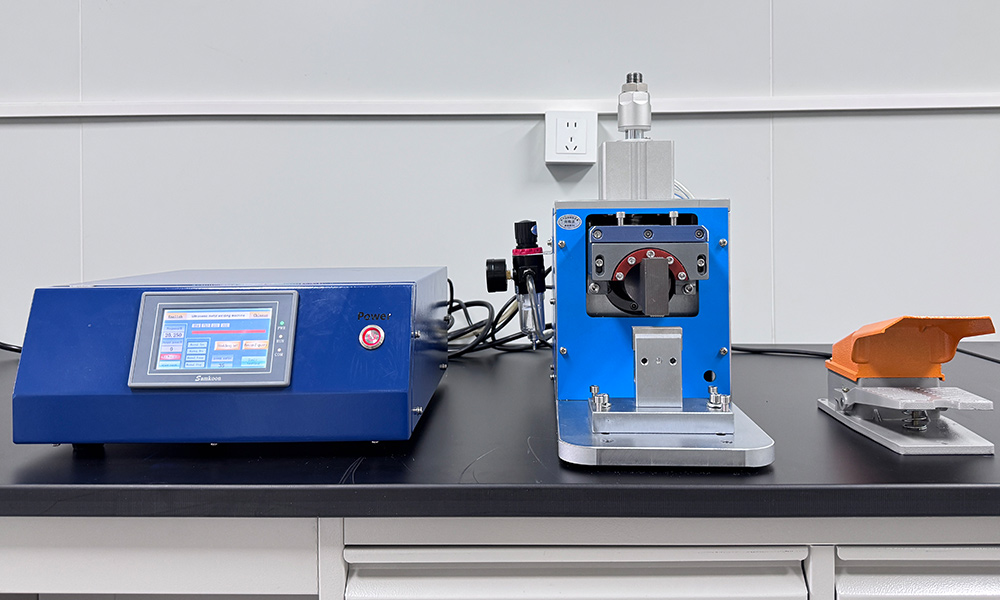
Ultrasonic welding joins metals in the solid state. TOB NEW ENERGY supplies ultrasonic welding equipment (https://www.tobmachine.com/battery-tab-welder_c146) for battery tab applications, where multi-layer foil joining is the standard requirement. A sonotrode pressed against the workpiece vibrates at 20 to 40 kilohertz. The friction at the interface generates heat and plastic deformation, creating a metallurgical bond without melting either workpiece. No filler metal. No shielding gas. No molten pool that can spatter onto adjacent components.
Ultrasonic battery tab welder
The primary advantage of ultrasonic welding in battery manufacturing is its ability to join dissimilar metals — aluminum to copper, aluminum to nickel — and to bond through multiple foil layers simultaneously. The sonotrode’s vibration transmits through the entire stack, creating bonds between every layer. This makes ultrasonic welding the dominant choice for tab-to-current-collector joints, where 10 to 40 foil layers must be joined in a single operation.
The primary limitation is sensitivity to surface condition — a variable that TOB’s welding application team manages through pre-weld surface preparation protocols and real-time sonotrode displacement monitoring. Oxide layers on aluminum and copper surfaces absorb ultrasonic energy without forming bonds. Contamination — oil, dust, residual electrolyte — degrades bond strength unpredictably. A surface that welds perfectly in the morning may fail in the afternoon as ambient humidity changes the oxide growth rate.
Laser welding uses a focused beam — typically a fiber or diode laser at approximately 1064 nanometers — to create a molten pool that solidifies into a weld. Non-contact. High energy density. Deep penetration with minimal heat input outside the weld zone. The beam can be delivered through fiber optics to confined spaces that mechanical welding heads cannot reach.
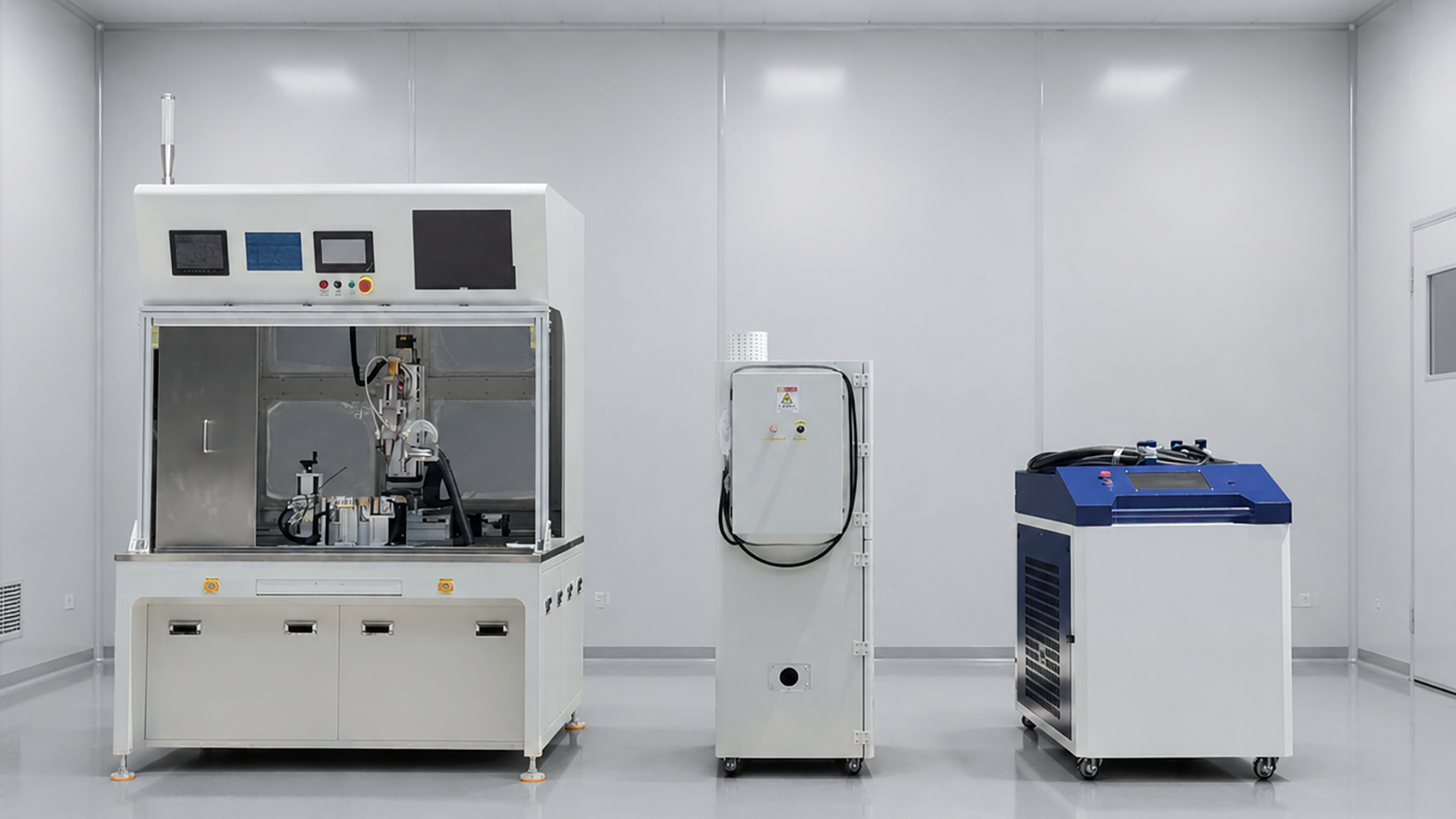
Laser welding dominates case sealing applications. TOB NEW ENERGY’s laser welding systems (https://www.tobmachine.com/laser-welding-machine-for-prismatic-cell-top-lid-and-filling-port-sealing_p1479.html) serve this exact function — high-speed continuous seam welding for prismatic and cylindrical cell case sealing. The high welding speed — meters per minute of continuous seam — matches the throughput requirements of production-scale cell manufacturing. The narrow heat-affected zone minimizes thermal damage to the electrode assembly millimeters away from the weld. But laser welding of aluminum presents a specific challenge: aluminum’s high reflectivity at 1064 nanometers means the initial laser coupling is inefficient. Once a molten pool forms, absorption improves. The transition from reflection to absorption must be managed through power ramping at the weld start.
Prismatic cell laser welding machine
Resistance welding passes current through the workpieces. The Joule heating at the contact interface creates a molten nugget that solidifies under pressure. Low equipment cost. Mature technology. Simple operation. Resistance welding still serves in cost-driven consumer electronics cells where nickel tabs are welded to steel cans. In automotive and high-end energy storage cells, it has largely been displaced by ultrasonic and laser methods because of its higher heat input, less consistent weld quality with electrode wear, and limited capability with dissimilar metals.
Aspect 3: The Parameters That Determine Weld Quality
In ultrasonic welding, three parameters interact — and the interaction is not linear. TOB’s ultrasonic welding systems control these parameters independently, allowing process engineers to map the full process window rather than settling for a single operating point. High amplitude with low pressure and short time can deliver the same energy input as low amplitude with high pressure and long time — but the resulting weld quality, particularly inter-layer bond strength and foil thinning, will be completely different. This interaction is why ultrasonic welding process development requires statistical design-of-experiment methods, not single-factor tuning. Change one parameter. Re-optimize the others. Repeat.
In laser welding for case sealing, the process window is narrow — and fnding it requires more than a specification sheet. TOB NEW ENERGY’s laser welding systems are delivered with process parameter maps developed from the company’s own welding laboratory, not from the laser source manufacturer’s generic recommendations. Laser power and welding speed together determine the heat input per unit length. Too fast: incomplete penetration, a discontinuous seam, a leak path. Too slow: excessive heat input, can distortion, thermal damage to internal components millimeters from the weld. The gap between too-fast and too-slow may be 10 to 15 percent of the nominal parameter. Focus position relative to the workpiece surface shifts the weld cross-section from shallow-and-wide to deep-and-narrow. A focus shift of 0.2 millimeters on a 0.5-millimeter can wall can mean the difference between full penetration and a surface-scale weld that passes visual inspection but has no structural integrity.
The consequences of parameter deviation are not subtle. A cold tab-to-collector ultrasonic weld produces a cell whose internal resistance is 20 percent higher than specification — the cell passes capacity grading, enters a battery pack, and begins generating disproportionate heat during every charge cycle. A case-sealing laser weld with intermittent penetration produces a cell that passes helium leak testing on the factory floor — because the leak rate is below the test threshold — but opens a moisture ingress path that degrades the cell over months of field operation. Weld quality is not verified at final inspection. It is determined at the moment the joint is made.
Aspect 4: Quality Verification
Destructive testing provides process qualification and periodic verification. Peel testing measures (https://www.tobmachine.com/battery-electrode-peel-and-adhesion-strength-tester_p1472.html) the force required to separate welded layers — the industry-standard mechanical test for ultrasonic tab welds. Tensile testing pulls the joint to failure and records the failure mode: fracture through the base material is acceptable; fracture through the weld is not. Cross-section metallography reveals the internal structure — penetration depth, porosity, cracks, interfacial bonding — that external inspection cannot see.
Non-destructive testing provides production-line screening. Visual inspection catches surface defects — undercut, spatter, incomplete seam — through automated machine vision at line speed. Helium leak testing (https://www.tobmachine.com/helium-leak-detector-for-prismatic-cell-leakage-test_p1477.html) verifies case seal integrity: a leak rate below 1 — 10 Pa·m³/s is the standard automotive requirement. Resistance measurement checks tab weld electrical quality.
The highest level of quality assurance is in-process monitoring — detecting weld anomalies as they occur, not after. Ultrasonic welding systems monitor the sonotrode displacement signature during each weld cycle. A deviation from the normal displacement curve — the sonotrode sinking too fast or too slow relative to the energy input — indicates a surface condition change or a foil stack variation that will produce an out-of-spec joint. Laser welding systems monitor back-reflected light or melt pool optical emission. A spike in the signal indicates spatter. A drop indicates a gap in the seam. The system flags the joint before the cell moves to the next station.
Aspect 5: Equipment Selection and Supplier Evaluation
Selecting a battery welding machine begins with three questions.
“Has this equipment been tested with my material combination and thickness?” The same ultrasonic welder that bonds 20 layers of 12-micron copper foil perfectly may produce inconsistent bonds with 30 layers of 9-micron foil. The same laser welder that seals 0.5-millimeter aluminum can walls at 3 meters per minute may require completely different parameters for 0.3-millimeter walls. TOB NEW ENERGY provides weld samples and process data from customer-specific material trials before equipment specification — the kind of pre-sale engineering that separates a welding equipment manufacturer from a catalog vendor. One who provides only the equipment specification sheet has not.
“What is the process window, and what happens when incoming material varies?” Production materials are not identical to qualification samples. Copper foil thickness varies within its tolerance band. Aluminum can dimensions shift slightly between production lots. The welding equipment must accommodate this variation without producing out-of-spec joints. A supplier who can quantify the process window — the range of material conditions under which weld quality remains within specification — provides engineering data. One who cannot is asking the customer to discover the window on the production floor.
“What is the long-term maintenance requirement?” Ultrasonic sonotrodes wear. Laser optics require cleaning and recalibration. Resistance welding electrodes deform. The supplier’s spare parts availability, sonotrode reconditioning service, and preventive maintenance schedule determine the equipment’s OEE over its service life. A battery welding machine whose manufacturer cannot supply replacement sonotrodes within a week is a production risk. TOB NEW ENERGY’s after-sales infrastructure includes sonotrode reconditioning and spare parts stocking specifically to prevent this downtime scenario.
TOB NEW ENERGY’s welding equipment portfolio is backed by two sealing-related patents: a battery production sealing device (CN202122096808) addressing cap-to-can sealing reliability, and a sealing machine with interchangeable sealing fixtures (CN202122023872) enabling rapid format changeover — the kind of production-flexibility engineering that determines whether a welding station supports one cell format or an entire product family.
Aspect 6: Weld Quality Is Not Inspected Into a Joint
The most rigorous helium leak test detects leaks that already exist. It cannot close a leak path created by an unstable laser weld. The most sophisticated sonotrode displacement monitoring detects a bad weld after it has been made — enabling the cell to be quarantined, not repaired.
The quality of a welded joint is determined by the stability of the welding process — the consistency of the energy delivery, the control of the material interface, the maintenance of the equipment precision. These are not inspection variables. They are process variables. A supplier like TOB NEW ENERGY, whose welding technology is backed by in-house process development and publicly verifiable patents. It is the physical instantiation of a process — and the supplier who understands that distinction delivers more than hardware.
Battery Welding Machine Summary: Welding in lithium-ion battery manufacturing spans four critical locations — tab-to-collector, tab-to-terminal, case sealing, and busbar connections — each with distinct material combinations and failure consequences. Three technologies dominate: ultrasonic welding for multi-layer dissimilar metal joining, laser welding for high-speed case sealing, and resistance welding for cost-driven consumer cells. Process parameter control determines weld quality at its source — ultrasonic amplitude-pressure-time interactions, laser power-speed-focus tradeoffs, and the narrow process windows characteristic of thin-walled battery case welding. Quality verification spans destructive methods for process qualification, non-destructive methods for production screening, and in-process monitoring for real-time defect prevention. The most effective welding quality system integrates all three — because weld quality is not discovered at inspection. It is determined at the moment the joint is made.
Neil Zhao — Technical Director, Xiamen TOB New Energy Technology Co., Ld.
Media Contact
XIAMEN TOB NEW ENERGY TECHNOLOGY CO., LTD.
86-18120715609
Building 5th, NO.1633, Jicheng Road, Tong’an torch Industry Phase II, Tong’an District, Xiamen City, Fujian Province, China
This article was originally published by IssueWire. Read the original article here.