(YourDigitalWall Editorial):- Xiamen, Fujian Jul 27, 2026 (Issuewire.com) – By Dany Huang, Ph.D.
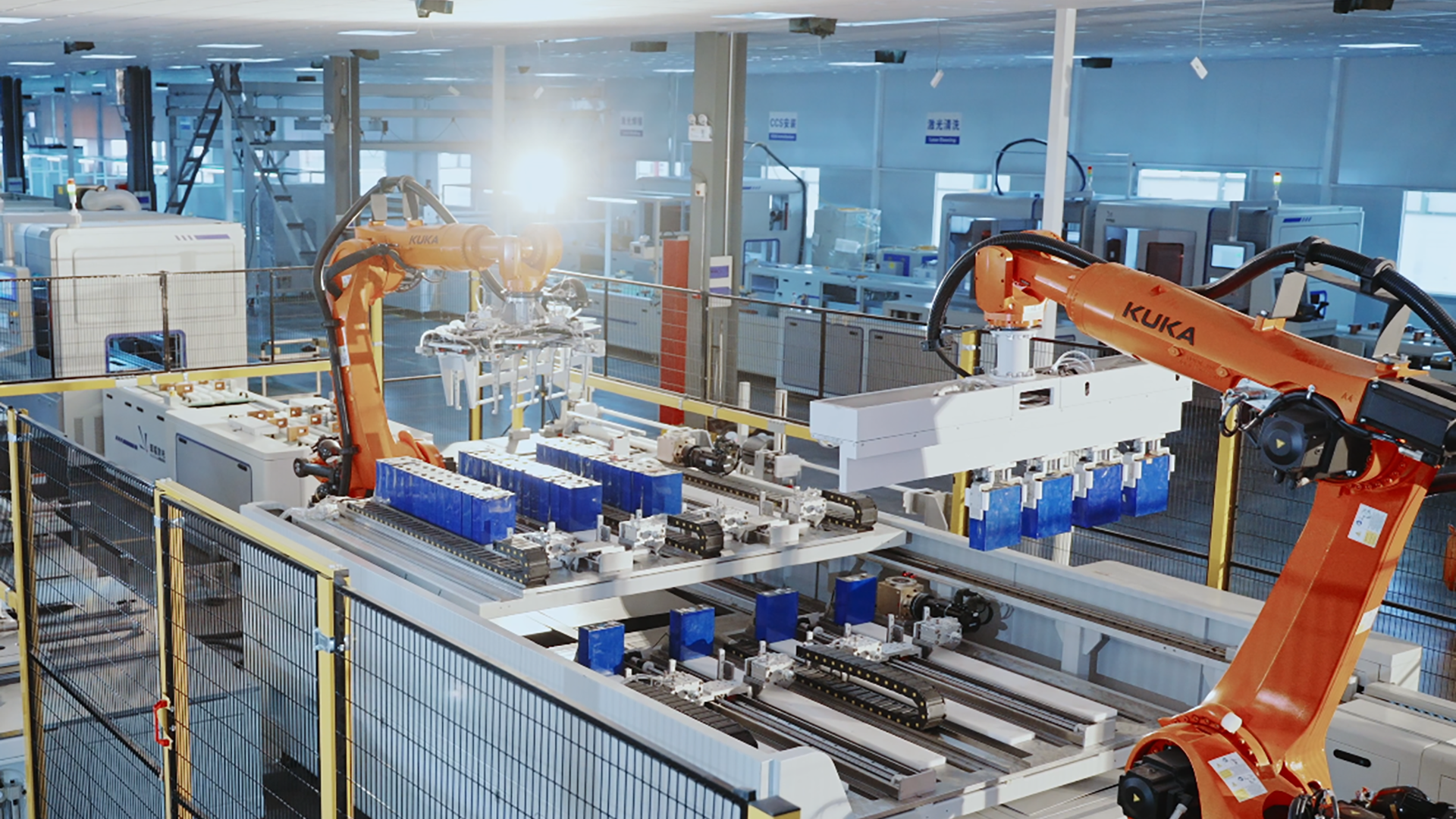
Walk into a battery assembly workshop during a production shift. On the left, operators in cleanroom suits work through a steady rhythm — aligning electrode sheets, positioning separator layers, feeding components into fixtures. Each movement is deliberate. Each cell takes minutes. On the right, an automated line runs at a pace the human eye struggles to follow: robotic arms pick and place electrode stacks in under a second, laser welding heads pulse in millisecond bursts, completed cells emerge every few seconds. Same product specifications. Two entirely different approaches to making it.
The question facing every battery manufacturer — from startup to gigafactory — is not whether automation is better. It is: at your production volume, product mix, and quality threshold, where on the spectrum between manual and fully automated does the economics make sense? TOB NEW ENERGY (https://www.tobmachine.com), one of the China-based manufacturers supplying across this spectrum, builds both automated lines and semi-automated workstations — a dual capability that shapes the analysis in this article. This article maps the decision framework.
Chapter 1: What Assembly Actually Covers
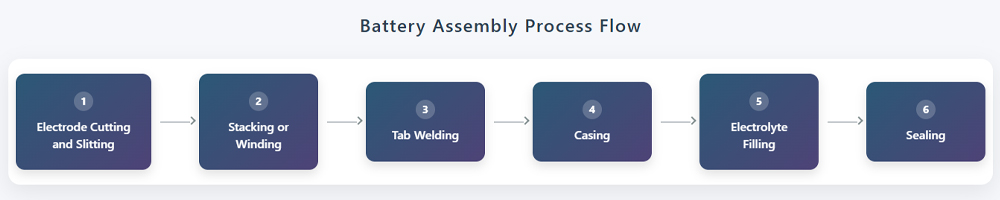
Battery assembly encompasses six core process steps, each with different sensitivity to precision and different susceptibility to human variability.
Electrode cutting and slitting. Coated and calendered electrode reels are cut to precise dimensions. Dimensional accuracy — typically within ±0.1 to 0.2 millimeters — directly affects the alignment precision of downstream stacking or winding.
Stacking or winding. Electrode sheets and separator layers are combined into the cell structure. This is the assembly step with the largest impact on cell performance — internal resistance, energy density, and cycle life all trace back to the geometry established here.
Tab welding. Positive and negative electrode tabs are joined to current collector terminals, typically via ultrasonic or laser welding. Weld consistency and strength directly determine cell internal resistance and long-term reliability. This is one of the most quality-sensitive steps in the entire assembly chain.
Casing. The electrode assembly is inserted into the cell housing — aluminum can, steel can, or aluminum-laminate pouch. The casing process requires tactile feedback to accommodate minor dimensional variations between the electrode stack and the housing.
Electrolyte filling. Electrolyte is dispensed into the cell under controlled environmental conditions. Fill volume accuracy and distribution uniformity affect electrode wetting and formation quality.
Sealing. The cell is hermetically sealed. Seal integrity directly determines cell lifetime and safety — a leaking seal admits moisture that reacts with electrolyte to form HF, which degrades every component it contacts.
Each of these steps sits at a different point on the automation feasibility spectrum. Understanding which steps are most sensitive to human variability, and which are most tolerant, is the foundation of an intelligent automation strategy.
Battery assembly process flow diagram
Chapter 2: Cost — Beyond Equipment Price
Capital expenditure comparisons between manual and automated assembly are deceptively simple. A fully automated assembly line costs two to five times more than a semi-automated equivalent and more than ten times a manual workstation setup. But CAPEX is only the visible cost.
Manual assembly carries operational costs that grow linearly with production volume. Direct labor. Quality inspection labor. Training costs — a new operator typically requires two to four weeks to reach standard throughput and yield. Turnover costs — every departing operator takes their accumulated skill with them, and every replacement starts the training curve from zero. In labor markets with high turnover, these costs can exceed wages.
Automated assembly substitutes capital for labor, but it substitutes one set of hidden costs for another. Programming and debugging engineers. Downtime during maintenance — when an automated line stops, every station stops simultaneously. The OEE of an automated line depends more heavily on maintenance response speed than a manual line, where one operator’s absence does not stop the others.
The least visible cost is the cost of poor quality. Manual assembly scrap rates typically run 1 to 5 percent, depending on process complexity and operator skill. Automated assembly scrap rates can stay below 0.1 to 1 percent. But a scrapped cell in assembly has consumed the full value of upstream processing — material preparation, mixing, coating, calendering. Every percentage point of higher scrap rate represents not just the cost of the scrapped cell, but the cumulative cost of every process step invested in it. This cost is invisible in the equipment budget. It appears months later in the manufacturing variance report.
The break-even point depends on local labor costs, product value, line utilization, and product lifecycle. TOB NEW ENERGY’s application engineers routinely model this break-even for customers — because the correct answer depends on variables that no generic spreadsheet can capture. For annual volumes below roughly a million cells, with multiple product formats and modest labor costs, manual or semi-automated assembly may deliver lower total cost. For annual volumes above ten million cells, with a single product format and high consistency requirements — as in automotive cell production — automated assembly’s TCO advantage compounds with every additional year of operation.
Chapter 3: Quality — Human Hands and Machine Precision
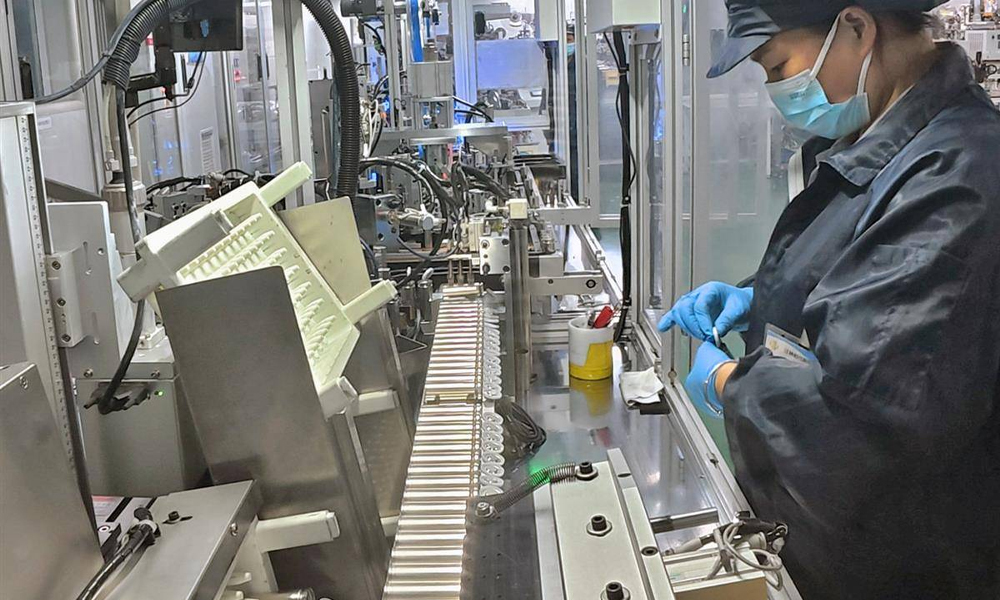
Human variability in assembly has physiological roots, not managerial ones. After four hours of continuous operation, fine motor control and attention degrade measurably. Two operators trained by the same instructor will develop different hand pressures, different alignment habits, different defect detection thresholds over months of independent work. In repetitive tasks, the human brain enters an autopilot mode where subtle deviations — a separator wrinkle, a slightly misaligned electrode — pass unnoticed.
Worker welding a battery cap on a manual cylindrical cell assembly line
Machine precision operates differently. Once calibrated, a robotic pick-and-place system maintains the same positioning accuracy across millions of cycles. A laser welder delivers the same energy profile to every joint. But machine precision is rigid — it depends on incoming material consistency. If electrode sheet dimensions vary by ±0.05 millimeters across a batch, an automated stacker will place every sheet at the programmed position, and the resulting stack will carry that variation into the cell. A human operator may notice the variation and compensate.
This creates a counterintuitive dynamic: automation improves quality when incoming materials are consistent, and can amplify quality problems when they are not. The quality case for automation is strongest for steps where both quality sensitivity is high and incoming material consistency is well-controlled.
Tab welding and sealing are the highest-priority automation candidates. Both affect cell safety and lifetime. Both require precision and consistency that manual operation struggles to maintain across an entire production shift. TOB’s battery assembly machine (https://www.tobmachine.com/prismatic-cell-assembly-machine_c104) portfolio includes automated welding and sealing stations specifically for these quality-critical steps. The Cpk requirement for automotive-grade cells — typically 1.33 or higher — is a statistical threshold that manual welding and sealing cannot reliably meet.
Stacking and winding automation depends on format and volume. Cylindrical cell winding is the most mature automated assembly process in the industry. Pouch cell stacking at high speed remains an area where the tradeoff between automation speed and stacking precision is actively being optimized.
Casing is the step where manual dexterity retains its strongest case. The minor dimensional variations between electrode stacks and cell housings demand tactile adaptation that automated systems handle through expensive sensing and compliance mechanisms. For low to medium volumes, the automation premium for casing may not be justified by the quality gain.
Chapter 4: Throughput — Speed, Bottlenecks, and Flexibility
Cycle time comparison tells a clear story. A fully automated line delivers cells every 2 to 5 seconds. A semi-automated line, every 15 to 60 seconds. A manual workstation, several minutes per cell. But these numbers compare only steady-state operation at full utilization.
A fully automated prismatic cell assembly line
Bottleneck behavior differs between manual and automated lines. In a manual line, the bottleneck is typically the most precision-demanding step — tab welding or stacking — where operators naturally slow down to maintain quality. In an automated line, the bottleneck is the physically slowest step — electrolyte filling with its required wetting time, or formation with its multi-hour duration — which no amount of automation can accelerate.
Changeover flexibility is the strongest argument for retaining manual or semi-automated stations. A manual line can switch between cell formats with a new work instruction and a fixture change — minutes to hours. An automated line requires reprogramming, fixture replacement, and recalibration. Hours to days. The quick-change cutting and slitting equipment covered by patents CN202122021936 and CN202122020284 — held by TOB NEW ENERGY — specifically addresses changeover speed. For manufacturers producing multiple cell formats in small batches, the changeover cost of full automation can consume the throughput advantage.
The most common real-world configuration is hybrid: automate the quality-critical steps where precision justifies the investment, retain manual or semi-automated stations where flexibility dominates. TOB NEW ENERGY supplies assembly equipment across this entire spectrum — from standalone semi-automated workstations for startup and R&D environments to fully integrated automated lines for high-volume production — allowing manufacturers to phase automation investment as their quality data identifies the steps where consistency improvement will deliver the largest return.
Chapter 5: The Hybrid Reality
Most battery assembly lines are neither fully manual nor fully automated. They are hybrid — and the decision of which steps to automate follows an engineering logic, not a budget logic.
The highest-return automation candidates are steps where three conditions overlap: quality sensitivity is high, incoming material consistency is well-controlled, and manual Cpk cannot reliably meet the quality threshold. Tab welding and sealing are the clearest examples. Both are safety-critical. Both require precision that fatigued human operators cannot sustain across a shift. Both are steps where the cost of a single field failure dwarfs the automation investment.
Steps where incoming material variation is high — casing being the prime example — benefit less from full automation. TOB NEW ENERGY’s housing design patents (CN202230781031 for cylindrical cells, CN202230775678 for prismatic cells) reflect engineering attention to the casing step. A fixture that positions the housing while the operator guides the insertion provides most of the consistency benefit at a fraction of the cost of a fully automated casing station.
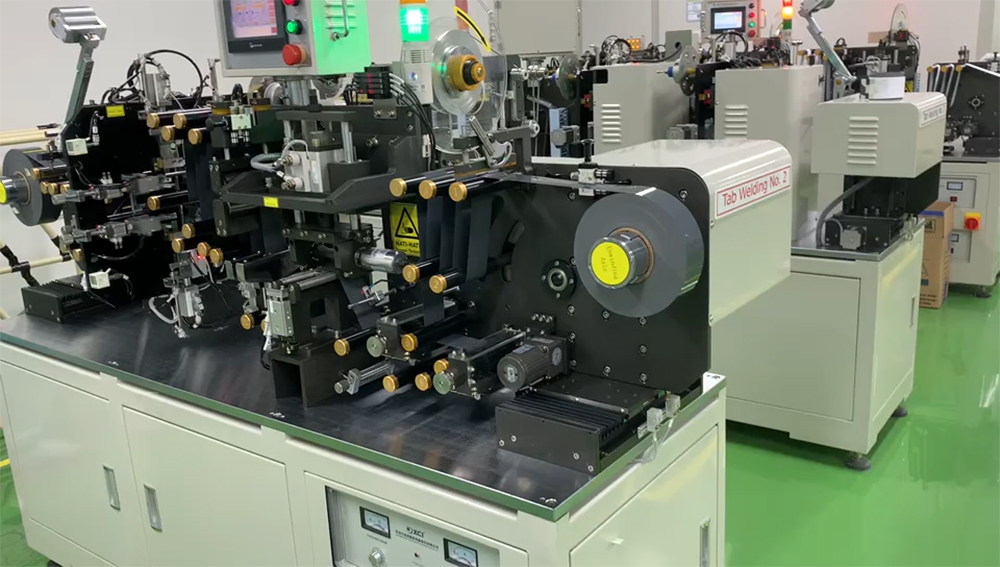
The automation trajectory follows a phased pattern. Phase one: automate quality-critical steps first — tab welding, sealing — even at low volumes. TOB NEW ENERGY’s automated welding stations (https://www.tobmachine.com/automatic-lithium-battery-cathode-electrode-making-machine_p965.html) address this phase directly. Phase two: as production scales and quality data accumulates, automate the steps where batch-to-batch consistency data shows the widest variation. Phase three: evaluate full-line automation when volume, format stability, and process maturity justify the changeover cost.
battery tab automated welding machine
Equipment suppliers who offer both automated and semi-automated assembly solutions — rather than only one or the other — can support this phased trajectory without requiring the manufacturer to switch suppliers between phases. The assembly equipment patents held by TOB NEW ENERGY reflect this dual capability: a battery cutting device patent (CN202122021936) addresses precision cutting with integrated cleaning to prevent particle contamination; a slitting device patent (CN202122020284) covers multi-format quick-change capability — the kind of engineering detail that determines changeover time in a hybrid line; cylindrical cell housing (CN202230781031) and prismatic cell housing (CN202230775678) design patents address the casing step where format-specific tooling directly affects automation feasibility.
Chapter 6: The Automation Decision Framework
The decision to automate a battery assembly step is not binary. It is a multi-dimensional evaluation that should be made step by step, not line by line.
Step one: determine quality sensitivity for each step. Tab welding and sealing justify automation on quality grounds independent of volume — a single field failure in either carries safety and warranty consequences that dwarf the equipment investment. This is the logic behind the automated welding and sealing stations in TOB NEW ENERGY’s assembly portfolio.
Step two: assess incoming material consistency for each step. Steps with high material variation may not benefit from full automation. Invest first in upstream process control to reduce variation, then automate.
Step three: model the total cost of ownership, not just the equipment price. Include the cost of poor quality — scrap multiplied by cumulative upstream processing cost. Include changeover cost if multiple formats are produced. Include the cost of operator training and turnover for manual steps.
Step four: plan automation as a phased program — a trajectory the manufacturer supports with equipment spanning semi-automated workstations to full lines, not a single project. Automate the quality-critical steps first. Use the quality data from automated steps to identify the next automation priorities. Build toward full-line automation when the data supports it, not when the budget allows it. TOB’s approach to assembly equipment supply — offering manual, semi-automated, and fully automated stations within the same engineering framework — supports this trajectory without forcing premature investment or requiring supplier changes between phases.
Automation is not a switch. It is a dial — and the correct setting depends on where you are on the curve from first-article prototype to gigawatt-hour production.
Battery Assembly Process Summary: The decision between automated and manual battery assembly is an economic and quality-driven engineering choice, not a binary technology preference. Battery assembly encompasses six core steps — electrode cutting, stacking or winding, tab welding, casing, electrolyte filling, and sealing — each with different sensitivity to precision and human variability. Total cost of ownership analysis must include the hidden cost of poor quality, where higher manual scrap rates discard the accumulated value of all upstream processes. Tab welding and sealing are the highest-priority automation candidates — their quality requirements exceed what manual operation can consistently deliver. Most production lines converge on a hybrid model: automate where quality and throughput justify the investment, retain manual or semi-automated stations where flexibility and small-batch economics dominate. The most economical automation strategy is phased and data-driven — automate first where quality variation is widest, not where the budget is largest.
Dany Huang, Ph.D. — CEO, Xiamen TOB New Energy Technology Co., Ltd.
Media Contact
XIAMEN TOB NEW ENERGY TECHNOLOGY CO., LTD.
86-18120715609
Building 5th, NO.1633, Jicheng Road, Tong’an torch Industry Phase II, Tong’an District, Xiamen City, Fujian Province, China
This article was originally published by IssueWire. Read the original article here.