(YourDigitalWall Editorial):- Chongqing, China Apr 16, 2026 (Issuewire.com) – The Foundation of Low-Altitude Security: A Multilayered Systemic Approach
In an era where unmanned aerial vehicles (UAVs) have transitioned from hobbyist toys to sophisticated tools for industrial and tactical use, the necessity for robust low-altitude security has never been more urgent. As the sky grows more crowded, the challenge of distinguishing a benign drone from a potential security threat requires more than just basic observation. Standing at the forefront of this technological frontier is MYT, a Global Leading Drone Detection System Exporter from China. Affiliated with the Institute of Internet of Things (IoT) under the Chinese Academy of Sciences, the company leverages a prestigious academic pedigree and deep-seated technical expertise to redefine how nations and private entities safeguard their airspace. By integrating advanced radar, spectrum sensing, and artificial intelligence, MYT has evolved from a regional research-driven entity into a pivotal player in the international defense market.
True security in the modern age cannot rely on a single sensor or a standalone device. Effective drone mitigation requires a comprehensive ecosystem capable of detection, tracking, identification, and neutralization. MYT’s philosophy centers on the “System” rather than just the “Product.” This systemic approach is powered by an elite R&D team exceeding 100 members, including 17 Ph.D. holders and 48 master’s degree holders, guided by an academician of the Chinese Academy of Sciences.
At the heart of the MYT value proposition is the seamless integration of various subsystems. A standard deployment typically involves a sequence of automated responses: first, long-range detection via radar and spectrum analysis; second, visual verification through high-definition photoelectric tracking; and finally, precision interference through targeted jamming. By ensuring these components communicate via a centralized command-and-control interface, the company provides a cohesive shield that minimizes human error and reduces response times to seconds.
1. Advanced Radar Technology: Filtering the Noise
Detection begins with the ability to “see” in environments cluttered by natural and man-made interference. One of the primary technical hurdles in low-altitude security is the presence of “clutter”–reflections from weather patterns, birds, and buildings that can mask a drone’s signature.
The company has pioneered sophisticated clutter algorithms for signal processing specifically designed to filter out these distractions. Their radar systems utilize two distinct technological paths to ensure reliability across diverse terrains. The first is based on MIMO (Multiple-Input Multiple-Output) microstrip antenna arrays, which allow for high-resolution identification of small, low-flying targets. The second utilizes traditional waveguide slot antennas combined with DBF (Digital Beamforming) recognition. This dual-path capability ensures that whether the system is deployed in a flat coastal region or a complex urban environment, it maintains a high probability of detection while keeping false alarm rates at an industry-leading minimum.
2. Spectrum Sensing and the SDR Revolution
While radar provides the physical location of an object, spectrum sensing provides its “fingerprint.” MYT has independently developed ultra-wideband signal sources and power amplifiers that form the backbone of their radio frequency (RF) detection capabilities. Utilizing leading Software Defined Radio (SDR) technology, their systems cover a massive frequency range from 70MHz to 8000MHz.
This broadband coverage is critical because modern drones frequently shift frequencies or utilize non-standard bands to evade detection. By monitoring this wide spectrum, the system can identify the unique communication link between a drone and its controller the moment the drone is powered on, often before it even takes off. The company’s pioneering integrated solution, which combines omnidirectional and directional antenna transmission, allows for 360-degree situational awareness followed by highly focused tracking once a signal of interest is acquired.
3. Photoelectric Tracking and AI-Driven Identification
In many scenarios, legal and operational protocols require visual confirmation before any countermeasure is taken. This is where MYT’s AI-based recognition and tracking solutions for photoelectric cameras become indispensable. Unlike standard surveillance cameras, these systems are calibrated to track high-speed objects against high-contrast backgrounds like the sky or complex backgrounds like mountain ranges.
By employing deep learning models trained on thousands of drone flight profiles, the photoelectric units can distinguish between a DJI consumer drone, a custom-built fixed-wing UAV, and a bird. This AI layer automates the tracking process, allowing the camera to “lock on” to a target and provide real-time coordinates to the jamming or radar units, ensuring that the entire defense chain is synchronized with visual evidence.
4. Precision Neutralization: From Jammers to “Anti Drone Guns”
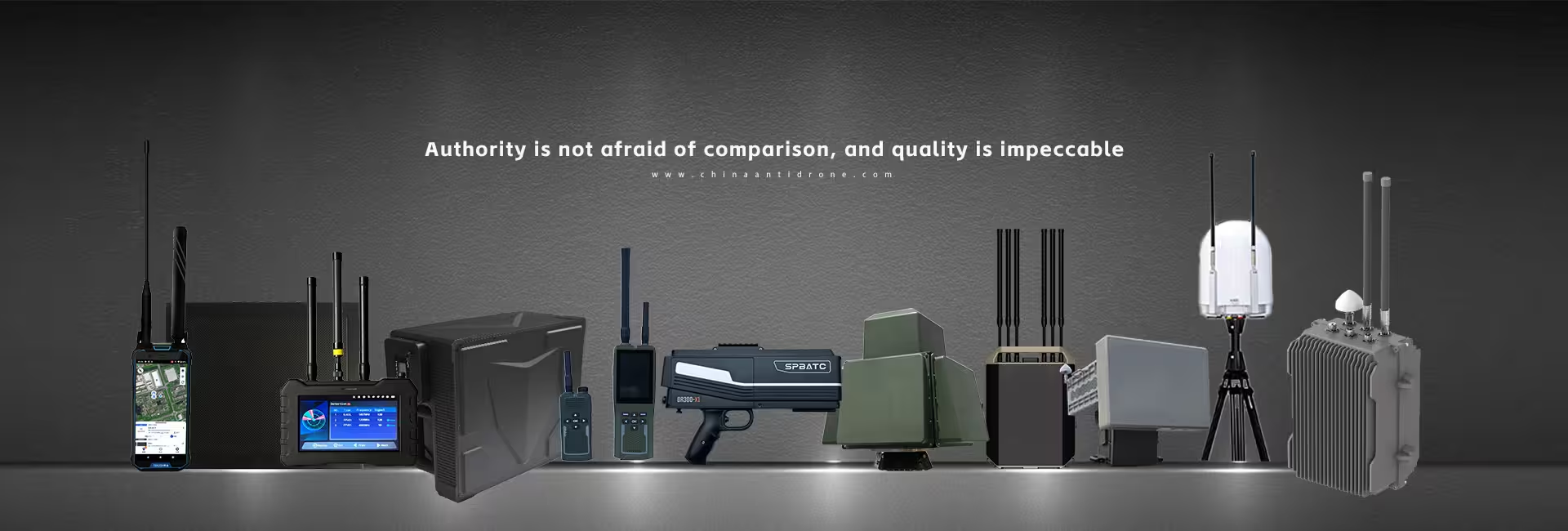
Once a threat is confirmed, the system moves to the mitigation phase. The company’s portfolio includes highly mobile solutions like the Handheld Drone Detector and the Anti Drone Gun, as well as stationary Anti Drone Jammers. These devices do not simply “blast” the air with noise; they use precision frequency disruption to sever the link between the UAV and its operator or to interfere with the drone’s GNSS (Global Navigation Satellite System) reception.
A key competitive advantage of these products is their modularity. The Anti Drone Module can be integrated into existing security infrastructures, while the portable “gun” units are designed for rapid response by security personnel on the ground. These tools are engineered to force drones into a “fail-safe” mode, causing them to either hover, land safely, or return to their point of origin, thereby neutralizing the threat without causing kinetic damage or collateral risks in populated areas.
Conclusion: Securing the Future of the Skies
As UAV technology continues to evolve, the “cat and mouse” game between drones and defense systems will intensify. MYT’s success as an exporter is built on a foundation of scientific rigor and an refusal to settle for “good enough” detection. By controlling the entire technological stack–from the underlying signal processing algorithms to the physical antenna arrays–the company provides a future-proof defense mechanism for critical infrastructure, airports, and national borders.
In a world that is increasingly looking upward with concern, the integration of academic research with practical, field-tested engineering has positioned this Chinese innovator as a guardian of low-altitude security. Their commitment to “Beyond Detection” ensures that for their global partners, the sky remains a space of innovation, not a source of vulnerability.
For more information on the full range of low-altitude security solutions, visit the official website: https://www.chinaantidrone.com
This article was originally published by IssueWire. Read the original article here.