(YourDigitalWall Editorial):- Jinan, Shandong May 23, 2026 (Issuewire.com) – As the global transition toward renewable energy accelerates, the demand for industrial-scale biomass wood pellets has reached unprecedented heights. North American (NA) firms, operating in one of the world’s most heavily regulated and volume-driven energy markets, face the continuous challenge of sourcing equipment that balances extreme durability with high output. In their search for reliable upstream partners, many leading transatlantic energy producers look to Asia, evaluating the Top 10 Biomass Pellet Machine Manufacturers In China to secure infrastructure that can handle massive regional forestry and agricultural waste streams. Among these elite fabricators, Shandong Bolida Machinery Co., Ltd. has emerged as a preferred partner. By providing highly engineered, high-capacity systems, the company addresses the specific, stringent operational mandates required by large-scale North American bioenergy operations.
Understanding the Demands of the North American Biomass Sector
The North American biomass pellet market is structurally distinct from smaller, localized heating pellet markets. NA firms typically focus on utility-scale power generation supply chains or massive industrial distribution networks. This operational framework introduces unique regional characteristics and technical demands:
- Continuous Volumetric Processing:Industrial processors in regions like the Pacific Northwest or the southeastern United States manage massive inflows of raw lumber byproducts, softwood residuals, and agricultural waste. To maintain profitability, processing plants must operate on a continuous, 24/7 production cycle, requiring machinery designed for maximum uptime and minimal structural fatigue.
- Stringent Operational Regulations:Safety, environmental compliance, and energy-efficiency standards are heavily enforced across North America. Processing equipment must integrate seamless dust mitigation, explosion proofing, and strict automated control systems to comply with regional workplace safety protocols.
- High Bulk Density Standards:Industrial buyers demand final products that strictly adhere to specific bulk density, moisture content, and mechanical durability thresholds to optimize long-distance rail or ocean transit.
To achieve these benchmarks consistently without escalating labor costs, North American buyers prioritize automated, heavy-duty processing configurations over piecemeal equipment setups.
a. Deep Process Integration and Custom Engineering
The primary reason major buyers look toward high-capacity solutions from BOLIDAMACHINERY is the company’s ability to move beyond basic machinery sales and deliver comprehensively engineered production lines. Processing raw biomass into uniform pellets requires a perfectly synchronized sequence of mechanical steps, particularly when managing the high-volume inputs typical of North American facilities.
Rather than offering standalone pellet presses, the company specializes in manufacturing complete, integrated Turnkey Wood Pellet Production Lines. These multi-stage systems smoothly handle the entire transformation cycle:
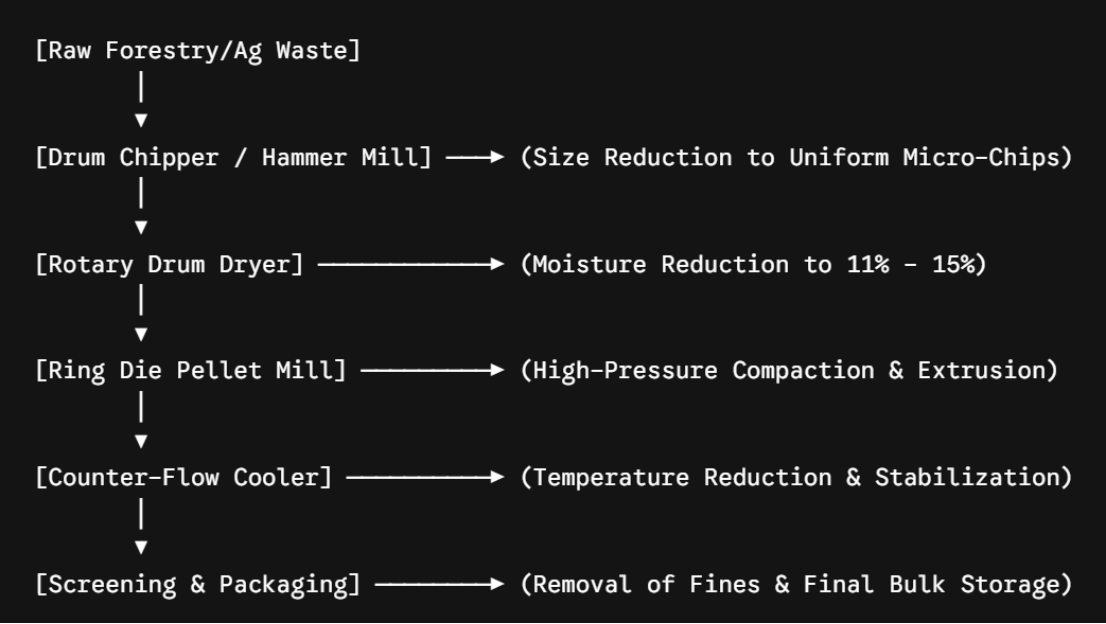
- Initial Size Reduction: High-capacity drum wood chippers and industrial hammer mills reduce variable logs, slabs, or forestry residuals into uniform micro-chips.
- Moisture Optimization: Automated rotary drum dryers utilize precision thermodynamics to reduce raw moisture down to the critical 11% to 15% range required for stable pelletization.
- Pelletization and Secondary Conditioning: The conditioned material is fed into heavy-duty ring die pellet mills, followed immediately by counter-flow cooling systems and screening machinery to eliminate fines before packaging.
- This deep process integration ensures that every stage acts as a natural buffer for the next, preventing mechanical bottlenecks and ensuring a steady, high-volume material flow throughout the plant.
b. Technical Innovation in High-Capacity Pelletization
At the core of these large-scale operations is the ring die pellet machine, a piece of equipment re-engineered specifically to handle high-tonnage stressors. Standard pellet machines often experience rapid component degradation when subjected to the continuous processing of dense North American softwoods. Chinese engineering innovations have systematically addressed these weaknesses through targeted structural enhancements.
The high-capacity ring die systems utilize advanced, high-chromium alloy steel dies that undergo specialized vacuum heat treatments to maximize wear resistance. The internal roller assemblies feature multi-point lubrication architecture, allowing operators to grease critical bearings during live operation without halting production. Furthermore, the main drive mechanisms abandon traditional belt-driven configurations in favor of high-torque, precision-ground gear transmission systems. This design selection improves energy transfer efficiency by up to 20%, lowers operational vibration, and directly prevents the slippage and subsequent drive shaft damage common in high-volume facilities.
c. Industrial Application and Material Flexibility
North American biomass sourcing varies greatly by region, demanding processing machinery that offers exceptional material flexibility. Facilities in agricultural zones require systems capable of handling low-density crop residues like wheat straw, corn stover, or miscanthus, while forestry-adjacent operations manage high-density bark and sawdust.
High-capacity systems resolve this challenge through configurable compression ratios within the ring die assembly. By adjusting the effective press length and introducing variable-frequency drive (VFD) feeders, a single production line can alternate between agricultural biomass and heavy forestry residues without requiring extensive mechanical overhauls. This adaptability allows NA firms to hedge their raw material procurement strategies, sourcing whatever biomass feedstock is most economically viable during a given season without sacrificing final pellet quality or processing speed.
d. Proven Infrastructure and Verifiable Plant Case Studies
Engineering claims must be validated by manufacturing capability and field performance. Operating from an expansive manufacturing base covering more than 80,000 square meters with a registered capital of 35 million RMB, Shandong Bolida Machinery maintains the heavy industrial infrastructure required to fabricate large-scale processing lines entirely in-house. Supported by a staff of over 300 skilled professionals and dedicated scientific research divisions, the enterprise ensures strict quality control across every casting, machining, and assembly phase.
The real-world execution of these systems is demonstrated in complete, multi-ton-per-hour industrial installations globally. In a typical high-capacity layout, raw materials undergo a highly systematic path designed for minimal human intervention:
In actual field operations, this layout functions as a fully automated closed-loop system. Raw material is metered through pneumatic conveying lines into heavy-duty chippers, moving automatically through triple-pass rotary dryers equipped with integrated spark detection systems. Once dried, the material passes through a magnet-equipped conditioning chamber to catch tramp metal before entering the pelletizing chamber. Following extrusion, the pellets immediately enter a counter-flow cooling column, which uses ambient air currents to lower the product temperature to within 5°C of the room temperature, hardening the lignin bonds. This verified system configuration routinely delivers consistent operational efficiency, satisfying the stringent volume and safety requirements of overseas buyers.
Strategic Capital Efficiency for Global Operators
Ultimately, the selection of high-capacity Chinese manufacturing by North American firms comes down to strategic capital efficiency. Establishing an industrial biomass processing facility involves substantial capital expenditure. Sourcing robust, verified production lines from an established enterprise with deep international trade experience allows project developers to optimize their initial investment.
With products already deployed across more than 10 domestic provinces and exported extensively to markets throughout Europe, South America, Southeast Asia, Africa, and North America, Bolida’s equipment has demonstrated its adaptability to diverse environmental and regulatory climates. The structural longevity of the machinery, combined with a highly competitive initial procurement cost, offers global energy operators a rapid return on investment (ROI) and lower ongoing maintenance expenses. For North American firms scaling up to meet international green energy mandates, these high-capacity solutions deliver the mechanical reliability, high throughput, and long-term cost predictability required to remain competitive in a rapidly evolving energy landscape.
To learn more about industrial-scale bioenergy solutions and complete production configurations, visit the official website: https://www.biopelletmachinery.com/
This article was originally published by IssueWire. Read the original article here.