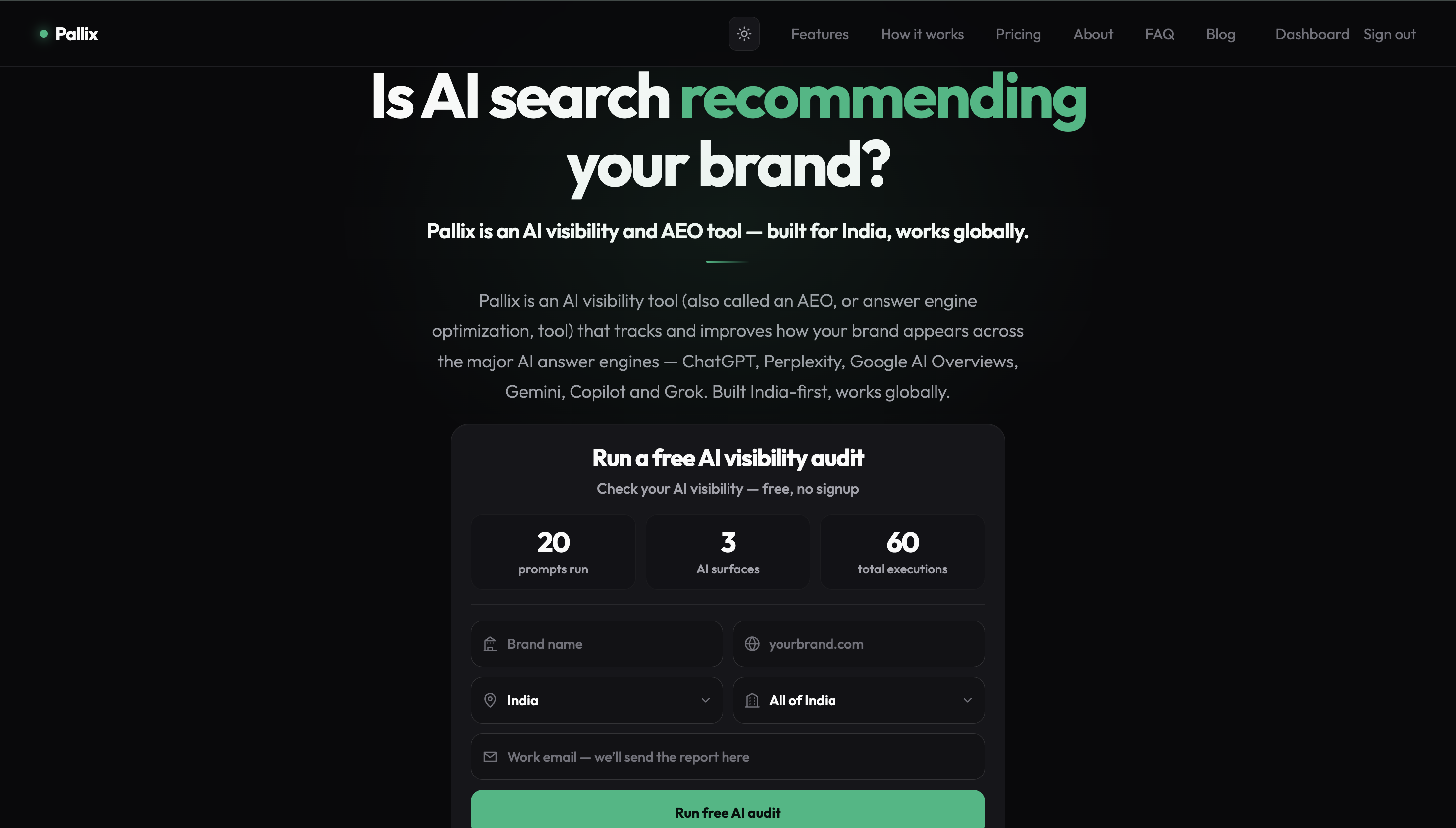
A platform tracks brand visibility across seven AI engines, decodes AI-driven traffic, and shows the exact source behind every score — giving Indian consumer brands a transparent, evidence-based alternative to guesswork SEO.
(YourDigitalWall Editorial):- Pune, Maharashtra Jul 14, 2026 (Issuewire.com) – Indian consumers are increasingly asking ChatGPT, Perplexity, and Google AI Overviews for product recommendations instead of searching Google directly. Most brands have no way to see whether they’re being mentioned in those answers, let alone why. Pallix, an AI visibility platform built specifically for India’s D2C and consumer brands, is launching to close that gap.
Pallix tracks brand visibility across seven AI engines — ChatGPT, Perplexity, Google AI Overviews, Gemini, Grok, Copilot, and Claude — using India-based infrastructure and Hinglish prompt support, so results reflect how Indian buyers actually search rather than a US-centric approximation. Learn more about Pallix’s approach.
The platform’s central premise is transparency. Every visibility score Pallix produces links back to its source: the platform’s AI sourcing engine shows exactly which pages, reviews, or mentions an AI engine drew on to form its answer. Scoring formulas are fully editable, so brands can adjust weightings to fit their own category instead of trusting a fixed, unexplained algorithm.
Core features include:
- AI Sourcing & Citation Intelligence — shows which sources AI engines cite for a brand’s category, and which ones competitors are winning that the brand isn’t.
- Content Freshness Tracking — flags when the sources AI engines rely on have gone stale, since outdated content gets deprioritized in AI-generated answers.
- Market Intelligence Engine — mines Reddit, Quora, marketplaces, and reviews to surface what Indian buyers are asking about a category before competitors catch the shift.
- DACT (Dark Agentic Commerce Traffic) Decoder — identifies AI-referred traffic on a brand’s site, distinguishing human visitors arriving via AI assistants from AI crawler bots, a distinction most analytics tools miss entirely.
- Evidence-Based Fixes — every recommendation is generated from a live engine query and tied to a specific, named citation gap, not generic SEO advice repurposed for AI.
For brands evaluating options in this space, Pallix has published a comparison of how AI visibility tools stack up in 2026.
“Most tools claiming to measure AI visibility are black boxes — you get a score with no way to check it,” said Akash, founder of Pallix. “We built Pallix so every score, citation, and fix traces back to something real you can verify yourself. Indian D2C brands also search differently than global markets assume, so we built for that from the start rather than bolting India on as an afterthought.”
Pallix is available now for D2C brands, consumer companies, and agencies managing AI visibility across multiple client accounts, with white-label support for agency partners. Pricing details are available on Pallix’s pricing page.
About Pallix
Pallix is an AI visibility and Generative Engine Optimization (GEO) platform built for India’s D2C and consumer brands. The platform tracks brand performance across major AI answer engines, provides source-level citation intelligence, and delivers evidence-based recommendations to close visibility gaps. Pallix is based in Pune, India. Read more on why Pallix is built for the Indian market.
For more information, visit pallix.in.