

(YourDigitalWall Editorial):- Shenzhen, Guangdong Oct 27, 2026 (Issuewire.com) – Industrial Systems Place Greater Emphasis on Power Supply Design
Reliable power delivery is an essential requirement for modern industrial equipment. From programmable logic controllers (PLCs) and sensors to factory automation systems and building control equipment, many applications depend on stable DC power to maintain consistent operation. As industrial systems become more integrated, choosing a reliable DIN rail power supply manufacturer requires careful consideration of electrical performance, installation requirements, protection functions, and operating conditions.
Huyssen Power discusses how DIN rail power supply design addresses these industrial requirements through practical considerations such as input voltage compatibility, output specifications, protective features, and installation flexibility. Established in 2011, the company provides a range of power solutions, including AC-DC power supplies, DIN rail power supplies, programmable power supplies, battery chargers, and DC-DC converters. Its product portfolio includes more than 1,300 models for applications across industrial, communications, healthcare, automotive electronics, and other sectors.
DIN Rail Mounting Supports Organized Industrial Installation
DIN rail power supplies are designed for installation on standardized mounting rails, making them suitable for electrical cabinets and control panels. This mounting arrangement helps engineers organize power equipment alongside circuit protection devices, controllers, relays, and terminal blocks.
In industrial environments, cabinet space and accessibility are important design considerations. A DIN rail-mounted unit can simplify installation and replacement while supporting a more structured control cabinet layout. The specific dimensions, mounting compatibility, ventilation clearance, and wiring access should nevertheless be evaluated against the requirements of the intended installation.
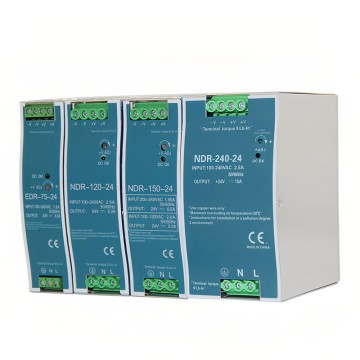
Huyssen Power’s DIN rail power supply range includes MDR, NDR, and DR series products. The range features different output ratings and configurations, allowing buyers to compare available models according to the needs of their equipment. Selection depends not only on the physical mounting method but also on electrical compatibility and the environmental conditions in which the power supply will operate.
Input Voltage and Output Ratings Determine Compatibility
Input voltage compatibility is one of the first factors to consider when choosing an industrial power supply. Equipment may operate in facilities with different AC supply conditions, so the selected unit must support the available input voltage and frequency. Huyssen Power lists DIN rail power supply models with an input voltage range of 85-264 VAC, providing flexibility for installations operating across a range of mains supply conditions. Buyers should verify the input specifications of the individual model before installation.
Output voltage and current are equally important. Many industrial control devices use 12 V or 24 V DC power, while some applications require 48 V outputs. The appropriate rating depends on the connected equipment and the total electrical load.
A power supply should be selected according to the combined operating requirements of the connected devices, including their normal current consumption and any temporary increases during startup. Appropriate capacity planning helps prevent persistent overloading and allows the system to operate within the manufacturer’s specified limits.
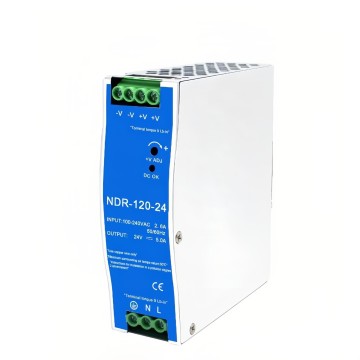
Huyssen Power’s listed products include 12 V and 24 V models, as well as 48 V options. For example, its product range includes the MDR-60-12, a 12 V, 60 W DIN rail power supply, and the NDR-120-24, a 24 V, 120 W model. These specifications provide a starting point for comparing power requirements, although the final choice should be based on the complete system design.
Protection Functions Help Address Common Electrical Risks
Industrial electrical systems may encounter overloads, short circuits, and voltage fluctuations. Protective functions therefore form an important part of DIN rail power supply design. Depending on the model, these functions can help limit the consequences of abnormal operating conditions and reduce the risk of equipment disruption.
Huyssen Power identifies overload, short-circuit, and overvoltage protection among the features of its DIN rail power supplies. Its product information also describes models with overcurrent and overtemperature protection. The exact protection functions and their operating characteristics should be checked against the relevant product datasheet.
Protection features do not replace appropriate system-level safeguards. Engineers must still consider upstream circuit protection, grounding, wiring quality, load distribution, and the operating limits of connected devices. Proper installation and maintenance are necessary to ensure that protective functions work as intended within the wider electrical system.
Efficiency and Thermal Management Influence Operating Performance
Energy efficiency is another consideration when evaluating a DIN rail power supply, particularly in installations that operate for extended periods. Conversion losses generate heat, which can affect operating temperature and contribute to the overall energy consumption of a control cabinet.
Huyssen Power lists an efficiency of up to 90% for certain DIN rail power supply models. Actual efficiency varies by model, input conditions, and loading, so buyers should review the corresponding technical specifications rather than assume that every unit achieves the same result.
Thermal management also depends on the installation environment. Ambient temperature, ventilation, cabinet density, and clearance around the power supply can influence heat dissipation. A unit installed in a crowded enclosure may experience different thermal conditions from one operating in a well-ventilated cabinet. Checking the manufacturer’s temperature and derating guidance helps determine whether a selected model is appropriate for the intended application.
Industrial Automation and Building Control Applications
DIN rail power supplies are widely used in industrial automation because control systems require dependable DC power for electronic components. PLCs, sensors, relays, and monitoring devices may all rely on suitable DC supplies to perform their designated functions. A correctly specified power supply helps maintain the electrical conditions required by these devices.
Building control systems also use DIN rail-mounted equipment for monitoring, switching, and automation tasks. In these installations, a suitable power supply can support control modules and related low-voltage devices within electrical distribution or automation cabinets.
Mechanical engineering and process industries represent additional application areas. Equipment configuration, load demand, environmental exposure, and maintenance requirements differ between installations. For this reason, the suitability of a DIN rail power supply should be assessed against the actual operating conditions instead of relying on output voltage alone.
Product Selection Requires a System-Level Assessment
Choosing a DIN rail power supply involves more than comparing price or nominal wattage. Industrial buyers and engineers should evaluate several factors together:
First, confirm that the input voltage range matches the available electrical supply. Second, identify the required output voltage and calculate the total load, allowing for relevant startup and operating conditions. Third, check the available protection functions and verify that the product meets the installation’s safety and compliance requirements.
Mounting dimensions, wiring access, operating temperature, ventilation, and efficiency should also be considered. For projects involving multiple control devices or specialized operating conditions, technical documentation and manufacturer consultation can help clarify compatibility before procurement.
Huyssen Power states that its research and development team supports customized power supply design for requirements that cannot be met by an existing catalog model. Its published customization process includes requirements communication, design, sampling, product validation, mass production, and quality inspection. This process provides a framework for discussing application-specific needs with the company, although the feasibility of individual requirements must be confirmed during technical evaluation.
Huyssen Power Addresses Diverse Industrial Power Requirements
DIN rail power supply design brings together electrical compatibility, mounting convenience, protective functions, thermal considerations, and application-specific capacity. Each factor contributes to determining whether a unit is suitable for a particular industrial installation. Evaluating these requirements together helps engineers and procurement teams make more informed equipment decisions.
With a product portfolio spanning multiple DIN rail power supply series and output configurations, Huyssen Power provides options for industrial control, building automation, and related applications. Its broader power supply capabilities and custom design services also provide a basis for discussing requirements that extend beyond standard catalog specifications.
For more information about the company’s products and power supply solutions, visit the official website: https://www.huyssenpsu.com/
This article was originally published by IssueWire. Read the original article here.

