TetiAI releases Lucid — the first open-source cognitive protection system for AI — and ships it inside Teti, its free AI assistant. Built on 30+ peer-reviewed studies, Lucid is now available for any AI company on Earth to adopt.
(YourDigitalWall Editorial):- Dover, Delaware Mar 19, 2026 (Issuewire.com) – The Problem No One in the Industry Is Addressing
Artificial intelligence is making us more productive. But science is now documenting a serious side effect: after three to six months of heavy use, people think worse.
This is not an opinion. A landmark study published by the MIT Media Lab in 2025 measured a measurable decline in independent critical thinking among users who heavily delegate cognitive work to AI. The mechanism is straightforward: when a machine reasons on your behalf, your brain stops training itself to do it. Cognitive abilities work like muscles — if you don’t use them, they atrophy.
The damage is invisible. Every single conversation with AI feels normal. The harm accumulates week after week, and by the time you notice, the pattern is already entrenched. Researchers have given it a name: cognitive debt — the progressive weakening of cognitive abilities when thinking is excessively outsourced to machines.
For people under 25, the risk is significantly higher. The prefrontal cortex — the part of the brain that governs critical thinking, decision-making, and impulse control — does not finish developing until roughly that age. Recent research on what scientists are calling AICICA (AI Chatbot-Induced Cognitive Atrophy) shows that young users develop AI dependency faster and score lower on critical thinking assessments. The American Psychological Association has issued specific recommendations on AI and adolescent wellbeing.
No AI company in the world has built a solution for this problem. Until TetiAI.
Introducing Lucid by TetiAI: Cognitive Protection for the AI Era
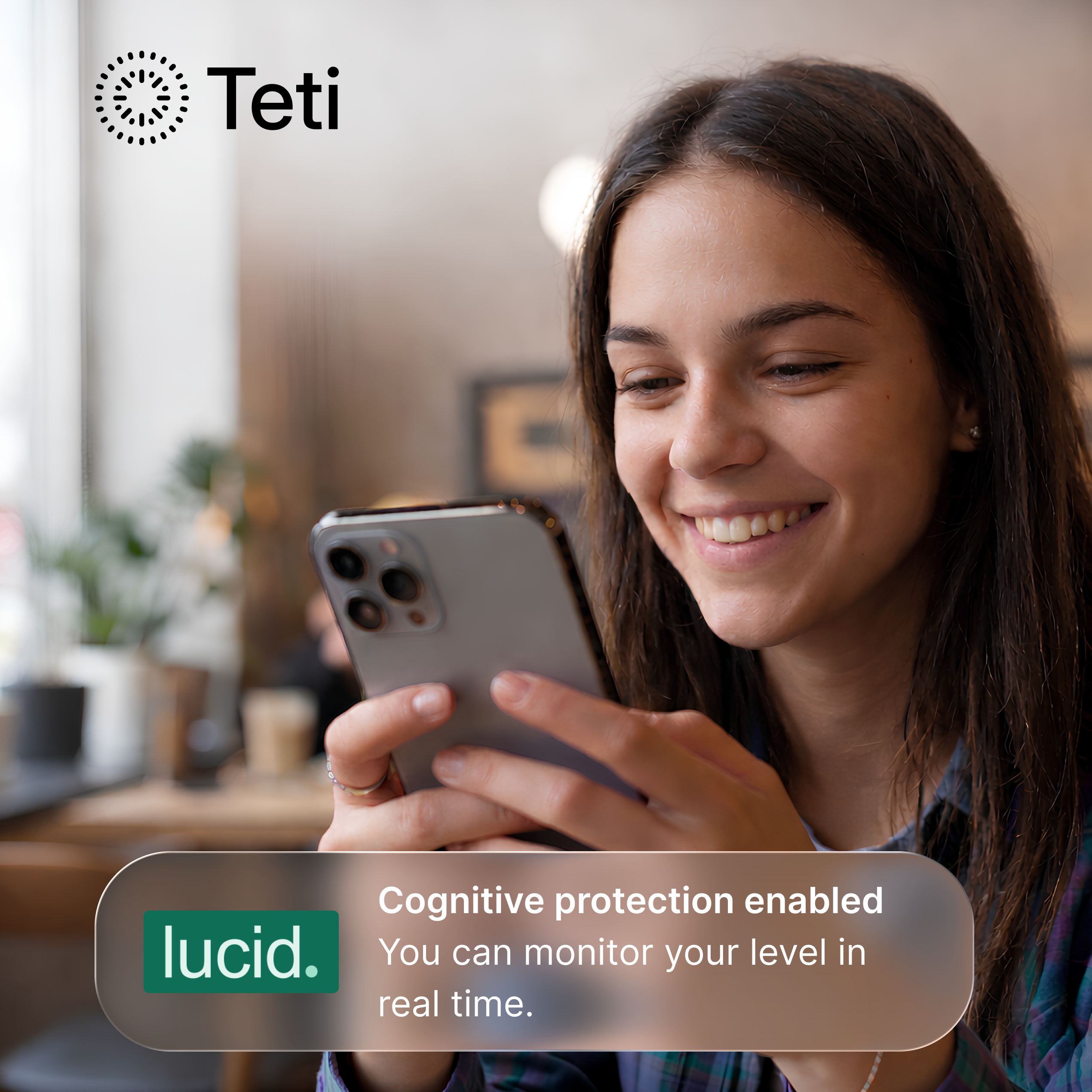
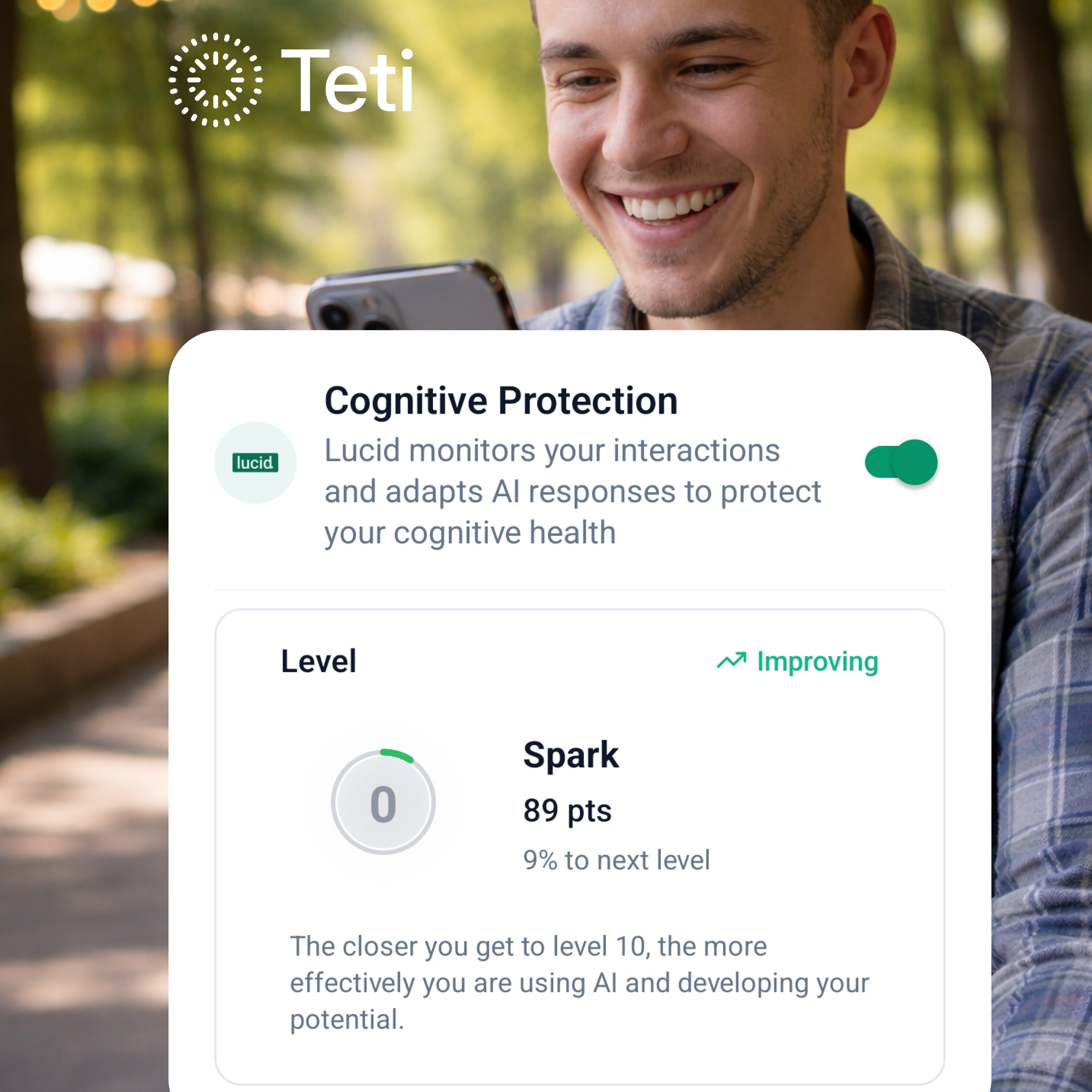
Lucid is a cognitive protection system created by TetiAI and released as open-source software — public code, freely integrable by any AI company in the world. It is the first technology of its kind, and it is already live inside Teti, TetiAI’s free AI assistant. Lucid does not block content. It does not slow down the conversation. What it does is observe how the user thinks while interacting with AI, and adapt responses in real time to protect their cognitive abilities.
Lucid analyzes every exchange across six dimensions:
- Independent reasoning — Is the user thinking for themselves, or delegating everything to the machine?
- Understanding vs. collecting — Is the user trying to understand concepts, or just harvesting ready-made answers?
- Depth of engagement — How deeply is the user involved in the conversation?
- Metacognitive awareness — Is the user conscious of how they’re thinking?
- Verification behavior — Does the user question what the AI tells them, or accept it uncritically?
- Motivation analysis — Why is the user turning to AI — genuine curiosity, practical need, or avoidance of mental effort?
Based on what it observes, Lucid dynamically adjusts the AI’s behavior. A user who delegates everything receives an AI that asks questions before answering — forcing them to reason. A user who demonstrates strong independent thinking receives an AI that challenges them with harder problems. A user showing signs of cognitive fatigue receives a suggestion to take a break.
Critically, Lucid distinguishes between healthy and problematic delegation. Asking AI to format a document or translate a text is normal — you’re delegating mechanical work. Asking AI to reason on your behalf, make your decisions, or analyze a situation for you is different — you’re delegating thought itself. Lucid intervenes only in the second case.
Stronger Protections for Users Under 25
For users under 25, Lucid enforces stricter safeguards: shorter sessions (30 minutes instead of 45), fewer messages per session (20 instead of 30), and interaction guidelines that always prioritize teaching over solving. Not because younger users are less capable, but because the science is clear that the developing brain is more vulnerable to cognitive dependency.
Built on Science, Not Marketing
Lucid’s methodology is grounded in over 30 peer-reviewed scientific publications spanning neuroscience, educational psychology, cognitive load theory, and motivation research. Its adaptive model draws from a well-established principle in learning science: support should be calibrated to the user’s current ability and gradually reduced as competence grows — like training wheels on a bicycle.
The system operates across four scaffolding levels, from guided step-by-step support to fully autonomous peer-level dialogue and intellectual challenge. At every level, it asks users to attempt a problem before providing the answer — because cognitive science shows that self-generated information is retained far more effectively than passively received information.
Lucid’s measurement framework is aligned with validated scientific scales tested on thousands of participants, including the Generative AI Dependency Scale, the AI Motivation Scale, and the Collaborative AI Metacognition Scale. Complete references are available in the project’s public documentation.
Why Open Source: A Standard, Not a Competitive Advantage
“Cognitive protection should exist in every AI product that people use regularly, the same way seatbelts exist in every car. Not because a single conversation is dangerous, but because the cumulative risk across thousands of interactions is real and measurable.”
— TetiAI
Lucid is open source because TetiAI believes cognitive protection must become an industry-wide standard adopted by everyone — not a proprietary feature locked inside a single product. The code is public on GitHub under the TetiAI organization. The scientific documentation is included. Any company can integrate it into their systems, free of charge.
Lucid is already fully operational inside Teti, TetiAI’s AI assistant — making Teti the first and only AI assistant in the world with built-in cognitive protection. Teti is available free on Web, iOS, and Android. TetiAI will publish real-world implementation results in the coming months.
About Teti
Teti is a free AI assistant with permanent memory, zero data tracking, and Lucid cognitive protection built in. It is powered by Teti N1, a proprietary open-source-based model architecture, with N2 currently in development. Teti is available worldwide on Web, iOS, and Android.
About TetiAI
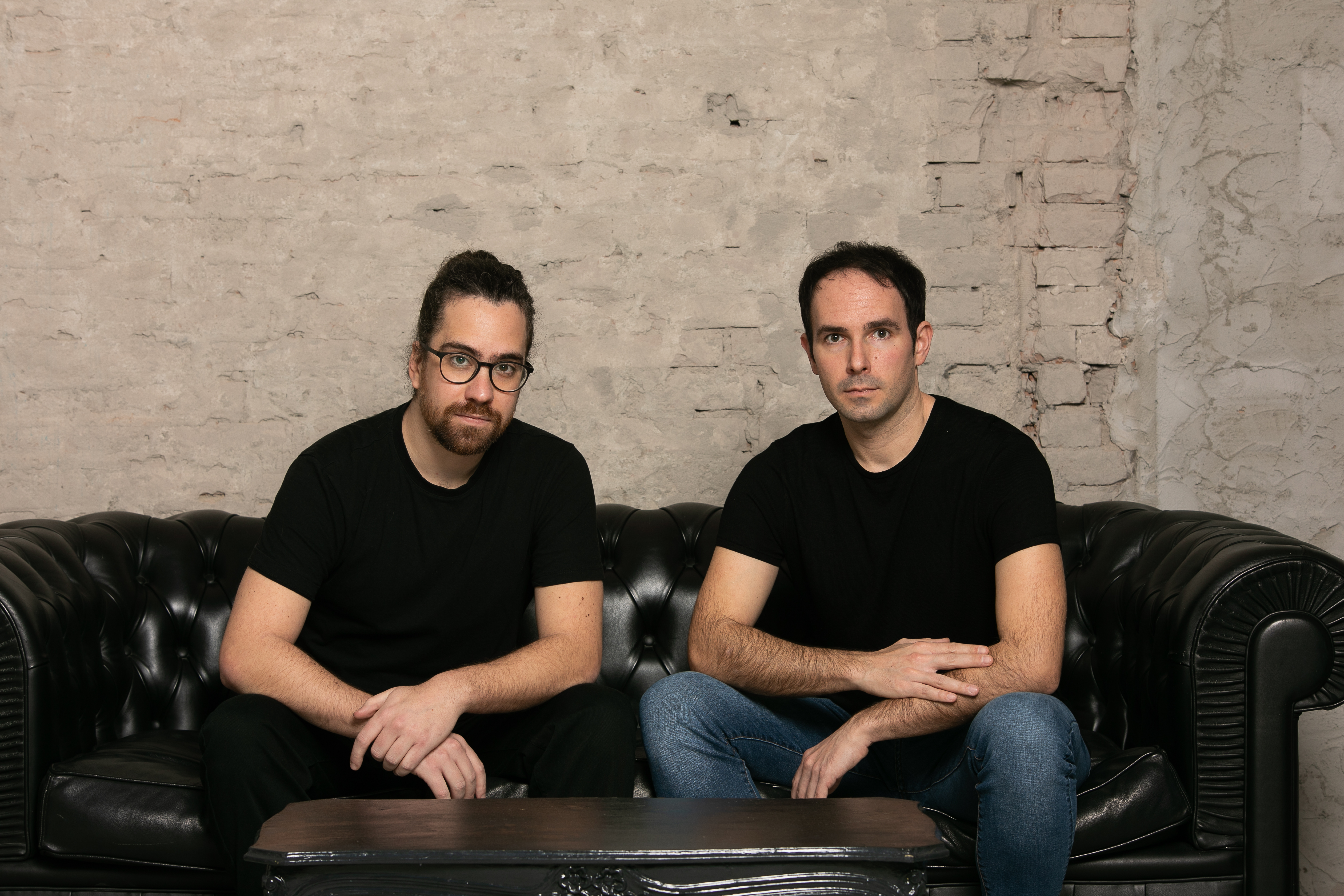
TetiAI is an international AI company founded in 2025 by Marcello Violini (CEO) and Lorenzo Nargiso (CTO), Italian entrepreneurs who previously co-founded Teyuto, a video streaming platform operating in 50+ countries and recognized by the European Commission, the European Investment Bank, and Gartner. Incorporated as a US LLC with operational hubs in both Europe and the United States, TetiAI develops human-centric AI technologies built on radical transparency, absolute privacy, and a binding Ethical Charter with an independent Ethics Committee holding veto power. The company’s stated goal for 2030 is Symbiotic AGI — artificial general intelligence designed as an extension of the human mind, not a replacement.