(YourDigitalWall Editorial):- Xianggang, China Jul 16, 2026 (Issuewire.com) – Beyond fat tires and motor wattage: a practical framework for evaluating mixed-surface capability, with the Wallke Titan X1 as a case study.
“All-terrain” is one of the least precise labels in the e-bike market. It can describe anything from a basic fat-tire commuter to a heavy, utility-focused machine intended for gravel roads, packed dirt, sand, snow, and moderate recreational trails. Tire width matters, but it is only one part of the equation.
A capable mixed-surface e-bike needs predictable power delivery, adequate braking, suitable suspension, stable frame geometry, secure battery mounting, useful weather resistance, and tires matched to the surface. It also needs clearly stated limits. A bike that feels planted on a farm road may still be unsuitable for downhill mountain-bike trails, jumps, deep-water crossings, or routes where motorized access is restricted.
How this article uses the term “all-terrain”:
it refers to mixed-surface riding on pavement, gravel, packed dirt, farm roads, hard sand, light snow, and moderate recreational trails. It does not mean unlimited trail access or suitability for downhill, enduro, jumping, or submersion.
The Wallke Titan X1 offers a useful case study because it combines a steel, moped-inspired frame, wide tires, front suspension, and a utility-oriented layout. It also illustrates an important point: every engineering choice involves trade-offs. Added stability and a substantial feel often come with more weight, while stronger assistance places greater demands on traction, braking, battery care, and rider judgment.
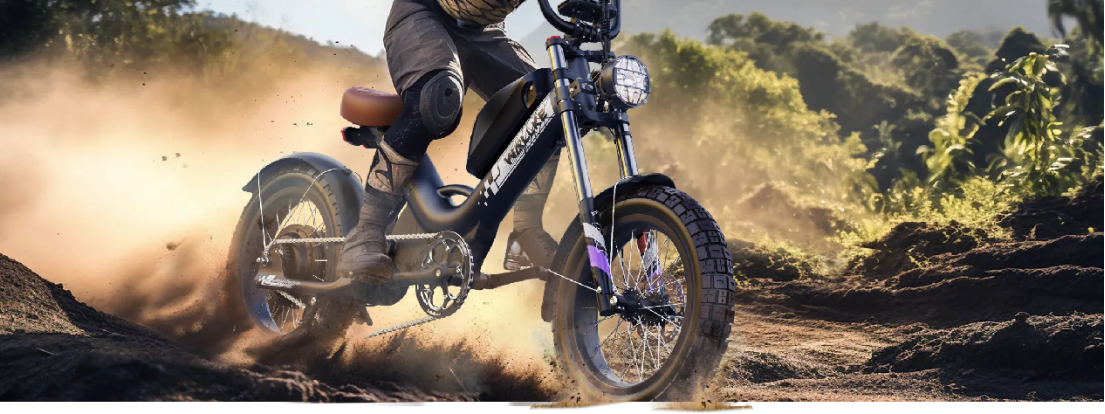
The Titan X1 shown in a dry, unpaved recreational setting. Surface conditions, legal access, and real-world performance vary.
1. Intended Use Comes Before Hardware
Before comparing motors, suspension, or tires, riders should define the surfaces they will actually use. A bike for paved commuting with occasional gravel has different requirements from one intended for sand, snow, farm roads, or loose dirt. Wallke’s off-road e-bike buying guide provides a broader checklist for matching components and riding conditions.
Local access rules are equally important. Some routes restrict throttle-equipped bikes, higher-speed e-bikes, or motorized vehicles entirely. A capable machine is only useful when its configuration is appropriate for the route and legal to operate there. Riders comparing purpose-built options can also review Wallke’s current range of off-road e-bikes.
2. Power Delivery Matters More Than Peak Wattage
Peak wattage is easy to advertise, but it does not tell riders how an e-bike will behave at low speed or on loose ground. On sand, gravel, wet grass, or a steep start, abrupt power can break traction. Delayed cutoff can also make tight turns and obstacle clearance harder to manage.
A better evaluation looks at how progressively assistance arrives, how quickly it stops, and whether the rider can modulate output through the selected assist level or throttle. Controller calibration, wheel size, total load, gearing, and motor temperature all affect the result. These factors are especially important when comparing high-output or dual-motor e-bikes, where available traction matters as much as headline power.
Without a published torque curve or instrumented testing, descriptions such as “linear pull” or “instant response” should be treated as ride impressions rather than engineering facts. For the Titan X1, the practical question is not simply how much power the system can produce. It is whether assistance can be applied predictably enough to preserve traction and rider control on the surfaces the bike is intended to use.
3. Suspension Must Control the Bike, Not Just Soften the Ride
Wide tires provide useful cushioning, but they cannot replace a properly functioning suspension fork. The fork’s job is to help the front wheel follow uneven ground while limiting sharp impacts transmitted to the rider and frame.
The Titan X1 uses an inverted-style front fork. On any e-bike, however, fork appearance matters less than measurable factors such as travel, damping quality, structural stiffness, wheel weight, tire pressure, and correct setup. An inverted appearance alone does not make a fork “motorcycle-grade.”
Buyers should look for clearly published information about fork travel and the exact adjustments provided. Preload, compression damping, and rebound damping describe different functions and should not be grouped together unless the component genuinely includes them.
4. Tire Width Works Only With the Right Pressure and Tread
Fat-tire e-bikes can increase the contact patch and help a bike stay on top of softer surfaces, but width is not a universal solution. Tire pressure, tread pattern, casing construction, rider weight, cargo, and surface conditions determine how the tire actually performs.
Lower pressure can improve flotation and comfort on sand or snow, but too little pressure may make steering vague, increase rim-strike risk, or allow the tire to deform excessively. Higher pressure can reduce rolling resistance on pavement, but it may reduce grip and comfort on loose ground. Riders should remain within the tire and rim manufacturer’s stated pressure range. For surface-specific setup considerations, see this guide to choosing a fat-tire e-bike for sand.
Tread should also match the intended terrain. A pattern that feels quiet and efficient on pavement may not clear mud well, while an aggressive off-road tread can add noise and drag during daily road use.
5. Frame Design Determines Stability, Fit, and Usability
Frame material is only one part of the durability equation. Tube shape, weld quality, geometry, battery placement, rack loading, and total system weight all influence how a bike handles under load.
The Titan X1’s steel frame contributes to its substantial, planted character. The trade-off is typically greater overall weight compared with many lighter aluminum-frame e-bikes. That can make lifting, transporting, turning in confined spaces, and stopping more demanding.
Payload ratings should also be read carefully. Riders should confirm whether a published limit includes the rider, cargo, accessories, and other equipment, and use the current manufacturer documentation as the controlling source.
6. Sensors and Controller Tuning Shape Low-Speed Control
The “feel” of an e-bike depends heavily on how its sensor and controller interpret rider input. Torque sensors respond to pedaling force, while cadence sensors primarily detect crank rotation. Both can work well, but they produce different ride characteristics and should be described accurately.
For technical, low-speed riding, the key questions are how quickly assistance begins, how smoothly it builds, and how promptly it stops when the rider pauses pedaling. Claims that a system measures pedal pressure or reacts at a specific sampling rate require supporting technical data.
Regardless of sensor type, real-world control depends on surface conditions, tire pressure, total load, gearing, assist-level selection, controller behavior, and rider input.
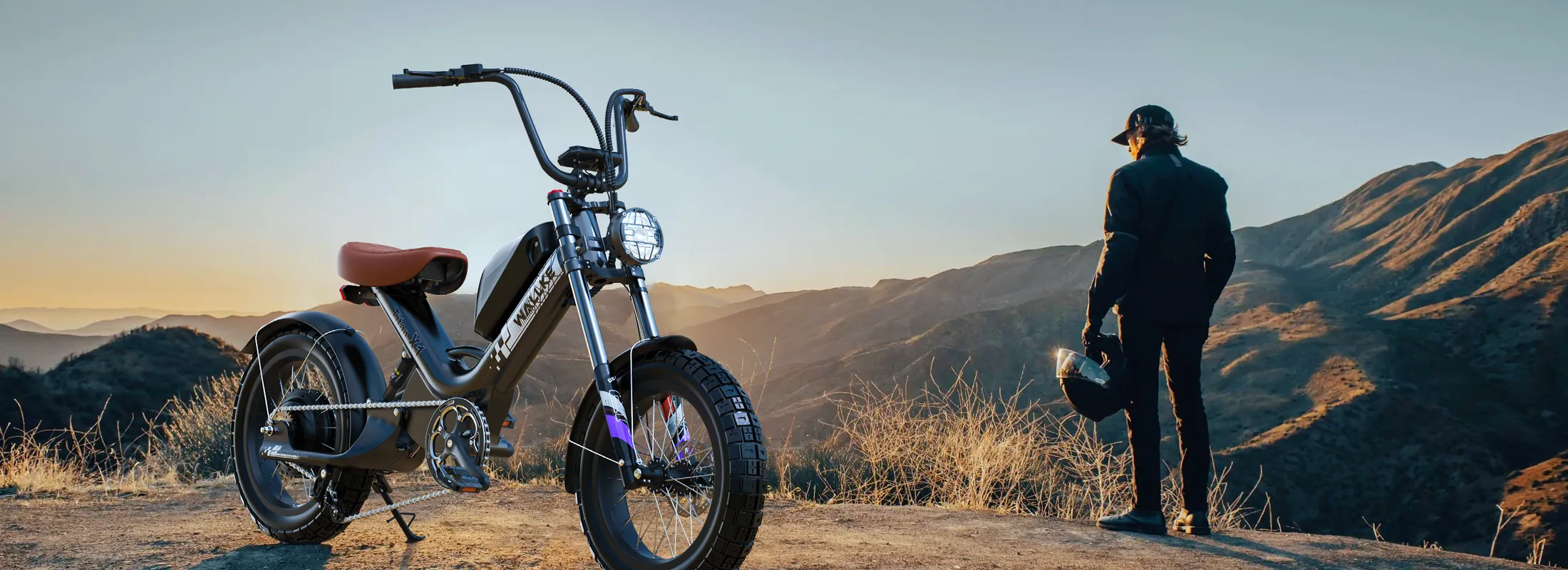
Mixed-surface performance depends on the rider, surface, speed, setup, and local access rules. This image should not be interpreted as approval for downhill, enduro, jump-line, or unrestricted trail use.
7. Braking Is a Core All-Terrain Requirement
Any discussion of all-terrain capability that focuses on motors and tires but ignores braking is incomplete. A heavy e-bike carrying a rider and cargo stores substantial momentum, especially on a descent. Loose or wet surfaces can further extend stopping distances.
Buyers should check whether a bike uses mechanical or hydraulic disc brakes, the rotor size, pad availability, and whether replacement parts are easy to source. Hydraulic brakes can provide strong, controllable braking, but they still require inspection, pad replacement, rotor care, and periodic service.
Riders should leave more stopping distance when a bike is heavily loaded, when tire pressure is reduced, or when the surface is wet, sandy, muddy, or covered with loose gravel.
8. Weather Resistance Has Limits
Mixed-surface riding often exposes an e-bike to rain, dust, and mud. Sealed connectors, protected wiring, secure battery interfaces, and published ingress-protection ratings can improve reliability. Weather resistance, however, is not the same as waterproofing.
Unless a manufacturer explicitly states otherwise and provides an appropriate rating, an e-bike should not be treated as suitable for submersion or creek crossings. Riders should avoid pressure-washing electrical components, dry the bike after wet rides, and inspect connectors and battery contacts regularly.
Where component-level ingress-protection ratings are not clearly published, buyers should not assume that the electrical system is waterproof.
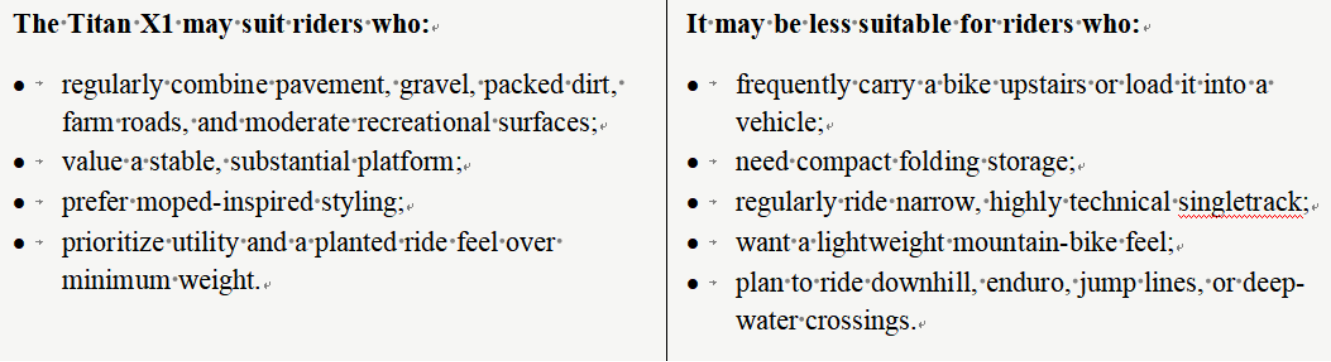
9. Where the Titan X1 Fits — and Where It Does Not
Wide tires, a substantial frame, and strong assistance can support stability and utility, but they also bring compromises. The bike may be harder to lift or maneuver through narrow sections, wide tires can add rolling resistance, and aggressive use of motor assistance can consume energy quickly. Riders still comparing formats and use cases may find the adventure e-bike selection guide helpful.
10. A Practical All-Terrain E-Bike Checklist
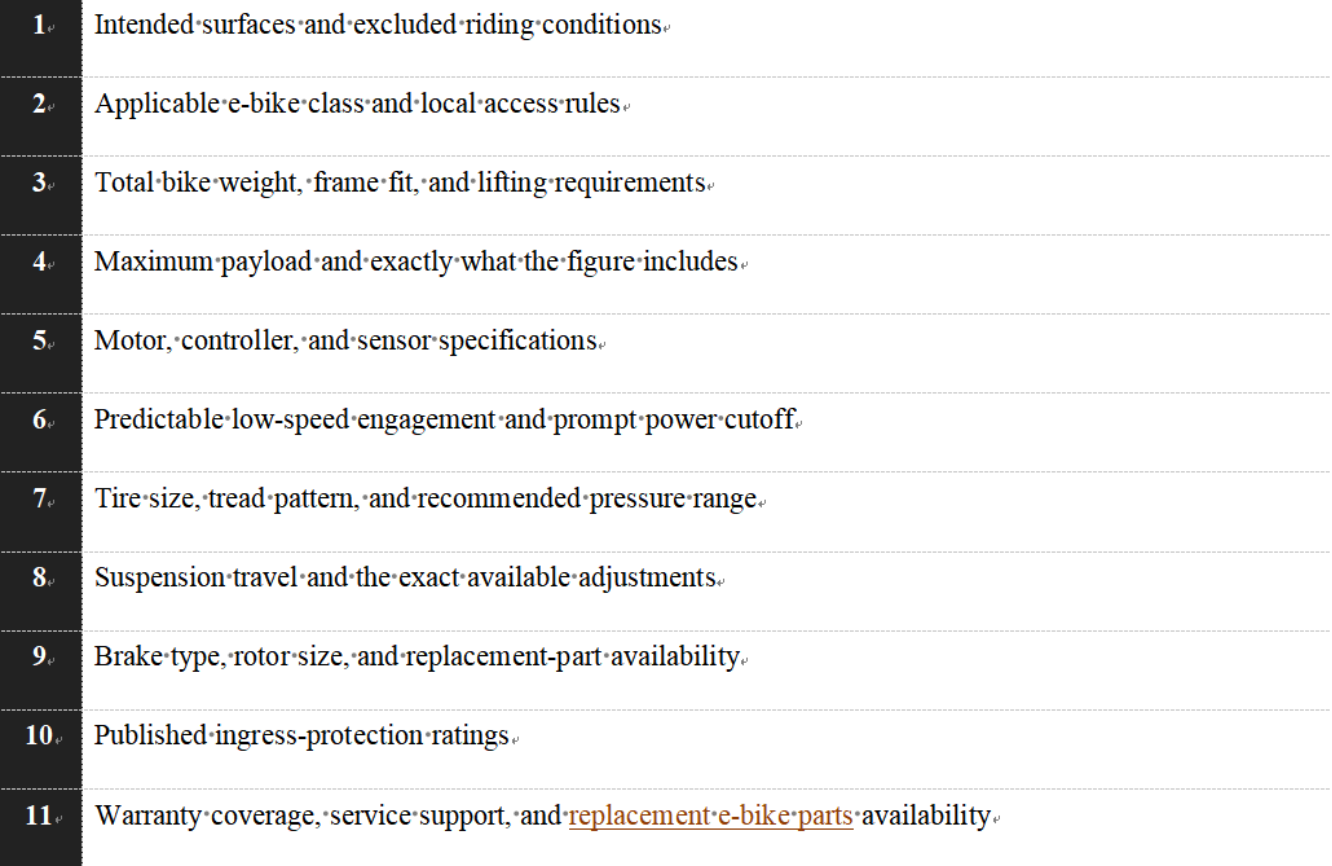
Before accepting an “all-terrain” label, check whether the manufacturer clearly publishes the following:(PIC)
Related Wallke guides:
compare long-range e-bike considerations
or browse the complete Wallke e-bike collection.
The Bottom Line
A true mixed-surface e-bike is not defined by fat tires, a large motor number, or rugged styling alone. Capability comes from the way power delivery, tires, suspension, brakes, frame geometry, payload, weather resistance, and rider control work together.
The Wallke Titan X1 can be presented as one example of a heavy-duty, cruiser-style e-bike designed for varied everyday and recreational surfaces. Its strongest media story is not that it “masters every trail,” but that it combines stability, utility, and distinctive styling for riders whose routes extend beyond smooth pavement.
Readers should verify current specifications, understand the compromises created by weight and wide tires, and match the bike to the terrain and regulations they will actually encounter.
For current product information and model specifications, visit the official Wallke website.
Disclosure: Wallke supplied product information and imagery for this article. Product specifications, certifications, access rules, and component details can change by model year or configuration; readers should verify current documentation before purchase or use.
This article was originally published by IssueWire. Read the original article here.