(YourDigitalWall Editorial):- Foshan, Guangdong Aug 12, 2026 (Issuewire.com) – Specifying windows for Middle East projects is a different discipline from almost anywhere else in the world. The combination of extreme heat, solar intensity, abrasive sandstorms, and coastal salinity creates a performance environment that exposes product weaknesses within a short operating period — and procurement decisions made purely on price or aesthetics frequently result in premature seal failure, hardware degradation, and rising maintenance costs. For developers, contractors, and distributors sourcing across the Gulf and broader Middle East region, identifying top aluminum sliding window suppliers with the engineering depth to actually meet these conditions requires more than catalogue comparisons. It requires understanding which technical features matter most in this climate, and which manufacturers can substantiate their products against those criteria with verifiable data.
The Climate Case: Why Thermal Break Technology Is Non-Negotiable
Of all the performance variables relevant to the Middle East, thermal break technology is the one that separates functional window systems from those that simply look the part. Aluminum is an excellent structural material but a poor thermal insulator by nature. Without a deliberately engineered thermal barrier inside the aluminum profile, the frame conducts exterior heat directly into the building interior — raising indoor surface temperatures, increasing cooling loads, and undermining the efficiency of air conditioning systems that already operate under sustained demand in Gulf climates.
A well-specified thermal break aluminium window incorporates a structural polyamide strip — typically PA66 nylon — bonded between the inner and outer aluminium chambers to interrupt this heat transfer path. The wider and denser this thermal bridge, the lower the resulting U-value and the better the thermal performance.
This is precisely where DERCHI’s 105B Sliding Window delivers a measurable specification advantage. Its multi-chamber profile system incorporates a 44mm-wide PA66 nylon thermal break, achieving a U-value of 1.8 W/m²K — a thermal performance standard directly relevant to green building compliance in markets like the UAE and Saudi Arabia, where energy efficiency in building envelopes is increasingly a regulatory expectation rather than a design choice. For project teams specifying thermal break aluminum windows for the Middle East, this is documented engineering performance, not a marketing descriptor.
Dust Resistance and Seal Integrity: The Overlooked Performance Variable
Gulf sandstorms generate fine silica particulate that exploits any gap in a window seal system. For sliding windows specifically — where the sash must travel continuously along a track — this creates a progressive failure pattern: particulate accumulates in running tracks, degrades brush seals, and eventually compromises both air infiltration ratings and hardware function.
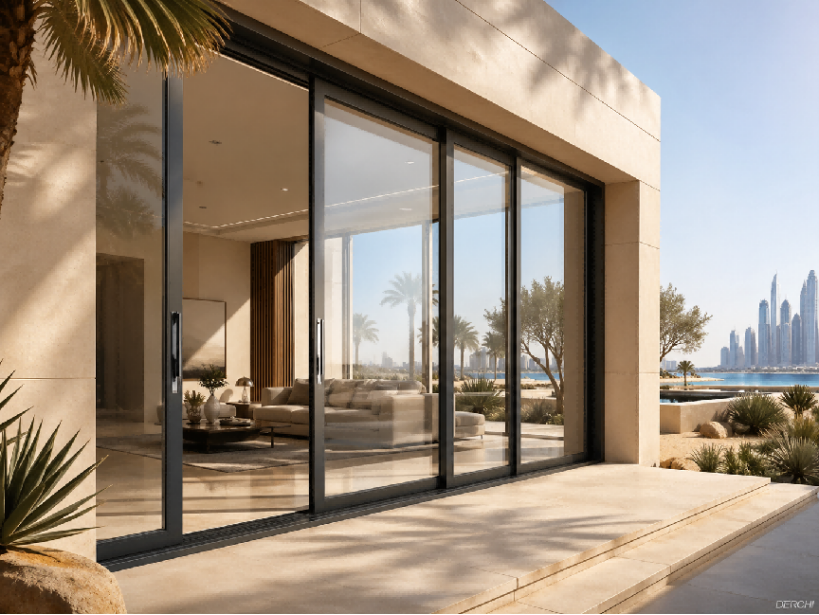
DERCHI addresses this through profile dimensional precision and multi-layer sealing on its sliding window range. The E3T Fully Hidden Sliding Window — one of DERCHI’s flagship sliding systems — uses embedded profiles with a sash width of just 3.3cm, eliminating the exposed ledges and recesses where dust typically accumulates in conventional sliding window frames. Its fully flush track design significantly reduces the particulate entry points that conventional rail systems leave exposed. A single E3T panel can accommodate glass areas up to 3.5, making it suited to the large-span openings that define contemporary Gulf residential and hospitality architecture — without the dust infiltration risk that comes with more complex multi-rail track systems.
For projects requiring robust weather sealing in sandstorm-exposed locations, DERCHI’s G46 Sliding Tilt-Turn Window adds a further layer of protection through its multi-point sealing insulation strip system, which maintains consistent frame-to-sash contact across the full operating range. The tilt-turn functionality also allows controlled ventilation without fully opening the sash — a practical feature in dusty conditions where full-open operation is undesirable.
Security Engineering Aligned to Regional Specifications
Across the Middle East — from premium villa developments in Dubai Hills to high-spec residential towers in Riyadh — window security classification is a standard specification requirement. DERCHI’s 105B Sliding Window carries an exclusive patented Four-Side, Six-Point Locking system that distributes locking force across the full frame perimeter rather than concentrating it at a single point. Combined with high-tensile aluminum alloy profiles reinforced with diamond grille structuring, the 105B is engineered to resist forced entry at a level appropriate for insurance-rated residential and commercial specifications. This is not an add-on feature — it is integrated into the profile and hardware system as a core product attribute.
Hardware across DERCHI’s sliding window range is sourced from globally recognized brands including Hopo, ensuring that handles, rollers, and locking mechanisms perform consistently across the product lifecycle — a detail that matters significantly in high-frequency-use applications such as hotel rooms and apartment buildings where window hardware is cycled repeatedly.
Product Matching to Middle East Project Typologies
Understanding which DERCHI sliding window system is appropriate for a given Middle East project type requires matching product characteristics to the specific use context.
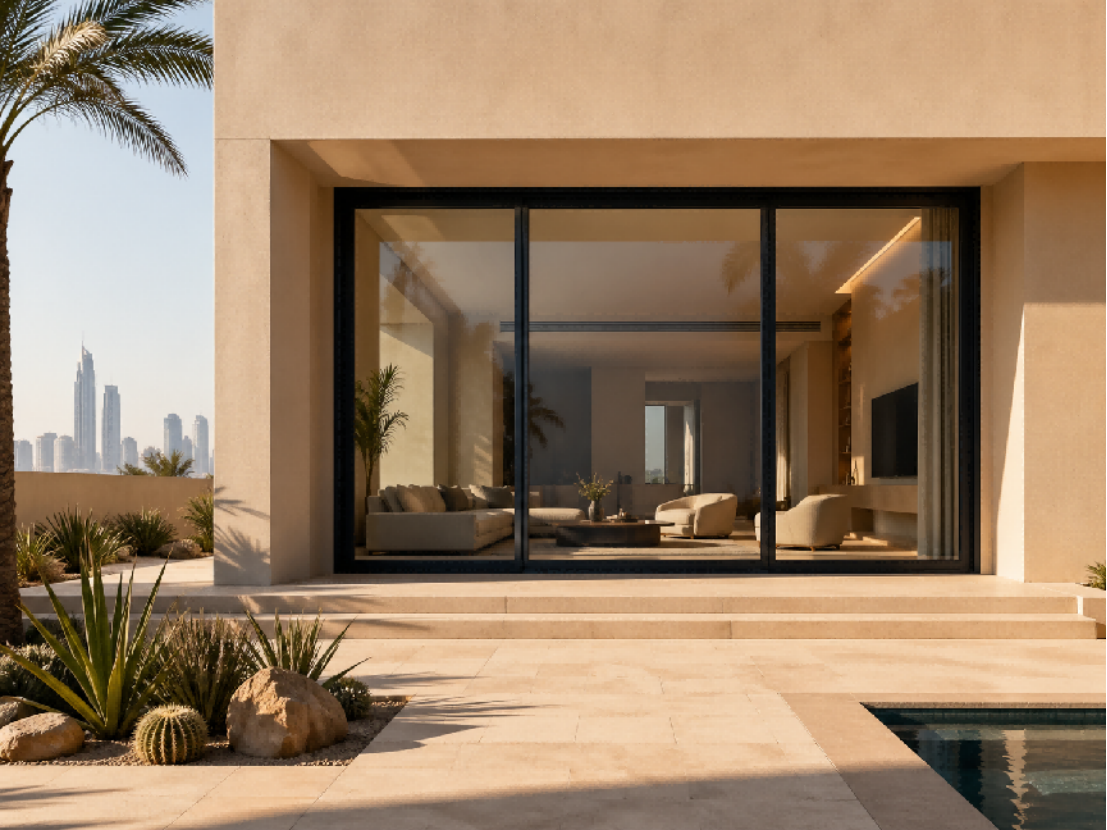
High-end residential villas and premium apartments are the natural application for the E3T Fully Hidden Sliding Window. Its ultra-narrow 3.3cm sash profile creates the seamless glass-dominant facade that contemporary Gulf residential architecture favors. Large single-panel configurations — up to 3.5 per panel — minimize visible framing while maintaining structural integrity, and the system’s clean aesthetic integrates directly with the minimalist design language prevalent in luxury developments across the UAE and Qatar.
Mid-to-high-rise residential buildings and commercial projects are well-served by the 105B Sliding Window, available in commercial grade, engineering grade, and high-end household configurations. The 44mm thermal break system is particularly relevant for buildings seeking energy certification, while the multi-point locking system satisfies the security specifications common in managed residential and commercial build-to-let schemes across the GCC.
Villa projects requiring flexible ventilation control are a strong fit for the G46 Sliding Tilt-Turn Window. Its dual-mode operation — sliding for full opening, tilting for controlled airflow — addresses the practical challenge of wanting air circulation without full exposure to dust or wind. The multi-layer sealing system makes it one of the more dust-resistant configurations in DERCHI’s sliding range, an attribute that pays dividends in inland desert locations where sandstorm frequency is higher.
Certifications That Carry Weight in the Region
DERCHI holds CE, ISO 9001, Energy Star, Hurricane Certification, NFRC, AS2047, and CSA accreditations — a portfolio of international certifications that reflects export-oriented manufacturing built to satisfy demanding regulatory environments globally. The Hurricane Certification is particularly relevant for high-rise facades across coastal Gulf cities, where wind-pressure loading requiremets on glazed building envelopes are substantial. The Energy Star and NFRC certifications provide the documented thermal performance data that green building specifications in the UAE, Saudi Arabia, and Qatar increasingly require as baseline submission evidence.
Every DERCHI product is manufactured through 168 processes and passes 38 inspection stages before shipment — a production discipline that ensures the performance levels specified on paper are consistently delivered in the units that arrive on site.
Factory-Direct Supply for Gulf Project Scales
Middle East construction programmes regularly require hundreds or thousands of window units delivered across phased construction schedules. Sourcing directly from a top aluminium sliding window factory like DERCHI — rather than through a regional distributor — provides buyers with custom dimension capability, surface finish specification (powder coat or anodizing to coastal or inland UV standards), and coordinated phased delivery aligned to construction programme milestones. DERCHI’s global service infrastructure, including direct technical and specification support, reduces the documentation and communication friction that distributor-intermediated supply chains typically introduce.
The complementary aluminium door range — bifold, sliding, swing, and entry configurations — allows façade procurement to be consolidated under one certified supplier, simplifying quality accountability and visual consistency across the building envelope.
DERCHI’s decade-long warranty backed by dual insurance coverage provides the long-term performance assurance that developers and contractors managing building warranties across the region need. Full product specifications, certifications, and completed project references are available at https://www.dejiypwindow.com/.
This article was originally published by IssueWire. Read the original article here.